




01. Edit your form online
Type text, add images, blackout confidential details, add comments, highlights and more.

Type text, add images, blackout confidential details, add comments, highlights and more.

Draw your signature, type it, upload its image, or use your mobile device as a signature pad.

Send it via email, link, or fax. You can also download it, export it or print it out.
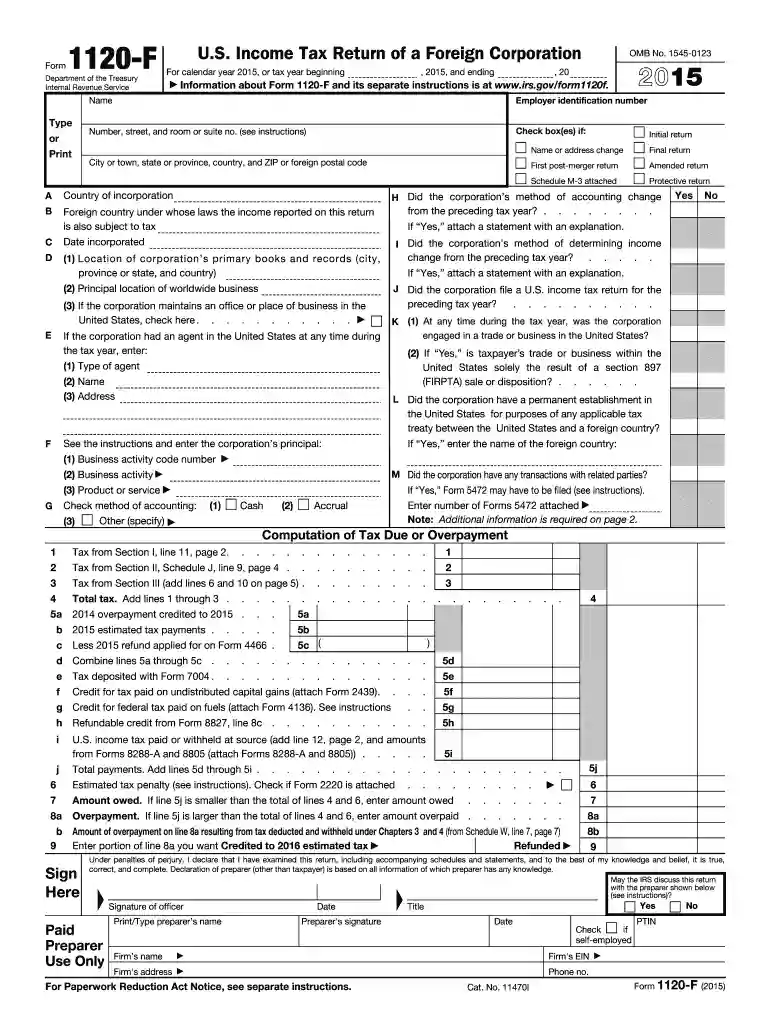
The 2015 IRS Form 1120, also known as the U.S. Corporation Income Tax Return, is used by domestic corporations to report their income, gains, losses, deductions, credits, and to calculate their tax liability. This form is essential for corporations, as it provides a comprehensive overview of a corporation's financial activity and ensures compliance with federal tax laws. Understanding the structure and components of Form 1120 is crucial for accurate tax reporting and avoiding potential legal issues.
Failure to file Form 1120 can lead to penalties, including fines and interest on unpaid taxes. It's crucial for corporations to adhere to deadlines and requirements to avoid escalating penalties.
For the 2015 tax year, the typical deadline for filing was March 15, 2016, for calendar-year corporations. Extensions are possible but require timely application.
Industries that engage in complex financial transactions or have significant income from various sources are especially inclined to use Form 1120 to manage tax obligations efficiently.
Corporations using Form 1120 can take advantage of specific deductions and tax credits unique to corporate tax structures, which can significantly reduce overall tax liability.
The form consolidates financial data, making it easier to understand overall business performance and adjust strategies accordingly.
While less common due to the ubiquity of digital solutions, paper filing may be preferred by entities with limited access to reliable internet or preference for physical recordkeeping.
Understanding the distinctions between these forms can help corporations choose the appropriate form based on their business structure and tax situation.
We've got more versions of the 2015 irs form 1120 form. Select the right 2015 irs form 1120 version from the list and start editing it straight away!
| Versions | Form popularity | Fillable & printable |
|---|---|---|
| 2024 | 4.6 Satisfied (35 Votes) | |
| 2023 | 4.9 Satisfied (24 Votes) | |
| 2022 | 4.6 Satisfied (46 Votes) | |
| 2021 | 4.8 Satisfied (45 Votes) | |
| 2020 | 4.4 Satisfied (256 Votes) | |
| 2019 | 4.4 Satisfied (167 Votes) | |
| 2018 | 4.1 Satisfied (67 Votes) | |
| 2017 | 4.4 Satisfied (260 Votes) | |
| 2016 | 4.4 Satisfied (317 Votes) | |
| 2015 | 4.2 Satisfied (62 Votes) | |
| 2014 | 4 Satisfied (20 Votes) | |
| 2013 | 4 Satisfied (41 Votes) | |
| 2012 | 4.4 Satisfied (51 Votes) | |
| 2011 | 4.2 Satisfied (64 Votes) | |
| 2010 | 4 Satisfied (35 Votes) |
At DocHub, your data security is our priority. We follow HIPAA, SOC2, GDPR, and other standards, so you can work on your documents with confidence.
During the first three quarters of 2019, the Company incurred charges totaling $131, $101 net of tax, due to obligations related to withdrawal liabilities forRead more
Jan 21, 2016 Use Form 1120, U.S. Corporation Income. Tax Return, to report the income, gains, losses, deductions, credits, and to figure the income taxRead more
check the box on line 1a, 2a, 3a, 4a, or 5a, below, and the amount on that line for the return being filed with this form was blank, then.


