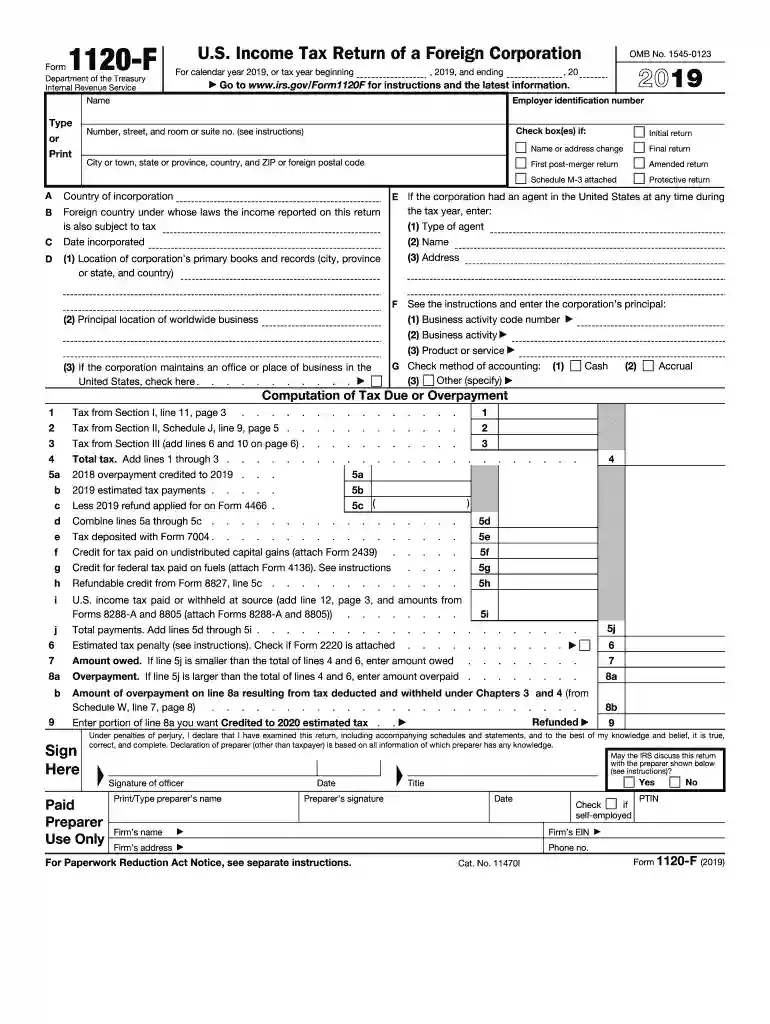
Understanding Form 1120-F: Definition and Purpose
Form 1120-F, officially known as the U.S. Income Tax Return for Foreign Corporations, is a tax document utilized by foreign corporations engaged in business activities in the United States. This form allows foreign entities to report their U.S.-sourced income, deductions, and tax liabilities for specific tax periods. It is crucial for ensuring compliance with U.S. tax laws and documenting financial activities conducted stateside.
The primary purpose of Form 1120-F is to provide a structured way for foreign corporations to disclose their income arising from U.S. sources, such as rent, royalties, and any business operations within the country. The form also facilitates the calculation of tax owed to the IRS, allowing these entities to claim deductions for allowable expenses incurred in earning that income. Notably, the form includes various sections dedicated to different types of income, deductions, and essential corporate information.
How to Use Form 1120-F
Utilizing Form 1120-F requires a systematic approach to ensure accuracy and compliance. Here are the key steps to follow:
- Determine Eligibility: Confirm that your corporation qualifies as a foreign entity under U.S. tax regulations.
- Gather Necessary Information: Collect all relevant financial details, including U.S.-sourced income documents and expenses incurred during the tax year.
- Complete the Form: Fill out the form accurately, ensuring that all fields related to income, deductions, and credits are addressed. Provide any necessary supplementary information as required.
- Revision and Review: Double-check the completed form for accuracy. Minor errors can lead to significant penalties or delays in processing.
- Signature Requirement: Ensure that the form is signed by an authorized individual within the corporation to validate the submission.
Key Considerations
- Understand the different sections of the form and their relevance to your specific tax situation.
- Be aware of the opportunities for deductions that can minimize tax liabilities effectively.
How to Obtain Form 1120-F
Obtaining Form 1120-F is a straightforward process that can be completed through several avenues:
- IRS Website: The most direct method is to download the form from the official IRS website. It is available in a PDF format, which can easily be printed and filled out.
- Authorized Software: Many tax preparation software applications include Form 1120-F as part of their offerings, making it easier for corporations to complete their filings.
- Tax Professionals: Consulting a tax advisor or accountant familiar with U.S. tax laws for foreign corporations can facilitate access to the form while ensuring proper guidance on its completion.
Benefits of Obtaining the Form Early
- Early access allows for ample time to compile necessary documents, thus reducing the risk of missing submission deadlines.
- Additional time enables thorough review and error correction.
Steps to Complete Form 1120-F
Completing Form 1120-F involves several specific steps. The following outline serves as a guide to navigate the required fields:
- Identification of the Corporation:
- Enter basic identifying information such as the corporation's name, Employer Identification Number (EIN), and address.
- Income Reporting:
- Detail all income received from U.S. sources. This may include wages, capital gains, dividends, and other relevant types of income.
- Deductions and Credits:
- Itemize any allowable deductions related to income-generating activities in the U.S. These may include operational costs, depreciation, and related expenses.
- Calculation of Tax Owed:
- Utilize the information provided in previous sections to accurately compute the corporation's tax liability. This includes the application of any applicable tax credits or prepayments.
- Additional Schedules:
- Complete any additional schedules required for more complex tax situations, such as Schedule F for claiming exemptions or allowances that apply specifically to certain business operations.
Importance of Accurate Reporting
Properly completing Form 1120-F is essential not only for compliance but also for optimizing potential tax outcomes. Errors in reporting can lead to audits, penalties, or even enforcement actions from the IRS.
Filing Deadlines for Form 1120-F
Entities must adhere to strict deadlines when submitting Form 1120-F to avoid penalties. The following timelines are essential for compliance:
- Standard Due Date: Form 1120-F is generally due on the 15th day of the fourth month after the end of the foreign corporation’s tax year. For example, if the tax year ends on December 31, the form is due by April 15 of the following year.
- Extensions: Corporations may request a six-month extension to file by submitting Form 7004. However, this extension does not apply to any tax payment that may be due.
Consequences of Missing Deadlines
- Late submissions can lead to fines and interest on any unpaid taxes.
- Failure to file can result in additional complications, including adverse compliance reviews by the IRS.
Important Terms Related to Form 1120-F
Understanding specific terminology associated with Form 1120-F is crucial for accurate filing and compliance. Here are some key terms defined:
- U.S.-sourced Income: This refers to income generated from activities performed within the U.S. or that otherwise meets specific IRS criteria for taxation in the U.S.
- Deductions: These are allowable expenses subtracted from total income to determine taxable income; they can significantly impact tax liability.
- Tax Liability: The total amount of tax that an entity is legally obliged to pay to the IRS based on its earnings and applicable deductions.
- Schedule F: This additional schedule allows foreign corporations to compute their income and deductions associated with effectively connected income, providing clarity on eligibility for deductions.
Application of Terms in Context
Understanding these terms gives a more nuanced perspective on the tax obligations and processes related to Form 1120-F, empowering foreign corporations to navigate compliance and reporting more effectively.