




01. Edit your form online
Type text, add images, blackout confidential details, add comments, highlights and more.

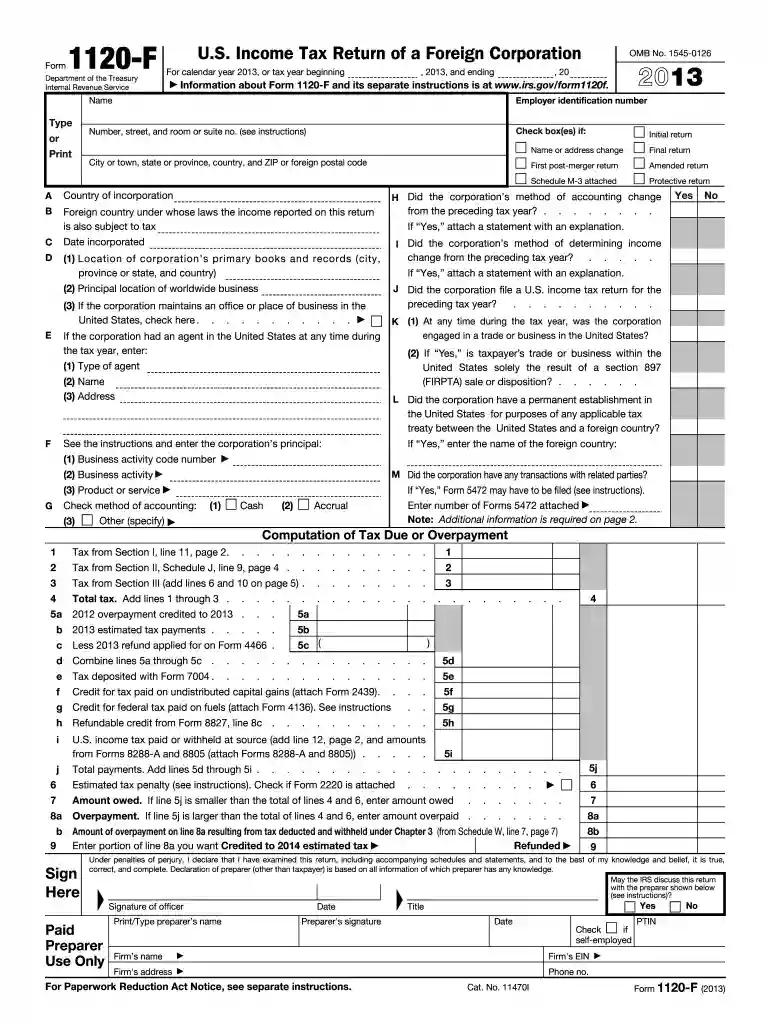
Type text, add images, blackout confidential details, add comments, highlights and more.

Draw your signature, type it, upload its image, or use your mobile device as a signature pad.

Send it via email, link, or fax. You can also download it, export it or print it out.
Form 1120-F is a U.S. tax return designed for foreign corporations operating within the United States. This form is used to report income, deductions, and tax liabilities. It is essential for documenting and reconciling business activities conducted by foreign entities in U.S. territories, ensuring compliance with federal tax obligations.
Before filling out Form 1120-F, ensure you have gathered the following:
We've got more versions of the 2013 1120 f form form. Select the right 2013 1120 f form version from the list and start editing it straight away!
| Versions | Form popularity | Fillable & printable |
|---|---|---|
| 2024 | 4.6 Satisfied (35 Votes) | |
| 2023 | 4.9 Satisfied (24 Votes) | |
| 2022 | 4.6 Satisfied (46 Votes) | |
| 2021 | 4.8 Satisfied (45 Votes) | |
| 2020 | 4.4 Satisfied (256 Votes) | |
| 2019 | 4.4 Satisfied (167 Votes) | |
| 2018 | 4.1 Satisfied (67 Votes) | |
| 2017 | 4.4 Satisfied (260 Votes) | |
| 2016 | 4.4 Satisfied (317 Votes) | |
| 2015 | 4.2 Satisfied (62 Votes) | |
| 2014 | 4 Satisfied (20 Votes) | |
| 2013 | 4 Satisfied (41 Votes) | |
| 2012 | 4.4 Satisfied (51 Votes) | |
| 2011 | 4.2 Satisfied (64 Votes) | |
| 2010 | 4 Satisfied (35 Votes) |
At DocHub, your data security is our priority. We follow HIPAA, SOC2, GDPR, and other standards, so you can work on your documents with confidence.
May 20, 2013 Tax Return For calendar year 2013 or tax year. Information about Form 1120. Income from controlled foreign corporations under subpart F (attach
Use Form 1120-F to report the income, gains, losses, deductions, credits, and to figure the U.S. income tax liability of a foreign corporation. Also, use Form.Read more
Apr 15, 1976 income on the form or schedule on which you originally took the deduction (for example, Schedule C or F (Form 1040),. Form 1040, Form 1120, etc.)Read more


