




01. Edit your form 1120 filing due date online
Type text, add images, blackout confidential details, add comments, highlights and more.

Type text, add images, blackout confidential details, add comments, highlights and more.

Draw your signature, type it, upload its image, or use your mobile device as a signature pad.

Send 2021 form 1120 f via email, link, or fax. You can also download it, export it or print it out.
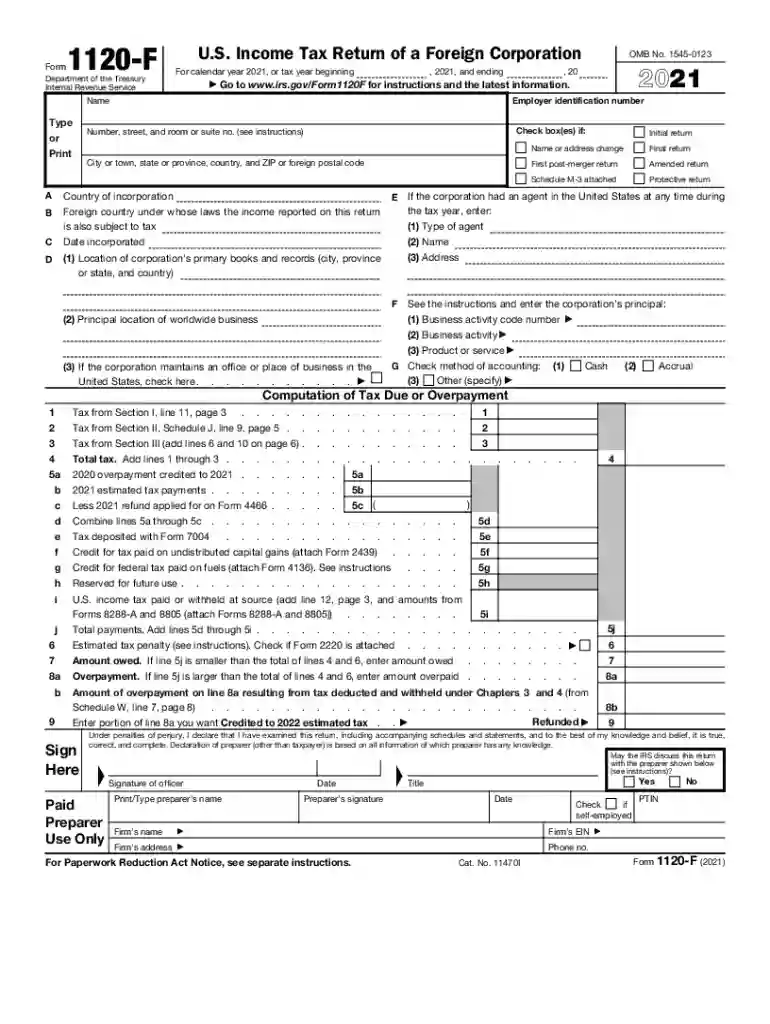
Form 1120-F, U.S. Income Tax Return of a Foreign Corporation, is a tax form used by foreign corporations to report their U.S.-sourced income, deductions, and tax liabilities. This form is essential for foreign entities operating within the U.S., ensuring compliance with U.S. tax laws. It covers all income derived from U.S. business operations, investment activities, or other economic engagements within the country.
Foreign corporations must fill out this form to accurately report their taxable income and calculate the amount due to the U.S. Treasury Department. The form also helps businesses establish any credits or exemptions applicable under U.S. tax laws. Furthermore, Form 1120-F serves as a record for the Internal Revenue Service (IRS) to monitor foreign business activities in the United States.
Gather Necessary Information: First, collect all relevant financial records, including income statements, balance sheets, and transaction details that reflect U.S.-sourced revenue.
Complete Identification Details: Enter the corporation's name, address, employer identification number (EIN), and other requested identification details on the top of the form.
Report Income: Fill out the sections detailing gross income, including income effectively connected with a U.S. trade or business and fixed or determinable annual or periodic (FDAP) income.
Claim Deductions: Enter available deductions in the appropriate sections. Common deductions for foreign corporations might include operational expenses, salary payments, depreciation, and other allowable business expenses.
Calculate Tax Liability: Utilize the form to calculate your total taxable income and determine the corresponding tax liability, using the provided tax rates and guidelines.
Attach Schedules and Statements: Where applicable, attach required schedules, such as Schedule I (Compensation of Officers) and Schedule M-1 (Reconciliation of Income), and any necessary supporting documentation.
Review and Submit: Double-check all entries for accuracy, ensure all attachments are included, and submit the form to the IRS by the due date.
Financial Statements: Provide detailed financial statements, including income statements and balance sheets, reflecting all U.S.-sourced business operations.
Tax Identification Documents: Include a copy of the foreign corporation’s EIN assignment letter if one is available.
Prior Year’s Tax Return: If applicable, give the previous year’s Form 1120-F as a reference.
Supporting Documentation for Deductions: Attach invoices, receipts, contracts, or any other documentation that substantiate claimed deductions.
Supplementary Schedules: Submit necessary schedules that complement and flesh out the information on Form 1120-F.
Form 1120-F must be filed by the 15th day of the sixth month following the end of your corporation's tax year. For a calendar year taxpayer, this typically means a due date of June 15. Make sure to adhere to this timeline to avoid penalties. Extensions are available; however, you must file Form 7004 to request an extension before the original due date.
Failing to file Form 1120-F accurately and on time may result in penalties. These could include fines for late filing, interest on overdue tax payments, and potential legal action from the IRS. Additionally, incorrect filing can trigger audits or further scrutiny from the IRS, which might lead to more severe financial or legal consequences.
Foreign Corporations: Any corporation incorporated outside the U.S. that engages in trade or business within the country must file Form 1120-F to report U.S. income and taxes.
Foreign Partnerships: These entities may need to file Form 1120-F if they have U.S. effectively connected income (ECI).
Financial Institutions: Foreign banks or investment companies with income derived from U.S. sources often need to report on Form 1120-F.
While Form 1120-F applies federally, various states might have specific rules or additional forms for foreign corporations operating within their jurisdiction. It's crucial to review state tax requirements to ensure full compliance. States may require separate state income tax returns in addition to the federal Form 1120-F submission.
Digital Filing: Offers streamlined processing, automatic error checking, and faster confirmations. It's often considered more efficient and reduces the risk of lost paperwork.
Paper Filing: While traditional, this method may lead to delays and lacks the benefit of automatic corrections. It remains an option for those who prefer to keep a physical record or cannot access digital means.
Both methods are acceptable to the IRS, but digital filing is recommended for its efficiency and accuracy.
Form 1120-F can be completed using various tax preparation software, such as TurboTax and QuickBooks. These platforms facilitate accurate data entry, easy sharing of financial documents through integration with accounting systems, and ensure compliance with updated tax laws through regular software updates. This digital support simplifies the form submission process, providing an efficient solution for foreign corporations.
We've got more versions of the form 1120 filing due date form. Select the right form 1120 filing due date version from the list and start editing it straight away!
| Versions | Form popularity | Fillable & printable |
|---|---|---|
| 2024 | 4.6 Satisfied (35 Votes) | |
| 2023 | 4.9 Satisfied (24 Votes) | |
| 2022 | 4.6 Satisfied (46 Votes) | |
| 2021 | 4.8 Satisfied (45 Votes) | |
| 2020 | 4.4 Satisfied (256 Votes) | |
| 2019 | 4.4 Satisfied (167 Votes) | |
| 2018 | 4.1 Satisfied (67 Votes) | |
| 2017 | 4.4 Satisfied (260 Votes) | |
| 2016 | 4.4 Satisfied (317 Votes) | |
| 2015 | 4.2 Satisfied (62 Votes) | |
| 2014 | 4 Satisfied (20 Votes) | |
| 2013 | 4 Satisfied (41 Votes) | |
| 2012 | 4.4 Satisfied (51 Votes) | |
| 2011 | 4.2 Satisfied (64 Votes) | |
| 2010 | 4 Satisfied (35 Votes) |
At DocHub, your data security is our priority. We follow HIPAA, SOC2, GDPR, and other standards, so you can work on your documents with confidence.
Mar 31, 2026 A foreign corporation files this form to report their income, gains, losses, deductions, credits, and to figure their U.S. income taxRead more
Instructions for Form 1120F, U.S. income tax return of a foreign corporation. Check request options from Main Library Government Information - Lower LevelRead more


