




01. Edit your bimco supplytime 2017 word format online
Type text, add images, blackout confidential details, add comments, highlights and more.

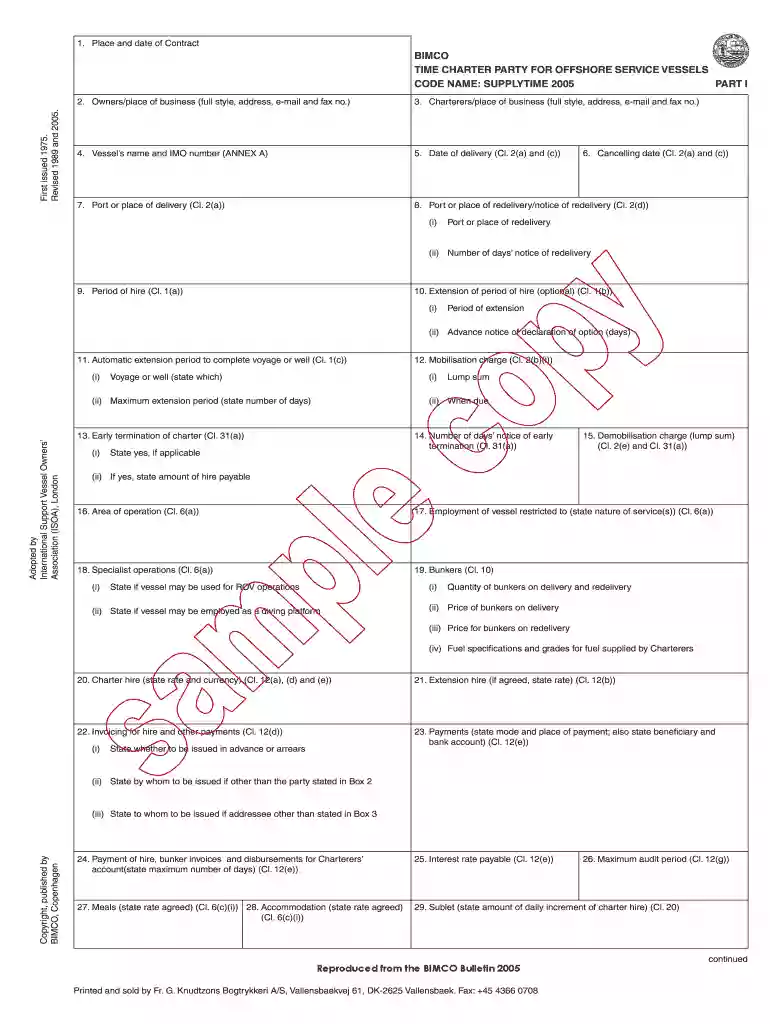
Type text, add images, blackout confidential details, add comments, highlights and more.

Draw your signature, type it, upload its image, or use your mobile device as a signature pad.

Send bimco supplytime 2017 pdf via email, link, or fax. You can also download it, export it or print it out.
BIMCO Supplytime 2017 is a standard time charter party developed by BIMCO (Baltic and International Maritime Council) specifically for offshore service vessels. It serves as a contractual framework outlining the relationship between Owners and Charterers. This form plays a crucial role in defining the operational guidelines and legal responsibilities associated with the chartering process.
The BIMCO Supplytime 2017 incorporates multiple critical elements that address various operational and legal aspects:
BIMCO Supplytime 2017 outlines distinct responsibilities for both Owners and Charterers in terms of:
A critical aspect of the BIMCO Supplytime 2017 is the inclusion of dispute resolution mechanisms. This represents a structured approach for resolving conflicts that may arise during the term of the charter, including:
While the BIMCO Supplytime 2017 has become widely utilized, it is important to be aware of earlier versions and other related documents, such as:
In an increasingly digital world, the BIMCO Supplytime 2017 can be accessed in various formats, including:
The BIMCO Supplytime 2017 is commonly utilized by:
To maintain effective use of the BIMCO Supplytime 2017, parties should:
Adopting best practices, combined with comprehensive understanding, enhances compliance and operational efficiency for stakeholders involved in vessel charters.
eSignatures are an excellent alternative to traditional signing, as they save time, effort, and costs people spend on printing, scanning, and paper delivery. You can eSign your supplytime 2017 pdf utilizing a trustworthy and robust online document management services like DocHub. It complies with primary eSignature policies (ESIGN and UETA), so all forms approved there are legally binding and have the same validity as manually signed ones.
If you are looking for a state-specific bimco supplytime 2017 sample, you can find it in our DocHub Forms & Templates catalog. Use the search field, key in your form’s name, and search through the results for your state. You may also filter out irrelevant results while searching our catalog by groups.
At DocHub, your data security is our priority. We follow HIPAA, SOC2, GDPR, and other standards, so you can work on your documents with confidence.


