
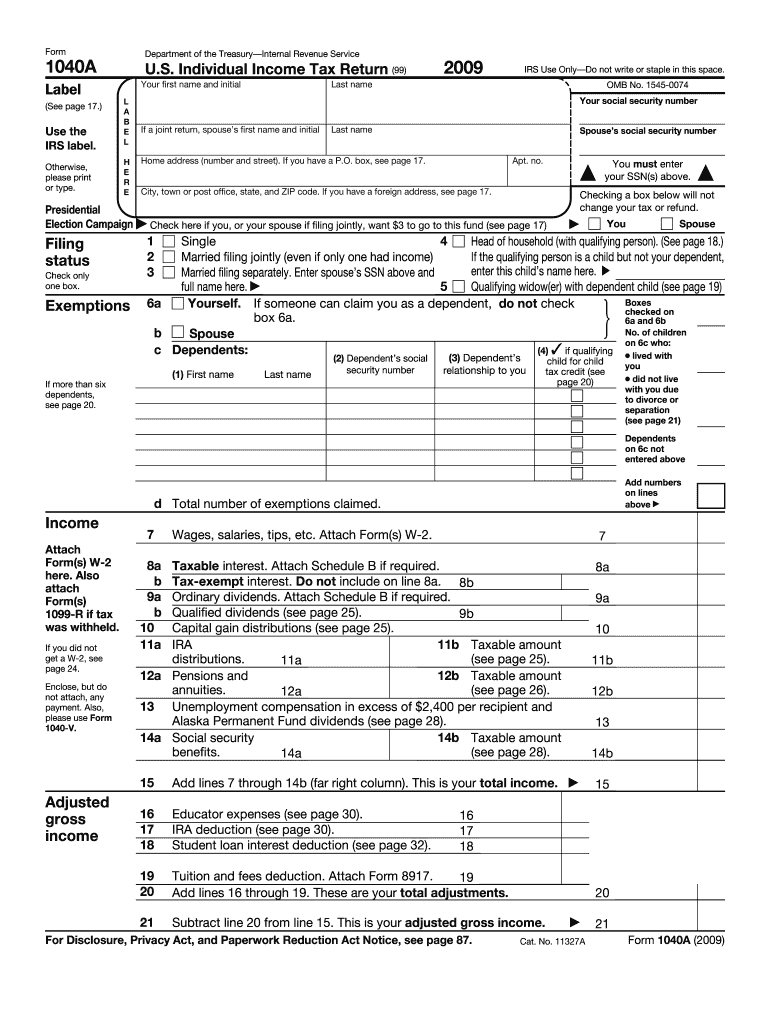







Definition and Meaning of IRS Form 1040A
The IRS Form 1040A, often referred to simply as the "1040A," was a simplified version of the standard IRS Form 1040 used for filing individual income tax returns in the United States. It was designed for taxpayers with less complicated financial situations. The form offered a faster and less detailed process for reporting income and calculating taxes owed or refunds due, making it an attractive option for many individuals who did not require the comprehensive coverage provided by the standard 1040 form.
Form 1040A was available for use by taxpayers until it was discontinued in 2018, being replaced by the enhanced and streamlined 1040 form, which now incorporates many of the features that 1040A and 1040EZ previously covered. This form allowed filers to include personal information, filing status, exemptions, income details, and specific deductions and credits.
Steps to Complete the 1040A
-
Gather Necessary Information and Documents: Before filling out the form, collect all relevant financial documents, such as W-2s, 1099s, and records of any taxable interest, dividends, and pensions.
-
Enter Personal Information: Start by filling out your name, Social Security number, and address. Ensure all information matches your Social Security card to avoid processing delays.
-
Select Filing Status: Choose the appropriate filing status from options such as single, married filing jointly, married filing separately, or head of household.
-
List Dependents: Include any qualifying dependents with their names, Social Security numbers, and relationship to you to benefit from potential exemptions and credits.
-
Report Income: Enter income from wages, salaries, and tips. Add any additional income from Social Security, Pensions, or Interest and Dividends in specified lines.
-
Claim Deductions and Credits: Determine eligibility for credits such as the Earned Income Credit or the Child Tax Credit. Include adjustments like IRA contributions if applicable.
-
Calculate Tax and Refund: Use the tables in the 1040A instructions to calculate owed taxes or anticipated refunds based on your taxable income.
-
Sign and Submit: After reviewing the form for accuracy, ensure all parties sign where necessary. The completed form can be submitted electronically or by mail to the IRS.
Important Terms Related to 1040A
Knowing certain terms can greatly assist in accurately completing the 1040A form:
-
Adjusted Gross Income (AGI): Your total gross income minus specific adjustments, which is pivotal for determining eligibility for deductions and credits.
-
Exemptions: Deductions allowed for each taxpayer and dependent that reduce taxable income.
-
Taxable Income: The portion of your income subject to tax, calculated by subtracting deductions and exemptions from AGI.
-
Standard Deduction: A fixed deduction amount that reduces the income eligible for taxation based on filing status.
-
Credits: Direct reductions in tax liability, such as the Earned Income Credit and Child Tax Credit, sometimes providing a refund even if no tax is owed.
Key Elements of the 1040A
The 1040A form was condensed into several components that simplified tax filing:
-
Income Section: Focused primarily on simple income sources, such as wages, salaries, interest, and dividends, it excluded business income or complex investments.
-
Exemptions and Deductions: Allowed taxpayers to report personal exemptions and the standard deduction, without itemizing.
-
Tax Credits: Provided opportunities to claim credits for education, dependent care, and retirement savings, which were subtracted from total tax.
-
Tax Tables and Instructions: Included to help taxpayers calculate owed taxes accurately based on their filing status and taxable income.
Filing Deadlines and Important Dates
Adhering to IRS deadlines is critical for avoiding late fees and penalties:
-
Annual Deadline: Typically falls on or around April 15 each year. Taxes for the previous year are due by this date.
-
Extensions: Taxpayers can file Form 4868 to request a six-month extension, pushing the final deadline to mid-October, but estimated taxes must still be paid by April.
-
Quarterly Payments: For those with untaxed income throughout the year, quarterly estimated tax payments may be required by specific due dates in April, June, September, and January.
Required Documents for Form 1040A
To complete the 1040A accurately, ensure you have the following documentation:
-
W-2 Forms: To report earnings from employment.
-
1099 Forms: To report other incomes such as freelance work, dividends, or retirement distributions.
-
Form 1098-T: For reporting tuition payments if claiming education credits.
-
Social Security Statements: If benefits were received during the tax year.
-
Childcare Receipts: If claiming the Child and Dependent Care Credit.
Digital vs. Paper Version of the 1040A
Taxpayers had the flexibility to choose between different methods of filing:
-
Digital Filing: Offered through IRS e-file systems which facilitated a faster processing time and immediate confirmation of receipt. It minimized errors through automated checks.
-
Paper Filing: Still an option for taxpayers preferring traditional means. Required downloading or ordering a physical form and mailing it to the IRS, typically entailing a longer processing period.
Each filing method had its advantages, with digital filing becoming increasingly preferred due to its convenience and efficiency.
Software Compatibility with Form 1040A
Various tax preparation software platforms supported Form 1040A to streamline filing:
-
TurboTax: Provided a user-friendly interface with step-by-step guidance for completing 1040A forms, including automatic import of W-2s and other documents.
-
H&R Block: Offered easy navigation and accuracy checks for 1040A, helpful for ensuring all eligible deductions and credits were claimed.
-
TaxSlayer and TaxAct: Competitively priced alternatives providing comprehensive support for 1040A form preparation, with access to live customer assistance.
These software options catered to individuals seeking a simplified process, maximizing refunds while minimizing errors through integrated e-filing capabilities.




