



01. Edit your 2016 tax return form online
Type text, add images, blackout confidential details, add comments, highlights and more.

Type text, add images, blackout confidential details, add comments, highlights and more.
Draw your signature, type it, upload its image, or use your mobile device as a signature pad.

Send tax forms for 2016 via email, link, or fax. You can also download it, export it or print it out.
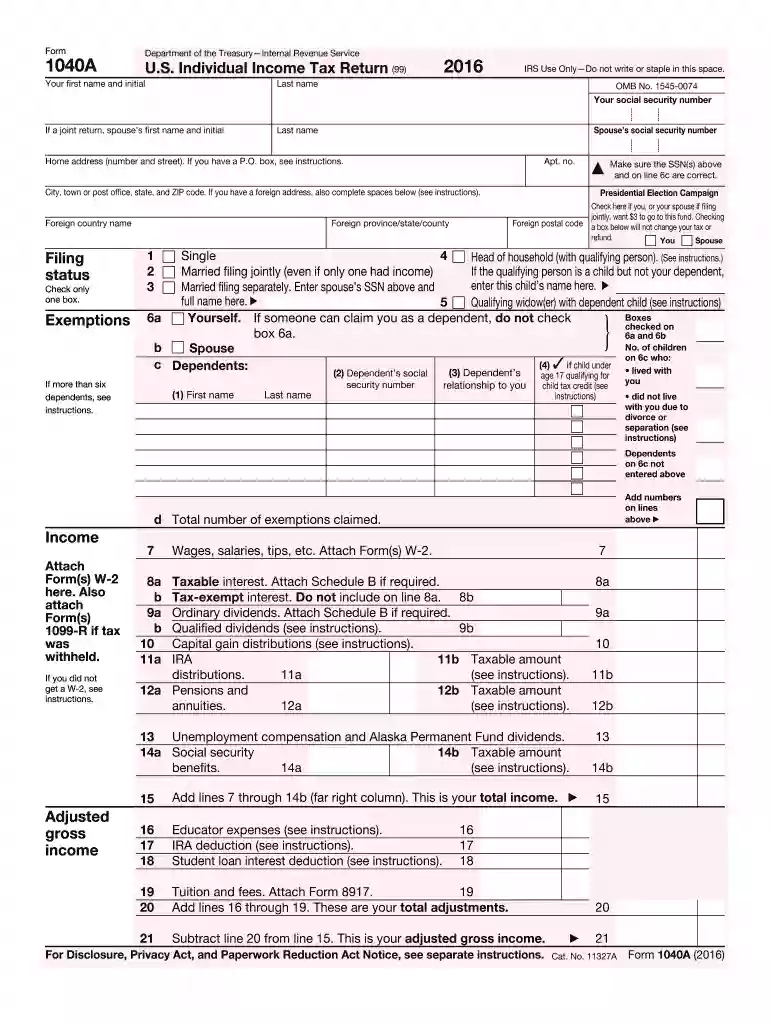
The 2016 Form 1040A is a simplified version of the U.S. Individual Income Tax Return, allowing taxpayers to report income, claim deductions and credits, and calculate tax liabilities or refunds. This form is intended for individuals with straightforward tax situations, providing a more concise alternative to the more detailed Form 1040.
Using the 2016 Form 1040A requires careful attention to each section to ensure accurate filing. Here's how to approach it:
A single taxpayer earning $50,000 with no dependents would report wages, apply the standard deduction, and include eligible credits to calculate the tax.
The form can be accessed through various channels:
Completing the form involves several critical steps:
Understanding the critical components of the form is essential for correct filing:
Each segment plays a pivotal role in determining your tax status and obligations. Accurately completing each part ensures compliance with tax laws and optimizes potential refunds.
Adherence to specific timelines is vital to avoid penalties:
Filing with Form 1040A requires compliance with IRS guidelines:
Certain documents are essential to support your tax return:
These documents substantiate your financial declarations, ensuring your tax return is both accurate and verifiable. Keeping detailed records aids in a stress-free audit process if the need arises.
We've got more versions of the 2016 tax return form form. Select the right 2016 tax return form version from the list and start editing it straight away!
| Versions | Form popularity | Fillable & printable |
|---|---|---|
| 2017 | 4.8 Satisfied (161 Votes) | |
| 2016 | 4.3 Satisfied (75 Votes) | |
| 2015 | 4.1 Satisfied (61 Votes) | |
| 2014 | 4 Satisfied (42 Votes) | |
| 2013 | 4 Satisfied (26 Votes) | |
| 2012 | 4 Satisfied (41 Votes) | |
| 2011 | 4.1 Satisfied (40 Votes) | |
| 2010 | 4.3 Satisfied (67 Votes) | |
| 2009 | 4.9 Satisfied (43 Votes) | |
| 2007 | 4.2 Satisfied (36 Votes) | |
| 2003 | 4.2 Satisfied (54 Votes) | |
| 2000 | 4 Satisfied (57 Votes) |
At DocHub, your data security is our priority. We follow HIPAA, SOC2, GDPR, and other standards, so you can work on your documents with confidence.




Jan 18, 2017 Form 1040A, or Form 1040NR instructions. However, if you are filing Form 2555, Foreign Earned Income; Form. 2555-EZ, Foreign Earned IncomeRead more
Form 1040A (2016). Page 2. Form 1040A (2016). Page 2. Tax, credits, and payments. 22. Enter the amount from line 21 (adjusted gross income). 22. 23 a Check ifRead more
Jan 4, 2017 You must report your taxable disability payments as wages on line 7 of Form 1040 or. Form 1040A or on line 8 of Form 1040NR until you DocHub.Read more


