




01. Edit your form 1040a 2010 online
Type text, add images, blackout confidential details, add comments, highlights and more.

Type text, add images, blackout confidential details, add comments, highlights and more.

Draw your signature, type it, upload its image, or use your mobile device as a signature pad.

Send 2010 form 1040a via email, link, or fax. You can also download it, export it or print it out.
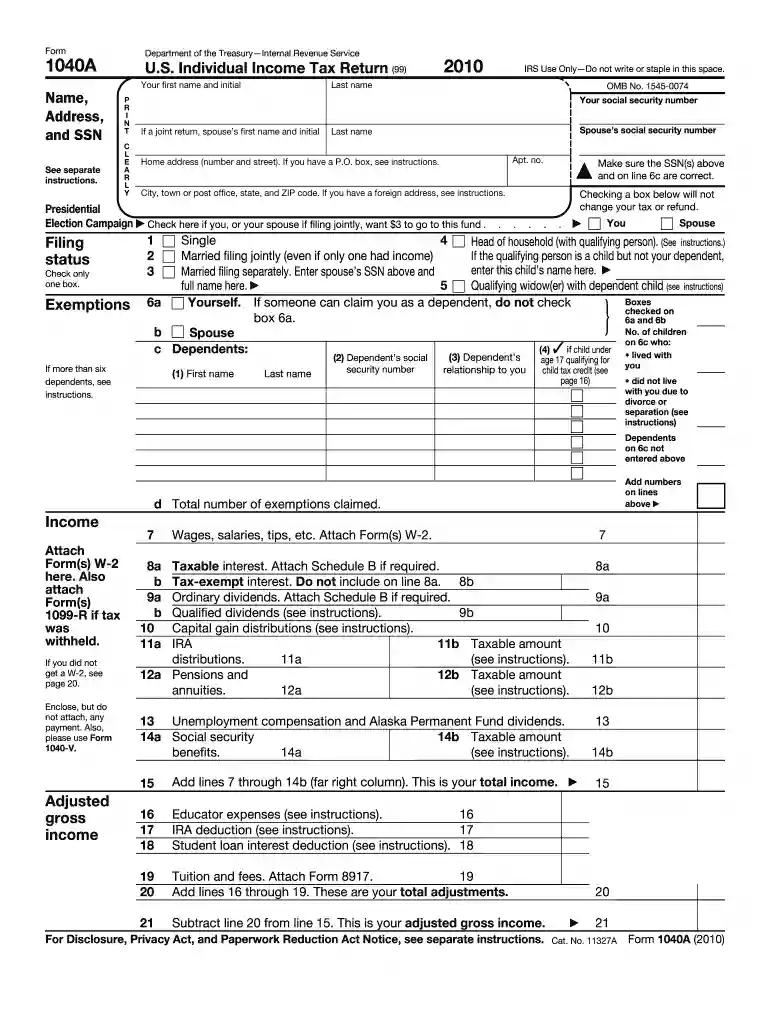
The 2010 Form 1040A is a version of the U.S. Individual Income Tax Return tailored for taxpayers with simpler financial situations. It strikes a balance between the basic Form 1040EZ and the more comprehensive Form 1040, allowing filers to report income from a variety of sources, claim certain tax credits, and specify several deductions. It's primarily used by individuals or families who do not itemize their deductions but require more sections than those available in the 1040EZ. To file using the Form 1040A, taxpayers must ensure their taxable income does not exceed $100,000 and meet specific eligibility criteria outlined by the IRS.
Taxpayers can access the 2010 Form 1040A through several avenues to ensure seamless filing. One of the most straightforward ways is directly from the IRS website, where forms from previous years are archived and freely available for download. Public libraries often house paper copies of tax forms, including the 1040A, around tax season. Additionally, tax software packages such as TurboTax or QuickBooks may include these forms in their database, offering digital downloads and automatic updates to match late-breaking IRS changes. Professional tax preparers can also supply this form along with assistance in filling it out.
Personal and Filing Information:
Income Reporting:
Adjustments to Income:
Tax Computation:
Payments and Refunds:
Sign and Submit:
The IRS provides thorough guidelines to ensure the accurate and compliant completion of the 2010 Form 1040A. These include specifics on eligibility criteria, comprehensive instructions on how to document income types and adjustments, and clarification on allowable tax credits and deductions. The IRS often outlines the documentation required to substantiate claims made on the form, helping to prevent errors and potential audits. Adhering to these guidelines helps taxpayers avoid miscalculations and potential penalties.
The standard deadline for filing the 2010 Form 1040A was April 15, 2011. Taxpayers who required more time to prepare their returns could request an extension, pushing the deadline to October 17, 2011. Extensions only granted additional time to file, not to pay taxes due, and penalties or interest on unpaid taxes could apply after the original April deadline.
Both digital and paper versions of the 2010 Form 1040A offer viable means of tax return submission. The paper version may appeal to those comfortable with traditional filing, often preferred in areas with limited digital access. The digital version, meanwhile, facilitates conveniences such as automated calculations and error checks, with many taxpayers valuing the ability to e-file for faster processing and quicker refunds. Security measures in e-filing systems provide protection for private financial data, thereby gaining reliability and trust among filers.
We've got more versions of the form 1040a 2010 form. Select the right form 1040a 2010 version from the list and start editing it straight away!
| Versions | Form popularity | Fillable & printable |
|---|---|---|
| 2017 | 4.8 Satisfied (161 Votes) | |
| 2016 | 4.3 Satisfied (75 Votes) | |
| 2015 | 4.1 Satisfied (61 Votes) | |
| 2014 | 4 Satisfied (42 Votes) | |
| 2013 | 4 Satisfied (26 Votes) | |
| 2012 | 4 Satisfied (41 Votes) | |
| 2011 | 4.1 Satisfied (40 Votes) | |
| 2010 | 4.3 Satisfied (67 Votes) | |
| 2009 | 4.9 Satisfied (43 Votes) | |
| 2007 | 4.2 Satisfied (36 Votes) | |
| 2003 | 4.2 Satisfied (54 Votes) | |
| 2000 | 4 Satisfied (57 Votes) |
At DocHub, your data security is our priority. We follow HIPAA, SOC2, GDPR, and other standards, so you can work on your documents with confidence.
HRA 2010e Supportive Housing Application. Required Documentation. Below are the required documents needed to complete and submit a 2010e application.Read more
Dec 6, 2017 If you filed Form 1040A, enter the amount shown (or as previously adjusted) on: Line 24 for 2010 2016,. Line 24a for 2009, or. Line 24 forRead more
Form W-4P is for U.S. citizens, resident aliens, or their estates who are recipients of pensions, annuities (including commercial annuities), and certain otherRead more


