Aircraft Weight and Balance Revision 2025

Get Form
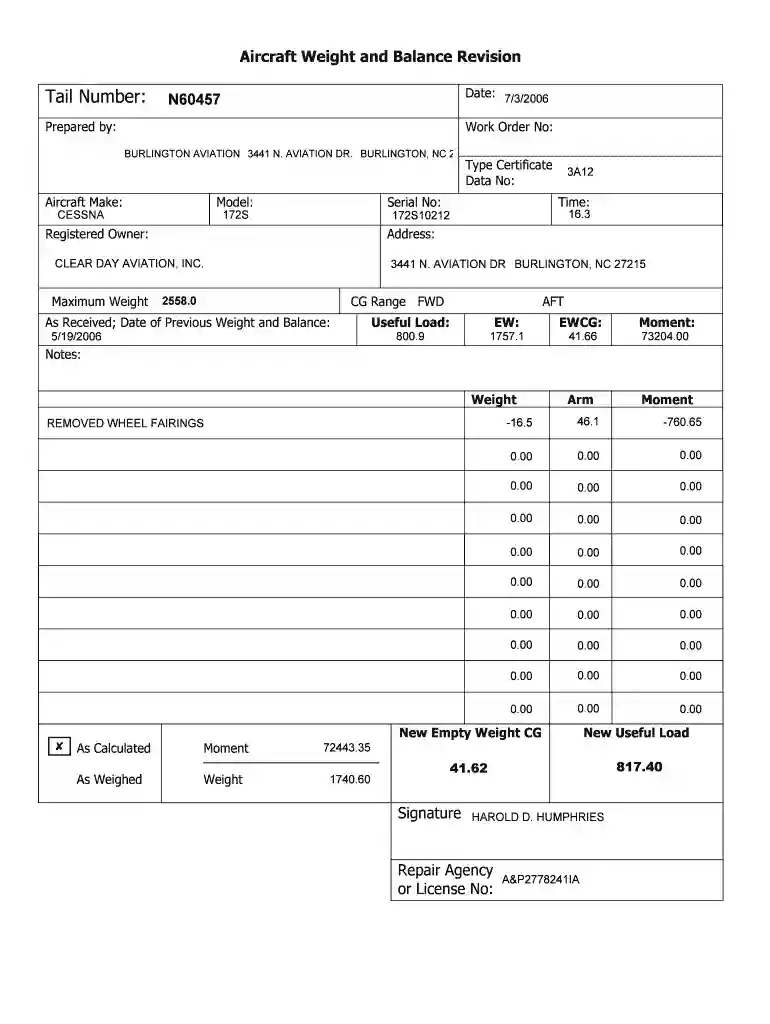
aircraft weight and balance form Preview on Page 1

Here's how it works

01. Edit your aircraft weight and balance form online
Type text, add images, blackout confidential details, add comments, highlights and more.

02. Sign it in a few clicks
Draw your signature, type it, upload its image, or use your mobile device as a signature pad.

03. Share your form with others
Send weight and balance form via email, link, or fax. You can also download it, export it or print it out.

How to use or fill out Aircraft Weight and Balance Revision with our platform

Form edit decoration
9.5
Ease of Setup
DocHub User Ratings on G2
9.0
Ease of Use
DocHub User Ratings on G2
  1. Click ‘Get Form’ to open the Aircraft Weight and Balance Revision in the editor.
  2. Begin by entering the Tail Number in the designated field. This is crucial for identifying the specific aircraft.
  3. Fill in the Date of the revision, ensuring it reflects the current date for accurate record-keeping.
  4. Input the Aircraft Make, Model, and Serial Number. These details are essential for compliance and tracking purposes.
  5. Complete the Maximum Weight and Useful Load sections. Ensure that these figures are accurate to maintain safety standards.
  6. Document any notes regarding changes made, such as 'REMOVED WHEEL FAIRINGS', to provide context for future revisions.
  7. Finally, have the authorized individual sign off on the document in the Signature field to validate the revision.

Start using our platform today to streamline your Aircraft Weight and Balance Revision process for free!

be ready to get more

Complete this form in 5 minutes or less

Get form

Got questions?

We have answers to the most popular questions from our customers. If you can't find an answer to your question, please contact us.
Contact us
You need to have the current weight and balance data on board the aircraft. This includes basic empty weight and moment, as well as the approved envelope for the aircraft.
The regulations do not explicitly require you to calculate your weight and balance before every flight, however it is implied. The regulations stipulate that you calculate your takeoff and landing distances and operate the airplane according to the AFM.
14 CFR part 125 requires aircraft with 20 or more seats or maximum payload capacity of 6,000 pounds or more to be weighed every 36 calendar months. Multi-engine aircraft operated under 14 CFR part 135 are also required to be weighed every 36 months.
Explanation. The acceptable variance in bag counts for weight and balance is +/- 2 bags.
It should show the empty weight, empty-weight CG, most forward and most rearward limits, and sample loadings. (The kit manufacturer or designer will provide the fore and aft CG limits and the maximum gross weight.) Loading the aircraft properly is up to you, and its absolutely essential for safe operation.
be ready to get more

Complete this form in 5 minutes or less

Get form

People also ask

Management of Weight and Balance Control While there are no specified requirements for a pilot operating under 14 CFR part 91 to conduct weight and balance calculations prior to each flight, 14 CFR part 91, section 91.9 requires the pilot in command (PIC) to comply with the operating limits in the approved AFM.

aircraft weight and balance calculator excel