




01. Edit your form 1094 online
Type text, add images, blackout confidential details, add comments, highlights and more.

Type text, add images, blackout confidential details, add comments, highlights and more.

Draw your signature, type it, upload its image, or use your mobile device as a signature pad.

Send 1094 c via email, link, or fax. You can also download it, export it or print it out.
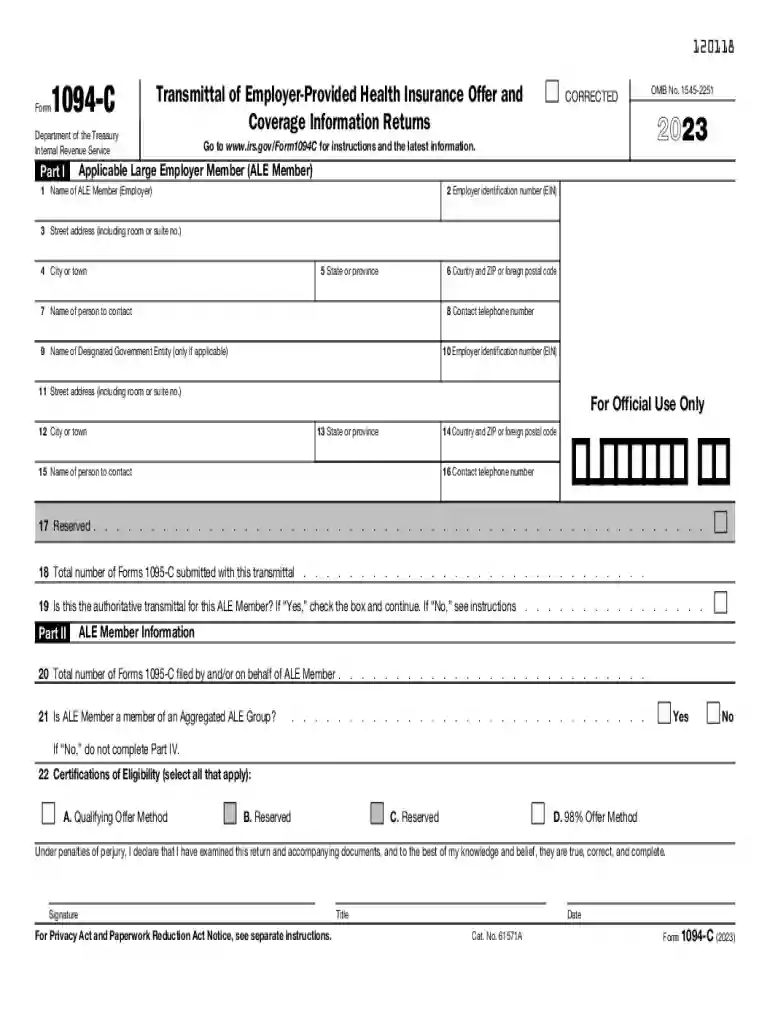
Form 1094-C, formally known as the "Transmittal of Employer-Provided Health Insurance Offer and Coverage Information Returns," serves as a cover sheet for Form 1095-C submissions. Applicable Large Employers (ALEs), those with 50 or more full-time employees, use this form to report information about health insurance offers and coverage to the IRS. It is essential for compliance with the Affordable Care Act (ACA) reporting requirements.
Form 1094-C acts as a transmittal document, summarizing and transmitting individual 1095-C forms for each employee. This form provides insights into the employer’s compliance with the shared responsibility provisions for employee health coverage under the ACA. It collects data on ALE group’s Part III reporting and certifications of eligibility, which help the IRS determine which employers are providing health coverage and meeting reporting obligations.
Filling out Form 1094-C requires detailed information about the employer's health insurance offerings. Here we break down the process step-by-step for ease of completion.
The structure of Form 1094-C is divided into various parts, each focusing on different aspects of the reporting requirements. Understanding these sections is critical to ensuring correct completion and submission.
Familiarity with specific terminology helps in accurately completing Form 1094-C. Here are some critical terms and their definitions:
Adhering to IRS guidelines is paramount for the successful submission of Form 1094-C. These guidelines ensure compliance with federal reporting requirements.
Meeting filing deadlines for Form 1094-C ensures compliance with IRS mandates and avoids penalties. Employers need to be mindful of these critical dates:
A comprehensive assembly of supporting documents is necessary to complete Form 1094-C accurately. This includes:
Employers have the option to submit Form 1094-C either digitally or through paper. Each method has its procedures and benefits.
We've got more versions of the form 1094 form. Select the right form 1094 version from the list and start editing it straight away!
| Versions | Form popularity | Fillable & printable |
|---|---|---|
| 2025 | 4.6 Satisfied (31 Votes) | |
| 2024 | 4.8 Satisfied (53 Votes) | |
| 2023 | 4.7 Satisfied (22 Votes) | |
| 2022 | 4.9 Satisfied (42 Votes) | |
| 2021 | 4.8 Satisfied (172 Votes) | |
| 2020 | 4.3 Satisfied (288 Votes) | |
| 2019 | 4.4 Satisfied (782 Votes) | |
| 2018 | 4.1 Satisfied (57 Votes) | |
| 2017 | 4.2 Satisfied (45 Votes) | |
| 2016 | 4.2 Satisfied (68 Votes) | |
| 2015 | 4 Satisfied (25 Votes) | |
| 2014 | 4 Satisfied (35 Votes) |
At DocHub, your data security is our priority. We follow HIPAA, SOC2, GDPR, and other standards, so you can work on your documents with confidence.
Tax Form 1094-C: Transmittal of Employer Provided Health Insurance Offer Coverage ; Administrative unit responsible for establishing retention criteria.Read more
Apr 29, 2026 Information about Form 1094-C, Transmittal of Employer-Provided Health Insurance Offer and Coverage Information Returns, including recent


