




01. Edit your 2015 1094 online
Type text, add images, blackout confidential details, add comments, highlights and more.

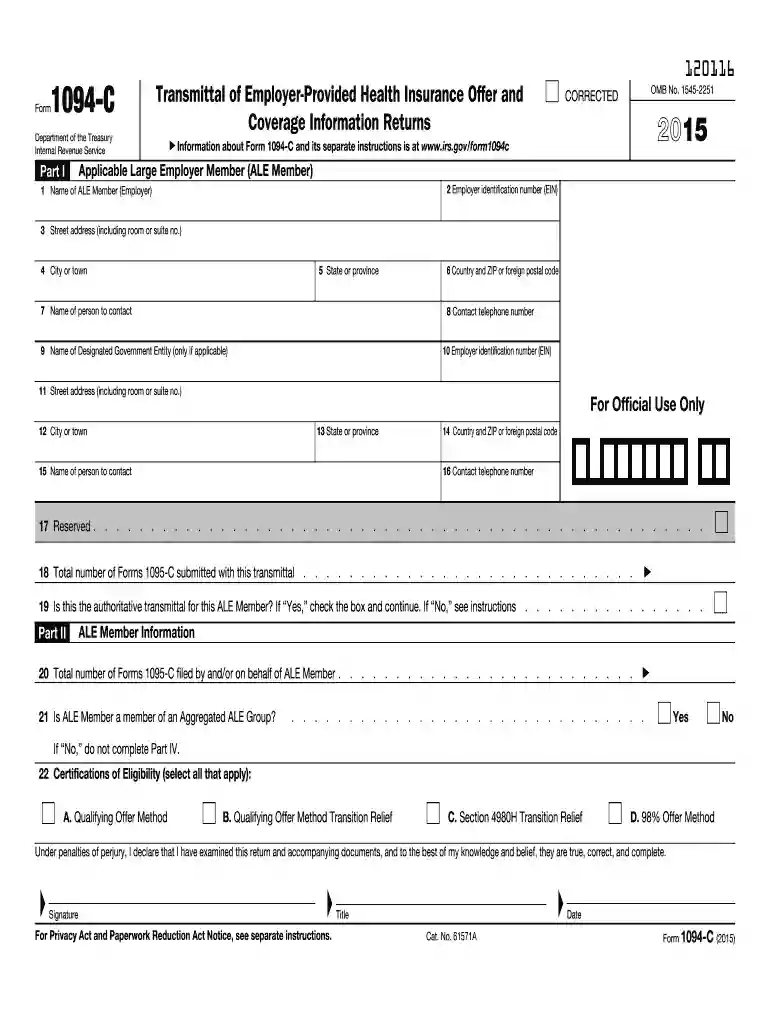
Type text, add images, blackout confidential details, add comments, highlights and more.

Draw your signature, type it, upload its image, or use your mobile device as a signature pad.

Send it via email, link, or fax. You can also download it, export it or print it out.
Form 1094-C serves as a transmittal document submitted by Applicable Large Employers (ALEs) to the IRS. It is used to report essential information about health insurance offers and coverage, adhering to regulatory requirements under the Affordable Care Act (ACA). Specifically, the form communicates details about the health plans offered by employers, the number of full-time employees, and certifications of eligibility. This informs the IRS about the employer's compliance with ACA mandate provisions, ensuring transparency in health coverage and assisting with the enforcement of penalties for noncompliance.
Employers should start by gathering accurate data regarding their full-time employees and health care coverage options. Form 1094-C is to be completed alongside Form 1095-C for individual employees. It consolidates all individual form submissions into one report for the IRS. While handling this form, employers must ensure correctness in filling out sections related to employer identification, total forms being submitted, and eligibility certifications. Familiarity with specific reporting guidelines and attention to detail during this process are imperative to avoid fines.
Timeliness is crucial when filing Form 1094-C. For the year 2015, the form was due to the IRS by February 28, 2016, if filed on paper, or by March 31, 2016, if submitted electronically. Employers must maintain strict adherence to these deadlines to avoid penalties and ensure compliance with IRS regulatory frameworks. Keeping updated with yearly deadlines is vital for organizational compliance, as dates may change due to policy adjustments.
This form includes several fundamental sections designed to capture comprehensive data for IRS analysis:
Employers can obtain Form 1094-C directly from the IRS website. It is crucial to ensure usage of the correct year-specific form to meet exact reporting requirements. The form is available as a downloadable PDF, which can be printed and filled manually or completed digitally if software compatibility exists. This accessibility facilitates straightforward submission, aiding in timely filing.
Failure to accurately file Form 1094-C or to submit it on time can lead to a variety of penalties. For incorrect or incomplete forms, employers may face fines, escalating with the degree of non-compliance. Penalty relief might be granted if an employer can demonstrate reasonable cause. Staying abreast of penalty guidelines ensures employers mitigate risks associated with potential misreporting.
Form 1094-C may be completed using various tax preparation software, including well-known platforms such as TurboTax and QuickBooks. These software options enhance efficiency by facilitating seamless data input and integration with digital filing systems. The form can be filed electronically via IRS-approved e-file providers, offering a more expedited and efficient filing process compared to mailing paper forms.
The IRS mandates that ALEs make precise, timely filings of Form 1094-C in conjunction with Form 1095-C. Understanding the IRS guidelines ensures that employers remain compliant and evade penalties. For in-depth information, employers should refer to IRS documentation and updates that provide comprehensive guidance on the form's filing protocols. Remaining informed of any changes to requirements or policies each tax year is necessary for ongoing compliance.
We've got more versions of the 2015 1094 form. Select the right 2015 1094 version from the list and start editing it straight away!
| Versions | Form popularity | Fillable & printable |
|---|---|---|
| 2025 | 4.6 Satisfied (31 Votes) | |
| 2024 | 4.8 Satisfied (53 Votes) | |
| 2023 | 4.7 Satisfied (22 Votes) | |
| 2022 | 4.9 Satisfied (42 Votes) | |
| 2021 | 4.8 Satisfied (172 Votes) | |
| 2020 | 4.3 Satisfied (288 Votes) | |
| 2019 | 4.4 Satisfied (782 Votes) | |
| 2018 | 4.1 Satisfied (57 Votes) | |
| 2017 | 4.2 Satisfied (45 Votes) | |
| 2016 | 4.2 Satisfied (68 Votes) | |
| 2015 | 4 Satisfied (25 Votes) | |
| 2014 | 4 Satisfied (35 Votes) |
At DocHub, your data security is our priority. We follow HIPAA, SOC2, GDPR, and other standards, so you can work on your documents with confidence.
Nov 11, 2015 Form 1094-C must be used to report to the IRS summary information for each employer and to transmit Forms 1095-C to the IRS. Form 1095-C is usedRead more
Form 1094-C (2015). Page 2. Part III ALE Member InformationMonthly. (a) Minimum Essential Coverage. Offer Indicator. Yes. No. (b) Full Form 1094-C (2015)Read more
Feb 23, 2018 Arizona Public Service Company meets the conditions set forth in General Instruction I(1)(a) and (b) of Form 10-K and is therefore filing thisRead more


