




01. Edit your schedule j online
Type text, add images, blackout confidential details, add comments, highlights and more.

Type text, add images, blackout confidential details, add comments, highlights and more.

Draw your signature, type it, upload its image, or use your mobile device as a signature pad.

Send schedule j form via email, link, or fax. You can also download it, export it or print it out.
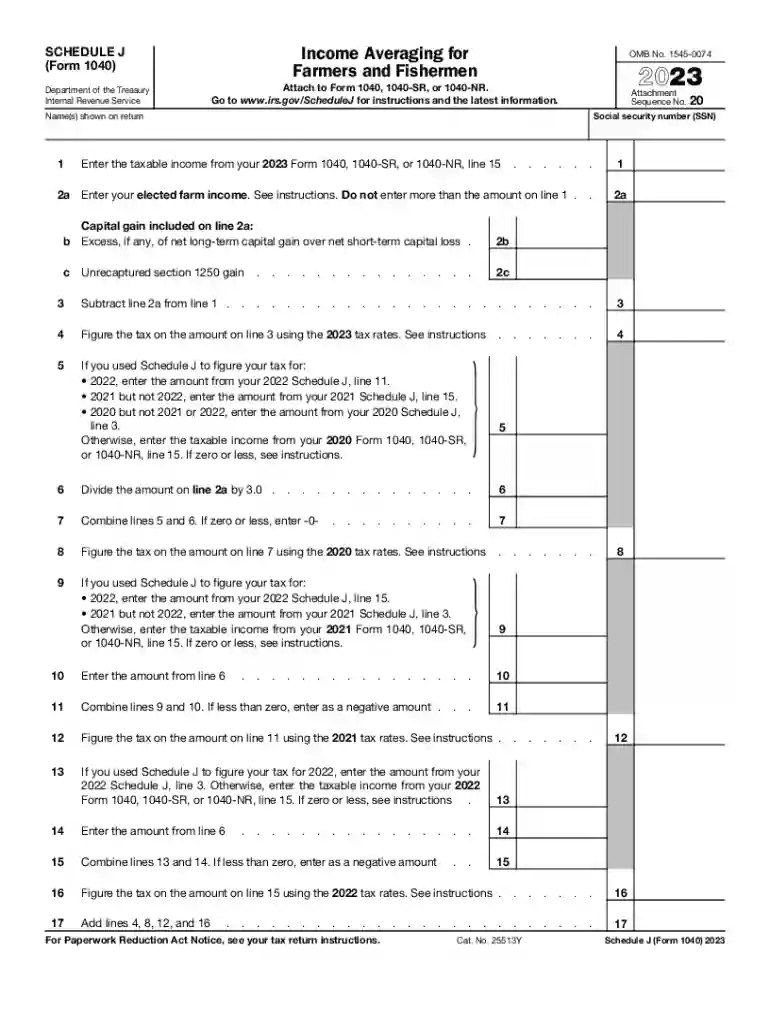
The "2023 Schedule J (Form 1040) Income Averaging for Farmers and Fishermen" is a tax form utilized by eligible farmers and fishermen to determine income taxes owed by averaging their taxable income over a span of three years. This approach helps mitigate the financial burden caused by fluctuating income from year to year, which is common in these industries due to varying harvests or catches. By using income averaging, eligible individuals can potentially reduce their tax liability by smoothing out spikes in income and related taxes.
Using the Schedule J involves several steps to appropriately calculate income tax based on income averaging. The form needs to be attached to the standard Form 1040, Form 1040-SR, or Form 1040-NR, and it specifically includes:
To accurately fill out the 2023 Schedule J, carry out the following sequence:
Farmers and fishermen benefit from using Schedule J as it allows for a more manageable tax payment process. Income in these professions often experiences significant variability due to factors largely beyond control, like weather or market conditions. Income averaging can smooth spikes over several years, potentially minimizing tax rate increases that come with one-off high-income years.
The typical users of the 2023 Schedule J are individuals engaged in farming or commercial fishing activities who experience substantial income fluctuations. These can include:


The form features several vital elements, including:
To qualify for Schedule J, taxpayers must:

Several situations illustrate the utility of Schedule J:
We've got more versions of the schedule j form. Select the right schedule j version from the list and start editing it straight away!
| Versions | Form popularity | Fillable & printable |
|---|---|---|
| 2025 | 4.2 Satisfied (28 Votes) | |
| 2024 | 4.9 Satisfied (27 Votes) | |
| 2023 | 4.2 Satisfied (48 Votes) | |
| 2022 | 4.4 Satisfied (22 Votes) | |
| 2021 | 4.8 Satisfied (22 Votes) | |
| 2020 | 4.3 Satisfied (98 Votes) | |
| 2019 | 4.4 Satisfied (740 Votes) | |
| 2018 | 4.3 Satisfied (196 Votes) | |
| 2017 | 4.4 Satisfied (168 Votes) | |
| 2016 | 4.4 Satisfied (436 Votes) |
At DocHub, your data security is our priority. We follow HIPAA, SOC2, GDPR, and other standards, so you can work on your documents with confidence.
The income which is eligible for averaging includes crop and livestock sales (and fish income) and the sale of personal property used in farming.Read more
Use Schedule J (Form 1040) to elect to figure your income tax by averaging, over the previous 3 years (base years), all or part of your taxable income.Read more


