



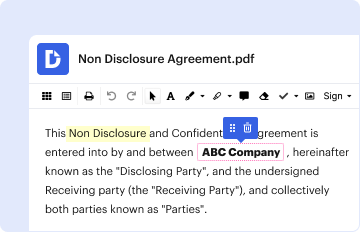
01. Edit your california schedule ca adjustments online
Type text, add images, blackout confidential details, add comments, highlights and more.

Type text, add images, blackout confidential details, add comments, highlights and more.
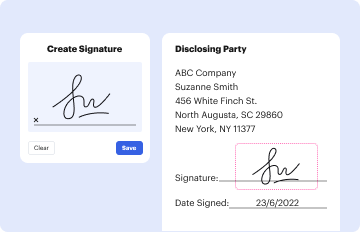
Draw your signature, type it, upload its image, or use your mobile device as a signature pad.

Send ca ftb schedule via email, link, or fax. You can also download it, export it or print it out.
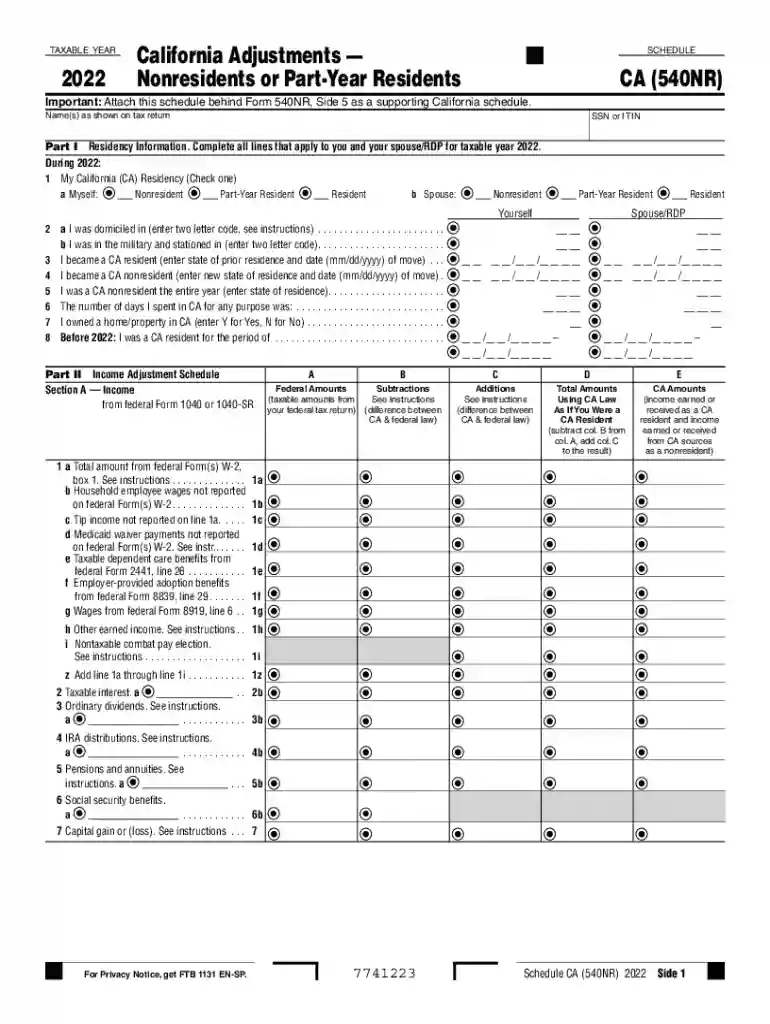
The 2022 Schedule CA (540NR) - California Adjustments - Nonresident or Part-Year Resident Income Tax Ret is a tax form used by individuals who are not full-year residents of California to report and adjust their income for state tax purposes. Specifically designed for nonresidents or part-year residents, this document ensures taxpayers accurately calculate their California adjusted gross income based on their federal tax returns. It is a crucial attachment to Form 540NR, which is the California Nonresident or Part-Year Resident Income Tax Return.
To report your income accurately, begin by obtaining your federal tax return details. California uses these details as a basis for determining state tax liability. Refer to your IRS Form 1040 to fill out Schedule CA (540NR). The form is divided into three sections corresponding to specific adjustments:
By completing these sections accurately, taxpayers can ensure compliance with California's tax laws and secure any potential refunds or credits.
Filling out the Schedule CA (540NR) involves several steps:
Review each section to ensure that all entries reflect your federal return accurately, but adjusted per California guidelines.
The form contains specific sections and lines crucial to determining state tax liabilities:
Each of these elements plays a role in ensuring compliance with state requirements and optimizing tax outcomes.
Understanding key terms is essential to correctly completing and submitting the form:
Taxpayers should familiarize themselves with these terms to effectively navigate the form.
The standard deadline for filing the 2022 Schedule CA (540NR) and Form 540NR is April 15, 2023. However, it's crucial to confirm dates, as filing extensions may apply. If an extension is requested, payments must typically be submitted by the original deadline to avoid penalties or interest.
California offers multiple submission routes:
Choosing the appropriate method can streamline the filing process and minimize errors.
Consider a scenario where you worked both in and out of California during 2022. As a part-year resident:
Each example highlights the nuances of state versus federal standards, illustrating the importance of the form.
We've got more versions of the california schedule ca adjustments form. Select the right california schedule ca adjustments version from the list and start editing it straight away!
| Versions | Form popularity | Fillable & printable |
|---|---|---|
| 2025 | 4.8 Satisfied (32 Votes) | |
| 2025 | 4.3 Satisfied (52 Votes) | |
| 2024 | 4.8 Satisfied (52 Votes) | |
| 2023 | 4.2 Satisfied (59 Votes) | |
| 2023 | 4.5 Satisfied (44 Votes) | |
| 2022 | 4.1 Satisfied (28 Votes) | |
| 2022 | 4.9 Satisfied (55 Votes) | |
| 2021 | 4.9 Satisfied (31 Votes) | |
| 2021 | 4.5 Satisfied (41 Votes) | |
| 2021 | 4.5 Satisfied (53 Votes) | |
| 2020 | 4.8 Satisfied (102 Votes) | |
| 2020 | 4.8 Satisfied (146 Votes) | |
| 2019 | 4.3 Satisfied (94 Votes) | |
| 2019 | 4.4 Satisfied (130 Votes) | |
| 2018 | 4.3 Satisfied (201 Votes) |
At DocHub, your data security is our priority. We follow HIPAA, SOC2, GDPR, and other standards, so you can work on your documents with confidence.
May 22, 1989 Schedule CA (540NR) 2022 Side 1. Page 11. TAXABLE YEAR California Adjustments -. 2022 Nonresidents or Part-Year Residents. Important: AttachRead more
Nonresidents or Part-Year Residents. Attach this schedule behind Form 540NR, Complete all lines that apply to you and your spouse/RDP for taxable year 2022.


