






Definition and Purpose of Schedule CA (540)
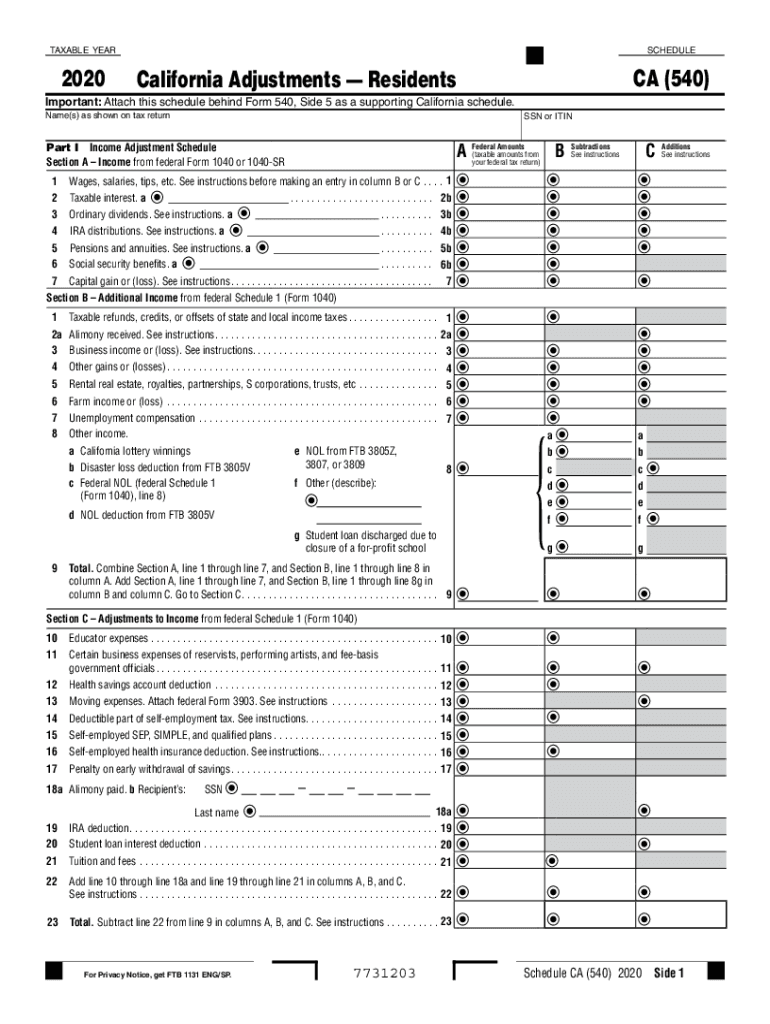
Schedule CA (540) is a California state tax form used to outline adjustments for California residents filing their state income tax returns. This document is necessary for residents to make specific income adjustments, account for additional income reflected on federal Schedule 1, and adjust federal itemized deductions. Taxpayers must attach Schedule CA (540) to Form 540 to accurately reflect their state taxable income and any deviations from federal filing requirements.
Key Elements of Schedule CA (540)
- Income Adjustments: Provides a detailed account of state-specific income modifications, including adjustments related to retirement contributions, medical savings accounts, and education expenses.
- Federal and State Discrepancies: Ensures discrepancies between federal and state tax regulations are reconciled, allowing for accurate state tax computation.
- Additional Sections: Incorporates additional sections for special circumstances, such as capital gains or specific deductions not listed on federal forms.
How to Obtain Schedule CA (540)
Residents can acquire Schedule CA (540) through multiple channels to ensure they have timely access to the form required for state tax filing.
Available Sources
- California Franchise Tax Board (FTB) Website: Download the form directly from the official FTB website, ensuring you have the most current version.
- Tax Preparation Software: Many tax software, like TurboTax, automatically include and complete this form based on input data.
- Physical Copies: Obtain physical copies from local libraries or tax assistance centers if digital forms are inaccessible.
Steps to Complete Schedule CA (540)
Completing Schedule CA (540) accurately is crucial for residents to avoid discrepancies between federal and state tax filings.
- Review Federal Adjustments: Begin by reviewing your federal tax return to identify areas where state modifications are necessary.
- Enter Adjustments for Income: Use the form to input adjustments made to your income, reflecting California's unique regulations.
- Itemized Deductions: Adjust federal itemized deductions to conform with California standards, ensuring deductions like mortgage interest and state taxes are appropriately modified.
- Attach to Form 540: Once completed, attach Schedule CA (540) to Form 540 when filing your state return.
Important Terms Related to Schedule CA (540)
Understanding key terms related to Schedule CA (540) helps in accurately completing the form and ensuring compliance with California tax laws.
- Adjusted Gross Income (AGI): The total gross income minus specific deductions, crucial for determining taxable income.
- Itemized Deductions: Deductions on a federal level that need adjustment per California state law.
- Nonconformity to Federal Tax Law: Instances where state tax law diverges from federal law, necessitating adjustments to income and deductions.
IRS Guidelines and Compliance for Schedule CA (540)
The IRS guidelines are crucial in shaping how federal discrepancies affect state tax filings, underscoring the need for Schedule CA (540).
Compliance Requirements
- Documentation: Ensure all supporting documents are available and accurately reflect adjustments made.
- Audit Preparedness: Maintain organized records of any adjustments and income details should the returns be audited by the state tax authorities.
Filing Deadlines and Important Dates for Schedule CA (540)
Adhering to filing deadlines is mandatory to avoid penalties and ensure timely processing of state tax returns.
Critical Dates
- Tax Filing Deadline: Generally April 15th, mirroring federal deadlines unless an extension is granted.
- Extension Requests: Must be filed before April 15th to prevent late submission penalties.
Penalties for Non-Compliance with Schedule CA (540)
Failing to accurately complete Schedule CA (540) can lead to penalties, interest charges, and possibly stricter scrutiny of your tax returns by the state.
Potential Consequences
- Late Filing Penalties: Imposed when tax returns are not submitted by the set deadline.
- Inaccurate Information Penalties: Penalties and interest may accrue if misstatements or omissions are identified.
Software Compatibility and Digital vs. Paper Version of Schedule CA (540)
Many taxpayers use software for convenience and accuracy when filing their taxes, and Schedule CA (540) is compatible with several platforms.
Software Options
- Tax Software Compatibility: Supported by major tax software programs like TurboTax and QuickBooks, allowing for streamlined integration.
- Digital vs. Paper Filing: Offers flexibility; taxpayers can opt to file digitally for efficiency or use paper submissions if preferred or when digital access is limited.
Taxpayer Scenarios and Business Types for Schedule CA (540)
Different scenarios or business types may necessitate specific adjustments on Schedule CA (540).


Common Scenarios
- Self-Employed Individuals: Often require distinct income adjustments reflecting business income specifics.
- Retired Taxpayers: Need to account for various distributions and potential state-specific credits or deductions.
- Student Workers: Require adjustments for educational expenses and income earned during school attendance.
Examples of Using Schedule CA (540)
Practical examples illustrate how Schedule CA (540) is used to reconcile state and federal tax filings.
Practical Scenarios
- High-Deduction Items: Demonstrates handling high-value deductions like home mortgage interest that may vary between federal and California returns.
- Capital Gains Adjustments: Reflects differences in handling long-term capital gains dividends between federal and state returns.
By understanding these sections, individuals and businesses can efficiently navigate the complexities of the Schedule CA (540) for accurate tax filings.