
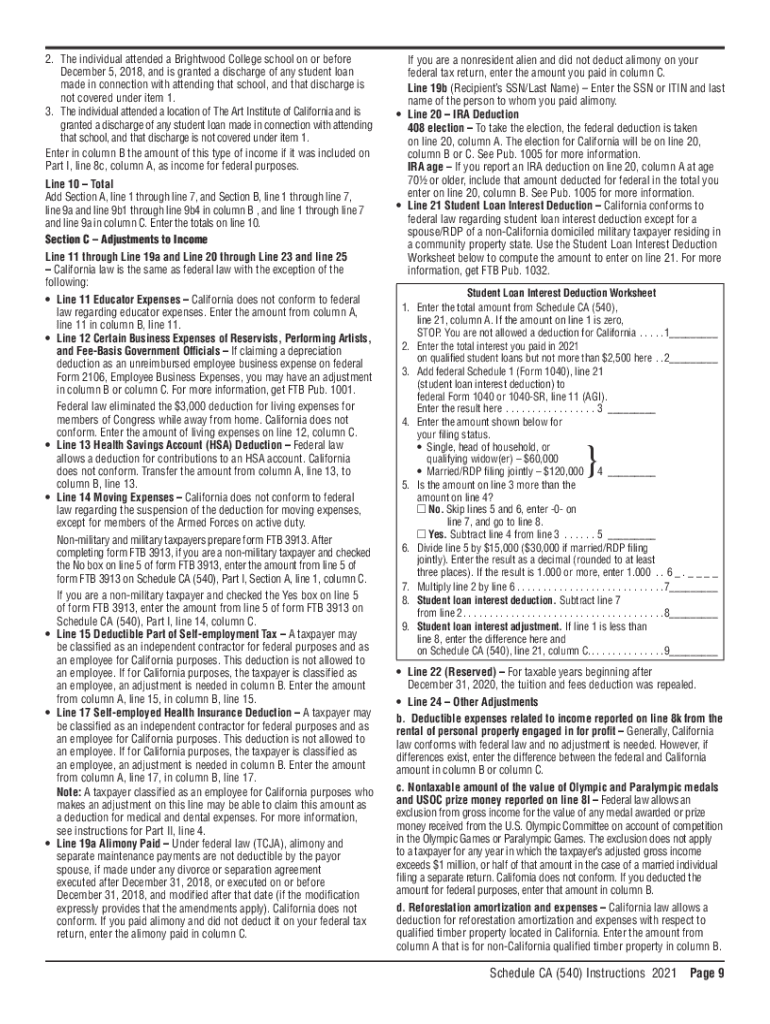







Definition and Purpose of Schedule CA (540) Instructions
The 2021 Instructions for Schedule CA (540) guide California taxpayers through the process of completing their state tax adjustments. These instructions are essential for taxpayers who need to align their federal tax return with California state requirements, particularly when it comes to income, deductions, and credits. The Schedule CA (540) serves as a bridge, detailing how to adjust federal amounts for California-specific tax laws. This comprehensive document provides explicit instructions on handling income exclusions, deductions, and tax credits, ensuring compliance with both state and federal regulations.
Utilizing the 2021 Instructions for Schedule CA (540)
Understanding and using the 2021 Instructions for Schedule CA (540) is crucial for accurately filing your California tax return. Here's how you can effectively use these instructions:
- Carefully review each section of the instructions, focusing on areas that pertain to your specific financial situation.
- Identify income types, deductions, and credits that require adjustments from federal to state figures.
- Follow step-by-step guidance for each line item on the Schedule CA (540) to ensure precision.
- Utilize examples provided within the instructions to understand better any complex adjustments that might apply to your case.
Obtaining the 2021 Instructions for Schedule CA (540)
California taxpayers can access the 2021 Instructions for Schedule CA (540) online via the official FTB.CA.GOV website. This digital version ensures easy navigation and search capabilities for finding specific topics or line items relevant to your tax situation. Additionally, paper copies can be obtained by requesting them from the California Franchise Tax Board, ensuring all taxpayers have access to this critical resource.
Steps to Complete Schedule CA (540)
Filing Schedule CA (540) involves several steps, and the instructions provide a meticulous roadmap for this process:
- Gather Necessary Documents: Ensure you have your federal tax return, W-2s, 1099s, and any other pertinent financial documents.
- Review Federal AGI: Start with your federal Adjusted Gross Income (AGI) as it forms the basis for state adjustments.
- Adjust for California Law: Carefully adjust income, deductions, and credits according to California-specific requirements.
- Complete Schedule Adjustment Sections: Fill out the income, subtraction, and addition lines on Schedule CA (540) with the guidance provided.
- Double-Check Calculations and Entries: Review all entries for accuracy before submission to avoid potential penalties.
Target Audience for Schedule CA (540)
The 2021 Instructions for Schedule CA (540) are primarily used by California residents, non-residents, and part-year residents who need to file a state tax return. The instructions are particularly relevant for individuals with complex tax situations involving multiple forms of income or those who need to make numerous adjustments based on differences between federal and state tax laws.
Key Elements in the 2021 Instructions
Critical components of the 2021 Instructions for Schedule CA (540) include:
- Income Adjustments: Guidance on making necessary adjustments to income amounts that differ between federal and California tax law.
- Deductions and Exemptions: Detailed instructions on allowable deductions and exemptions specific to California.
- Credits and Carryovers: Information on how to apply credits and carryover amounts in line with California tax specifications.
- Instructional Examples: Practical examples illustrating complex adjustment scenarios to aid in taxpayer understanding.
State-Specific Rules for Schedule CA (540)
Several state-specific rules must be adhered to when using the 2021 Instructions for Schedule CA (540):
- Diverse Criteria for Deductions: California disallows certain federal deductions while allowing state-specific ones that taxpayers should be aware of.
- Adjustments for Educational Credits: The document includes guidelines for different educational credit adjustments unique to California.
- Healthcare Mandates: Reference to California’s healthcare mandates and their impact on taxes are included in the instructions.
Submission Methods for Schedule CA (540)
California taxpayers have multiple options for submitting their completed Schedule CA (540):
- Electronic Filing: Most efficient and error-reducing. Taxpayers can submit through approved e-file providers.
- Mail Submission: Paper submissions can be sent directly to the Franchise Tax Board’s designated mailing address.
- In-Person Assistance: Taxpayer assistance centers provide in-person help, but in-person submissions typically rely on mail forms afterward.
Required Documentation for Filing
To complete Schedule CA (540) accurately, taxpayers must gather:
- Federal Tax Return: Required for aligning figures with California’s Schedule CA.
- Proof of Income: W-2 and 1099 forms, among any other income proof.
- Detailed Records of Deductions and Credits: Supporting documents that justify all claims and adjustments.
Important Deadlines and Penalties for Non-Compliance
Filing Schedule CA (540) comes with strict deadlines, typically aligning with federal tax due dates, often April 15. Late filings or failures to adjust accurately as per California requirements can result in penalties, increasing overall tax burden, and potentially triggering audits. It is essential to adhere to all timelines specified in the instructions to remain in compliance and avoid fines.




