2017 CA Schedule CA (540) Instructions-2026

Get Form
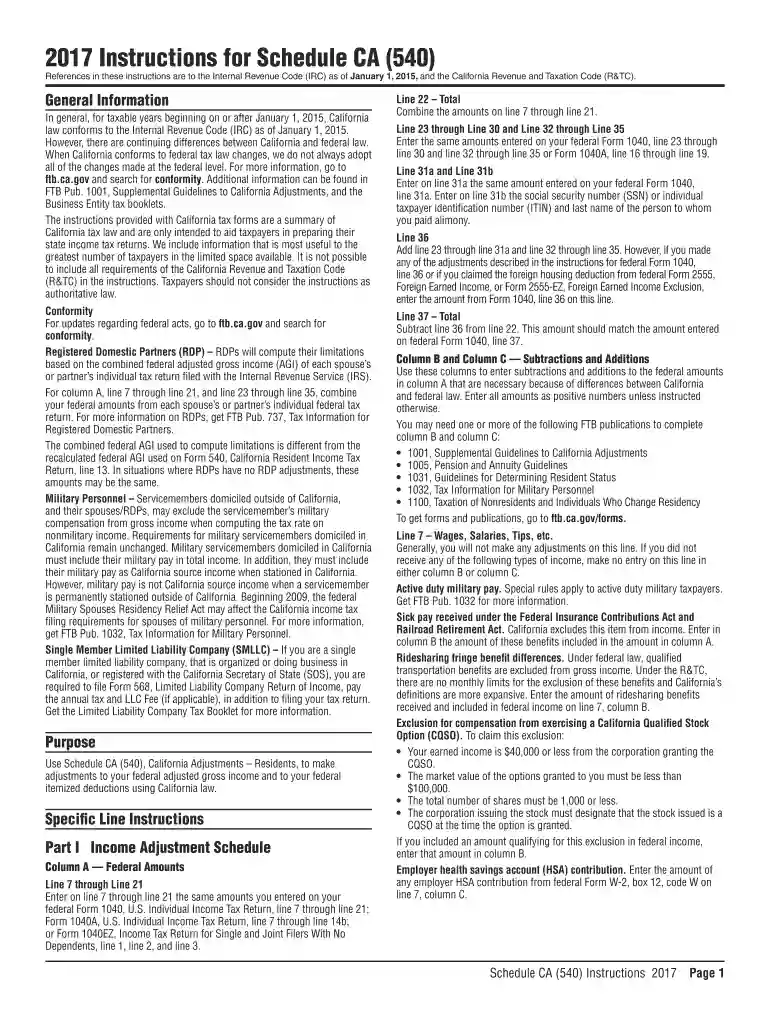
2017 CA Schedule CA (540) Instructions Preview on Page 1

Here's how it works

01. Edit your form online
Type text, add images, blackout confidential details, add comments, highlights and more.

02. Sign it in a few clicks
Draw your signature, type it, upload its image, or use your mobile device as a signature pad.

03. Share your form with others
Send it via email, link, or fax. You can also download it, export it or print it out.

Definition and Importance

The 2017 CA Schedule CA (540) Instructions serve as a comprehensive guide for California residents when adjusting their federal adjusted gross income (AGI) and itemized deductions to align with state tax laws. They clarify the differences between California and federal tax regulations, helping taxpayers accurately file their state income tax returns. The instructions emphasize critical areas such as conformity with the Internal Revenue Code and outline state-specific tax nuances.

How to Use the 2017 CA Schedule CA (540) Instructions

To use the 2017 CA Schedule CA (540) Instructions effectively, follow these steps:

  1. Review Federal Income: Start by examining your federal income figures. Identify all reported income types and applicable deductions on federal forms.
  2. Compare with State Requirements: Use the instructions to compare federal reports with California-specific requirements. Pay close attention to variations in income classifications and adjustments.
  3. Adjust Income and Deductions: Apply California’s unique rules to adjust your federal adjusted gross income and itemized deductions. This may involve recalculating figures based on state-specific exemptions or credits.
  4. Complete the Schedule CA (540): Fill out the form using the adjusted amounts. Ensure accuracy to prevent delays or penalties from misreported data.
  5. File with California Tax Return: Submit the completed Schedule CA (540) with your overall California tax return, ensuring it reflects the correct state figures.

Key Elements of the Instructions

The instructions cover various critical components, helping taxpayers navigate state tax requirements. Key elements include:

  • Income Differentiation: Clarification on income types that have differing federal and state tax treatments.
  • Registered Domestic Partners: Adjustments required for registered domestic partnerships to align with state recognition.
  • Military Personnel Considerations: Special instructions for active-duty military members, reflecting differences in residency and income sourcing.
  • Single-Member LLC Adjustments: Specific filing requirements for individuals with ownership of single-member limited liability companies, ensuring compliance with state tax obligations.

State-Specific Rules

California imposes several unique tax rules that differ from federal guidelines, and it's crucial to understand these:

  • Nonconformity Items: Certain federal deductions might not be recognized by California, requiring specific adjustments.
  • Local Exemptions: Availability of California-specific exemptions that need to be applied, which differ from federal exemptions.
  • Credit Limitations: Differences in how tax credits are applied, particularly those involving energy or education.

Steps to Complete the Instructions

The process of completing the instructions involves meticulous detail:

  1. Gather Necessary Documents: Ensure you have access to your federal tax return, W-2s, 1099s, and other relevant financial documents.
  2. Understand Adjustments and Deductions: Familiarize yourself with the specifics of California adjustments and deductions as stated in the instructions.
  3. Accurate Calculations: Use the guide to perform any necessary recalibrations of your AGI based on state laws.
  4. Double-Check Entries: Validate all figures entered on the CA Schedule CA (540) for accuracy.
  5. File Timely: Meet all filing deadlines to avoid penalties and ensure your return is processed without delay.

Examples of Using the Instructions

Here's how different scenarios might require application of the 2017 CA Schedule CA (540) Instructions:

  • Self-Employed Individuals: These taxpayers often face significant income adjustments because self-employment tax treatments vary between state and federal levels.
  • Retired Taxpayers: Retirees with income from pensions and social security need to pay attention to how these are taxed differently by California.
  • Students with Part-Time Jobs: Student income might require specific state adjustments not accounted for on federal returns.

Filing Deadlines and Important Dates

It’s essential to adhere to specific dates to avoid late fees:

  • Filing Deadline: Aligns with the federal tax deadline, typically April 15.
  • Extensions: If extending, ensure submission by October 15, but note extensions to file are not extensions to pay.

Digital vs. Paper Version

Modern filing has shifted towards digital platforms:

  • Digital Submission: Offers quick filing, instant verification, and is eco-friendly.
  • Paper Filing: Still available for those who prefer or require a tangible paper trail.

Understanding the distinction between these methods allows you to choose according to your preference and comfort level.

Eligibility Criteria

To use the Schedule CA (540), taxpayers must:

  • Be California Residents: Primarily reside within the state during the tax year.
  • Have Federal Tax Obligations: Filed a federal return that requires state adjustments.
  • Meet Income Thresholds: Ensure income levels necessitate the completion of additional forms, per California’s thresholds.

These criteria help determine applicability and necessity of filing specific forms related to California's state taxes.


decoration image ratings of Dochub

See more 2017 CA Schedule CA (540) Instructions versions

We've got more versions of the 2017 CA Schedule CA (540) Instructions form. Select the right 2017 CA Schedule CA (540) Instructions version from the list and start editing it straight away!
Versions Form popularity Fillable & printable
2023 4.2 Satisfied (59 Votes)
2022 4.1 Satisfied (28 Votes)
2022 4.9 Satisfied (55 Votes)
2021 4.5 Satisfied (53 Votes)
2021 4.5 Satisfied (41 Votes)
2021 4.9 Satisfied (31 Votes)
2020 4.8 Satisfied (102 Votes)
2020 4.8 Satisfied (146 Votes)
2019 4.3 Satisfied (94 Votes)
2019 4.4 Satisfied (130 Votes)
2018 4.3 Satisfied (264 Votes)
2018 4.8 Satisfied (165 Votes)
2018 4.3 Satisfied (201 Votes)
2017 4.4 Satisfied (236 Votes)
2017 4.2 Satisfied (54 Votes)
be ready to get more

Complete this form in 5 minutes or less

Get form

Got questions?

We have answers to the most popular questions from our customers. If you can't find an answer to your question, please contact us.
Contact us
Do I need to attach Schedule CA 540? Schedule CA 540 should be attached to your Form 540 if you need to make any adjustments to your income because of differences between California and federal tax laws. Its used to modify federal adjusted gross income and itemized deductions to align with Californias tax rules.
Accepted forms Forms you can e-file for an individual: Form 540 , California Resident Income Tax Return. Form 540 2EZ , California Resident Income Tax Return. Form 540NR , California Nonresident or Part-Year Resident Income Tax Return.
Form 540 is used by California residents to file their state income tax every April. This form should be completed after filing your federal taxes, such as Form 1040, Form 1040A, or Form 1040EZ, because information from your federal taxes will be used to help fill out Form 540.
2024 Standard deduction amounts Filing statusEnter on line 18 of your 540 Single or married/Registered Domestic Partner (RDP) filing separately $5,540 Married/RDP filing jointly, head of household, or qualifying widow(er) $11,080 Jan 27, 2025

Security and compliance

At DocHub, your data security is our priority. We follow HIPAA, SOC2, GDPR, and other standards, so you can work on your documents with confidence.

Learn more
ccpa2
pci-dss
gdpr-compliance
hipaa
soc-compliance