




01. Edit your printable manual j form online
Type text, add images, blackout confidential details, add comments, highlights and more.

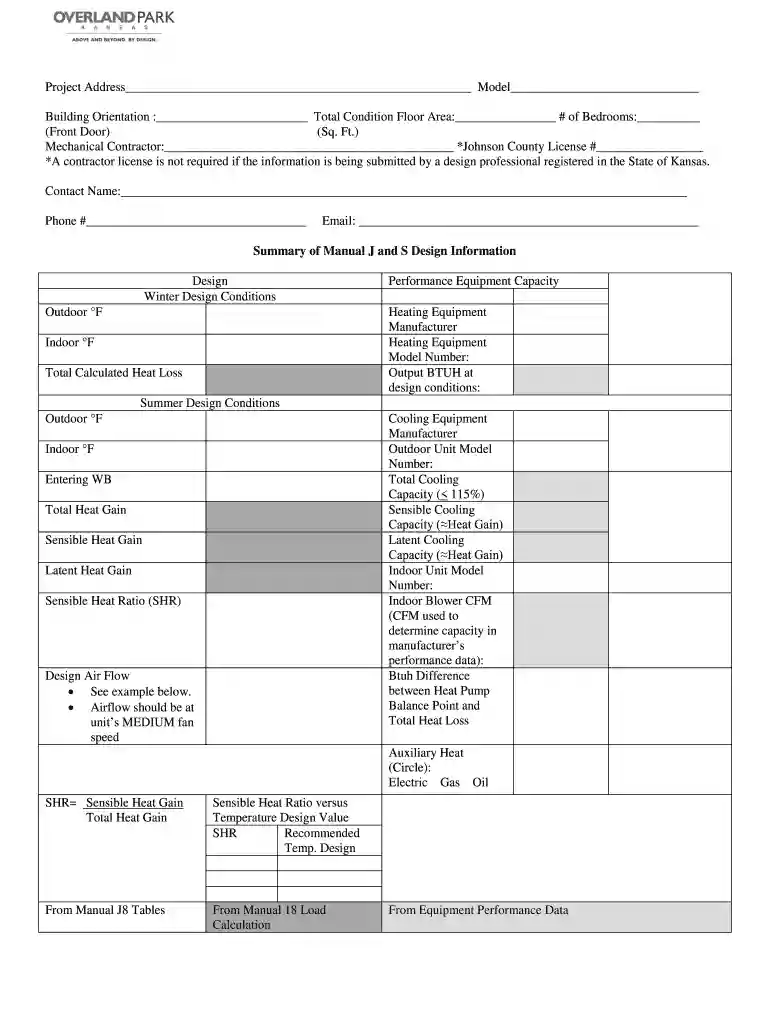
Type text, add images, blackout confidential details, add comments, highlights and more.

Draw your signature, type it, upload its image, or use your mobile device as a signature pad.

Send manual j worksheet pdf via email, link, or fax. You can also download it, export it or print it out.
The blank manual J forms are standardized documents used primarily within the HVAC industry for residential heating and cooling load calculations. These forms, developed by the Air Conditioning Contractors of America (ACCA), facilitate the assessment of the energy demands of a home or building, allowing industry professionals to accurately size heating and cooling equipment. The information gathered through manual J calculations is essential for ensuring optimal energy efficiency and comfort in living spaces.
The key elements of these forms include:
Room Dimensions: Measurements are required to determine the volume of each area.
Window and Door Specifications: Details regarding the number and types of windows and doors are crucial, as they affect heat gain and loss.
Insulation Levels: The type and quality of insulation play a significant role in energy retention, impacting load calculations.
Occupancy: The number of occupants can influence the latent heat load based on human activity and moisture generation.
Accurate completion of the blank manual J forms is vital for HVAC contractors to perform reliable load calculations and provide effective heating and cooling solutions.
Using the blank manual J forms involves several steps that guide HVAC professionals through the load calculation process. Here are detailed procedures to help ensure accuracy:
Collect Required Information: Gather all necessary details, including room dimensions, construction materials, insulation ratings, window types, and climate data.
Fill Out Room Data:
Assess Thermal Factors:
Calculate Load Values:
Review and Validate: After completing the forms, review all entries for accuracy. Errors in data input can lead to improper system sizing, which may result in inefficiencies or comfort issues.
These steps ensure that HVAC technicians utilize the blank manual J forms effectively, providing reliable data crucial for selecting the right systems.
When completing the blank manual J forms, following a structured approach is essential to achieving accurate calculations:
Preparation:
Measure Each Room:
Identify Building Materials:
Window and Door Details:
Occupancy and Appliances:
Perform Calculations:
Finalizing the Form:
By adhering to these steps, HVAC professionals can achieve precise load calculations using the manual J forms, leading to effective and energy-efficient installation practices.
Understanding key terminology associated with the blank manual J forms is crucial for effective use. Some essential terms include:
Thermal Load: Refers to the heating or cooling requirements necessary to maintain comfortable indoor conditions based on data input on the form.
Sensible Heat: This is the heat required to change the temperature of air without changing its moisture content, vital in load calculations.
Latent Heat: Refers to the heat involved in phase changes, such as condensation, which is critical for managing humidity levels in a building.
R-Value: A measure of thermal resistance used to quantify the effectiveness of insulation materials.
ASHRAE: The American Society of Heating, Refrigerating and Air-Conditioning Engineers, which publishes standards and guidelines for HVAC practices, often referenced in manual J calculations.
A solid grasp of these terms ensures accurate communication and understanding among professionals working with or evaluating manual J forms, improving the overall effectiveness of HVAC projects.
Practical applications of the blank manual J forms illustrate their importance in different scenarios. Here are a few pertinent examples:
Residential Installations: A homeowner planning to replace an aging HVAC system would benefit by having a technician perform a manual J calculation to ensure the new system is appropriately sized to meet their specific needs, contributing to enhanced comfort and energy efficiency.
New Constructions: Builders often require manual J forms to determine values for heating and cooling installations during the design phase of new homes, ensuring compliance with local codes and energy efficiency standards.
Renovation Projects: In cases where a homeowner is converting an attic or basement into living space, a manual J load calculation may be necessary. It aids in assessing if the existing system can accommodate the additional load or if upgrades are needed.
Commercial Applications: Businesses seeking accurate temperature control in office settings must rely on manual J calculations to size their HVAC systems appropriately, preventing unnecessary costs associated with over- or under-sizing systems.
These examples underscore the versatility of the blank manual J forms as pivotal tools for achieving energy efficiency and occupant comfort in residential and commercial settings.
At DocHub, your data security is our priority. We follow HIPAA, SOC2, GDPR, and other standards, so you can work on your documents with confidence.
Note: If 1a and 1c are blank, skip lines 10 through 15. preceding tax year ended ▷ preceding tax year ended ▷ preceding tax year ended ▷. Computation ofRead more
Most forms are fill-in-the-blank, and can be completed either electronically (by downloading the blank PDF and typing in the blank fields) or by printingRead more
Oct 27, 2021 Manual J speedsheet. Free download from ACCA. Automates load calculation for the abridged version only. Designers can create a template.Read more


