




Here's how it works

01. Edit your form online
Type text, add images, blackout confidential details, add comments, highlights and more.

02. Sign it in a few clicks
Draw your signature, type it, upload its image, or use your mobile device as a signature pad.

03. Share your form with others
Send it via email, link, or fax. You can also download it, export it or print it out.
How to use or fill out MCW Department of Radiology ACGME Neuroradiology Brain with our platform

- Click ‘Get Form’ to open it in the editor.
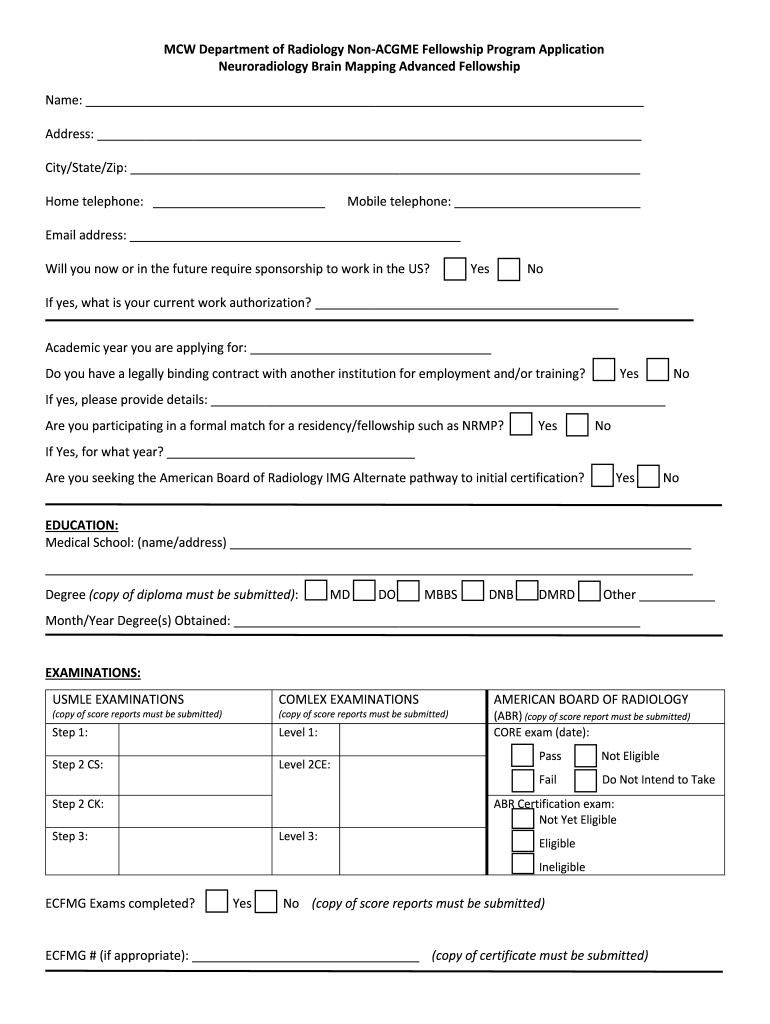
- Begin by entering your personal information in the designated fields, including your name, address, and contact details. Ensure accuracy as this information is crucial for communication.
- Indicate whether you will require sponsorship to work in the US by selecting 'Yes' or 'No'. If applicable, provide details about your current work authorization.
- Fill out the education section by providing the name and address of your medical school, along with the degree obtained. Remember to upload a copy of your diploma.
- Complete the examinations section by listing relevant exams and attaching score reports as required. This includes USMLE and COMLEX examinations.
- In the training section, detail your graduate medical education, including program names and accreditation status. Attach completion certificates where necessary.
- Finally, review all sections for completeness before electronically signing the document to confirm that all provided information is accurate.
Start using our platform today for free to streamline your application process!
Fill out MCW Department of Radiology ACGME Neuroradiology Brain online
It's free
It's free
Got questions?
We have answers to the most popular questions from our customers. If you can't find an answer to your question, please contact us.
Contact us
Who is the chief of neuroradiology UCSF?
Vinil Shah, MD, is Associate Professor and Chief of Neuroradiology in the UCSF Department of Radiology and Biomedical Imaging.
What is the neuroradiology department?
We provide specialist brain and spinal imaging and treatment using techniques including: magnetic resonance imaging (MRI) scanning, which uses a powerful magnet and radio waves to produce images. computerised tomography (CT) scanning, which uses x-rays to produce detailed cross-sectional and 3D images.
What diseases does neuroradiology diagnose?
Diagnostic neuroradiologists examine brain scans to detect and diagnose conditions such as Parkinsons disease, tumors, aneurysms and vascular malformations. But our work doesnt just find serious disease or problems in the brain. We provide detailed images to help your neurosurgeon understand treatment options.
Why would you see a neuroradiologist?
Neuroradiology is primarily used to diagnose brain or spinal cord injuries, diseases, or conditions, such as: Blood vessel disorders in the brain or spinal cord, such as aneurysms, arteriovenous malformations (AVM), and dural arteriovenous fistulae. Brain injury, including anoxic injury or traumatic brain injury.
Is neuroradiology a specialty?
[Neuroradiology, a specialty among the neurosciences]
Security and compliance
At DocHub, your data security is our priority. We follow HIPAA, SOC2, GDPR, and other standards, so you can work on your documents with confidence.
Learn more


