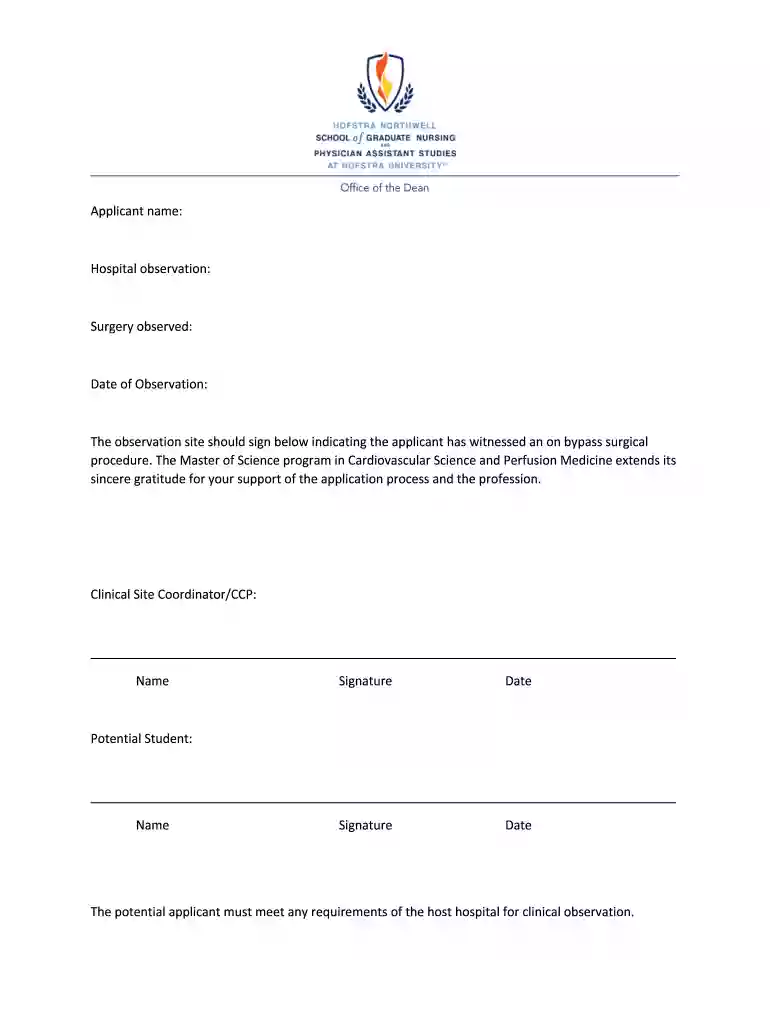
Perfusion observation 2026

Get Form
hofstra observation form Preview on Page 1

Here's how it works

01. Edit your hofstra observation form online
Type text, add images, blackout confidential details, add comments, highlights and more.

02. Sign it in a few clicks
Draw your signature, type it, upload its image, or use your mobile device as a signature pad.

03. Share your form with others
Send perfusion observation form via email, link, or fax. You can also download it, export it or print it out.

How to use or fill out perfusion observation with our platform

Form edit decoration
9.5
Ease of Setup
DocHub User Ratings on G2
9.0
Ease of Use
DocHub User Ratings on G2
  1. Click ‘Get Form’ to open the perfusion observation document in the editor.
  2. Begin by entering the 'Applicant name' in the designated field. Ensure that the name matches official documents for accuracy.
  3. Next, fill in the 'Hospital observation' section with the name of the hospital where the observation took place.
  4. In the 'Surgery observed' field, specify the type of surgery that was observed during your clinical experience.
  5. Enter the 'Date of Observation' accurately to reflect when the procedure occurred.
  6. Have the Clinical Site Coordinator/CCP sign and date in their respective fields to validate your observation.
  7. Finally, ensure you sign and date as a potential student in your designated area to complete your application process.

Start using our platform today for free to streamline your form completion and enhance your application experience!

be ready to get more

Complete this form in 5 minutes or less

Get form

Got questions?

We have answers to the most popular questions from our customers. If you can't find an answer to your question, please contact us.
Contact us
The skin, an easily accessible organ, allows clinicians to quickly evaluate the peripheral tissue perfusion with noninvasive bedside parameters such as the skin temperatures gradient, the capillary refill time, the extent of mottling and the peripheral perfusion index.
Perfusion is composed of what I call the Three Ps: The pump (heart) The pipes (blood vessels) The plasma (blood)
Inspection. Skin color to assess perfusion. Inspect the face, lips, and fingertips for cyanosis or pallor. Cyanosis is a bluish discoloration of the skin, lips, and nail beds and indicates decreased perfusion and oxygenation.
Check for pallor, cyanosis, and cool or clammy skin. Assess the quality of every pulse. The nonexistence of peripheral pulses must be reported or managed immediately. Systemic vasoconstriction resulting from reduced cardiac output may be manifested by diminished skin perfusion and loss of pulses.
In medical terms, perfusion means the flow of blood or fluid to tissues and organs. This can occur naturally through the circulatory and lymphatic systems. It can also occur synthetically through the administration of intravenous therapy and pharmaceutical drugs.

Security and compliance

At DocHub, your data security is our priority. We follow HIPAA, SOC2, GDPR, and other standards, so you can work on your documents with confidence.

Learn more
ccpa2
pci-dss
gdpr-compliance
hipaa
soc-compliance

People also ask

Classically, the presentation of acute compartment syndrome has been remembered by The Five Ps: pain, pulselessness, paresthesia, paralysis, and pallor. However, aside from paresthesia, which may occur earlier in the course of the condition, these are typically late findings.
Getting into perfusionist school Experience as a registered nurse (RN) or respiratory therapist (RRT) or other healthcare practitioner. Experience working in a hospital environment. B.S. degree with courses completed in anatomy, algebra, calculus, physiology, physics, and chemistry.

perfusion observation