



Plant disease form 2026

Get Form
plant disease form Preview on Page 1

Here's how it works

01. Edit your plant disease form online
Type text, add images, blackout confidential details, add comments, highlights and more.
02. Sign it in a few clicks
Draw your signature, type it, upload its image, or use your mobile device as a signature pad.
03. Share your form with others
Send it via email, link, or fax. You can also download it, export it or print it out.

How to use or fill out plant disease form with our platform

Form edit decoration
9.5
Ease of Setup
DocHub User Ratings on G2
9.0
Ease of Use
DocHub User Ratings on G2
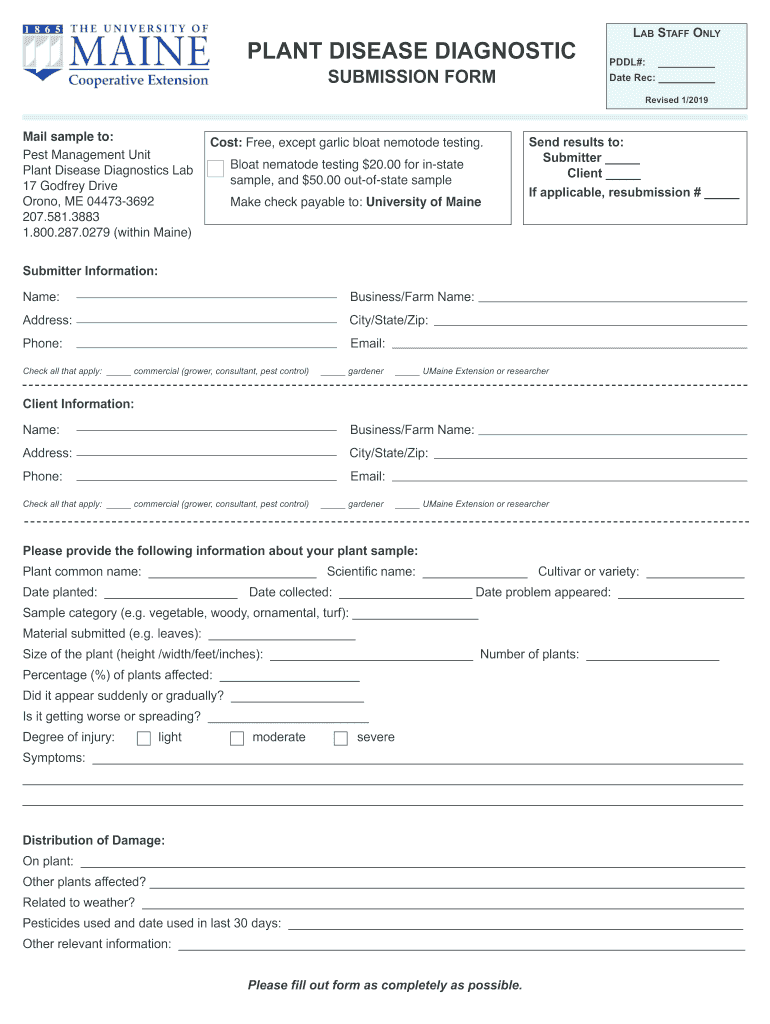
  1. Click ‘Get Form’ to open the Plant Disease Diagnostic Submission Form in the editor.
  2. Begin by filling out the 'Submitter Information' section. Provide your name, business or farm name, address, city/state/zip, phone number, and email. This information is crucial for identifying who submitted the sample.
  3. Next, complete the 'Client Information' section if applicable. Fill in the same details as above for the client receiving the results.
  4. In the 'Plant Sample Information' section, enter details about your plant sample including common name, scientific name, cultivar or variety, and important dates such as when it was planted and when problems appeared.
  5. Indicate the sample category (e.g., vegetable or ornamental) and describe the material submitted. Include dimensions of the plant and percentage affected to provide a clear picture of the issue.
  6. Finally, detail any symptoms observed and any pesticides used recently. Ensure all fields are filled out completely to facilitate accurate diagnosis.

Start using our platform today to easily fill out your Plant Disease Diagnostic Submission Form for free!

be ready to get more

Complete this form in 5 minutes or less

Get form

Got questions?

We have answers to the most popular questions from our customers. If you can't find an answer to your question, please contact us.
Contact us
Common Plant Diseases Anthracnose. Anthracnose is a fungal disease that affects plants, trees, fruits and vegetables. Blossom-End Rot. Downy Mildew. Early Blight. Mosaic Viruses. Powdery Mildew. Rust Plant Disease. White Mold.
The Top 10 list includes, in rank order, (1) Tobacco mosaic virus, (2) Tomato spotted wilt virus, (3) Tomato yellow leaf curl virus, (4) Cucumber mosaic virus, (5) Potato virus Y, (6) Cauliflower mosaic virus, (7) African cassava mosaic virus, (8) Plum pox virus, (9) Brome mosaic virus and (10) Potato virus X, with
A plant disease is any harmful condition that affects a plants appearance or function. Common pathogens that cause diseases include: fungi, bacteria, and viruses. Some nematodes are plant disease agents.
list of plant diseases aster yellows. bacterial wilt. blight. fire blight. rice bacterial blight. canker. crown gall. rot. basal rot. scab.
There are several types of organisms that cause plant diseases. These include fungi, bacteria, viruses, nematodes, mycoplasmas and spiroplasmas. These pathogens need to be present in the greenhouse in order to set the stage for a disease problem.

Security and compliance

At DocHub, your data security is our priority. We follow HIPAA, SOC2, GDPR, and other standards, so you can work on your documents with confidence.

Learn more
ccpa2
pci-dss
gdpr-compliance
hipaa
soc-compliance

People also ask

Plant disease - AQA Pathogens as causes of plant diseases. Pathogens are disease-causing viruses, bacteria, fungi or protists which attack plants as well as animals. Plants have physical and chemical defences against pathogens.
Viruses, crops affected, and damage caused: VirusHost plants Turnip mosaic virus Brassicas. Cucumber mosaic and potato mosaic virus Capsicum; tomato; potato; celery. Carrot virus Y Carrot. Papaya rin; Watermelon mosaic virus; Zucchini yellow mosaic virus Cucurbits.7 more rows

Related links