Feline Behavioral HistoryAnimal Behavior Consultants of 2026

Get Form
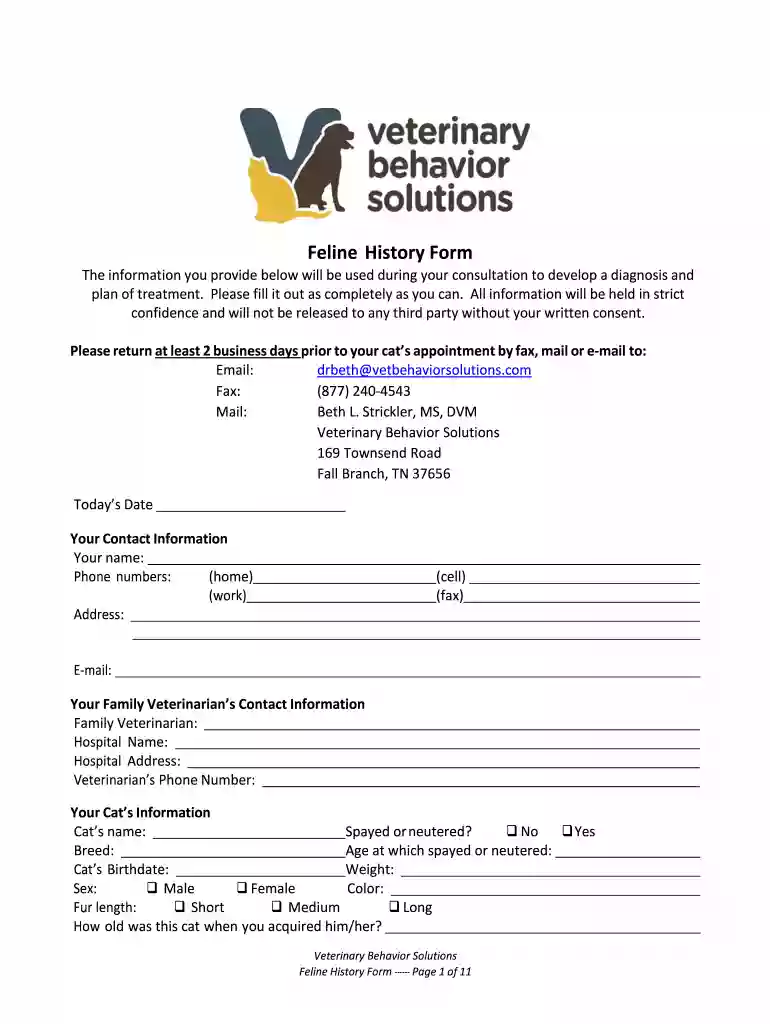
Feline Behavioral HistoryAnimal Behavior Consultants of Preview on Page 1

Here's how it works

01. Edit your form online
Type text, add images, blackout confidential details, add comments, highlights and more.

02. Sign it in a few clicks
Draw your signature, type it, upload its image, or use your mobile device as a signature pad.

03. Share your form with others
Send it via email, link, or fax. You can also download it, export it or print it out.

How to use or fill out Feline Behavioral History Animal Behavior Consultants of with our platform

Form edit decoration
9.5
Ease of Setup
DocHub User Ratings on G2
9.0
Ease of Use
DocHub User Ratings on G2
  1. Click ‘Get Form’ to open it in the editor.
  2. Begin by entering today’s date and your contact information, including your name, phone numbers, and email address. This ensures that the consultant can reach you easily.
  3. Next, provide details about your family veterinarian, including their contact information. This is crucial for any necessary follow-up regarding your cat's health.
  4. Fill in your cat’s information such as name, breed, age, weight, and whether they are spayed or neutered. Be thorough to help the consultant understand your cat's background.
  5. In the behavior history section, describe the main behavioral issues and rank their seriousness. Include detailed descriptions of incidents to give a clear picture of the situation.
  6. Complete the medical history section by listing any current medications or past medical problems. This helps in assessing any underlying health issues affecting behavior.
  7. Finally, review all sections for accuracy before submitting via email or other preferred methods outlined at the top of the form.

Start using our platform today to streamline filling out your Feline Behavioral History form for free!

be ready to get more

Complete this form in 5 minutes or less

Get form

Got questions?

We have answers to the most popular questions from our customers. If you can't find an answer to your question, please contact us.
Contact us
How much does an Animal Behaviorist make in Los Angeles, California? As of Sep 11, 2025, the average annual pay for an Animal Behaviorist in Los Angeles is $63,454 a year. Just in case you need a simple salary calculator, that works out to be approximately $30.51 an hour.
What are Top 10 Highest Paying Cities for Veterinary Behaviorist Jobs CityAnnual SalaryHourly Wage San Francisco, CA $69,382 $33.36 Santa Clara, CA $69,162 $33.25 Sunnyvale, CA $69,116 $33.23 Livermore, CA $69,077 $33.216 more rows
Cat behavior consultants These professionals can assess a cats history, temperament, environment, and reaction to various situations to help everyone involved understand what it will take to manage or correct the behavior.
The most common feline behavior problems are associated with elimination. Some of these are related to the litter box, while others reflect social conflicts and involve anxiety or aggression. Much feline aggression is subtle and passive, so its real frequency may be greatly underestimated.
The best Animal jobs can pay up to $287,000 per year. Some of the more well-known careers are zoologist and veterinary doctor. As a zoologist, you can work with a wide variety of wild animals in a zoo setting.

Security and compliance

At DocHub, your data security is our priority. We follow HIPAA, SOC2, GDPR, and other standards, so you can work on your documents with confidence.

Learn more
ccpa2
pci-dss
gdpr-compliance
hipaa
soc-compliance
be ready to get more

Complete this form in 5 minutes or less

Get form

People also ask

A degree in Animal Behavior offers exciting career possibilities. There are numerous career paths to explore if you earn a degree in Animal Behavior. Some students plan to attend graduate school to continue their research or obtain advanced degrees in fields such as wildlife conservation.
Animal behaviorists working in private practice or for private companies typically earn more than researchers or those working for nonprofit organizations, such as zoos. Typical entry-level jobs in zoos or shelters could start at less than $30,000. At higher levels, or in industry, salaries can be considerably higher.

Related links