




01. Edit your free fillable drug test results online
Type text, add images, blackout confidential details, add comments, highlights and more.

Type text, add images, blackout confidential details, add comments, highlights and more.

Draw your signature, type it, upload its image, or use your mobile device as a signature pad.

Send fillable drug test results via email, link, or fax. You can also download it, export it or print it out.
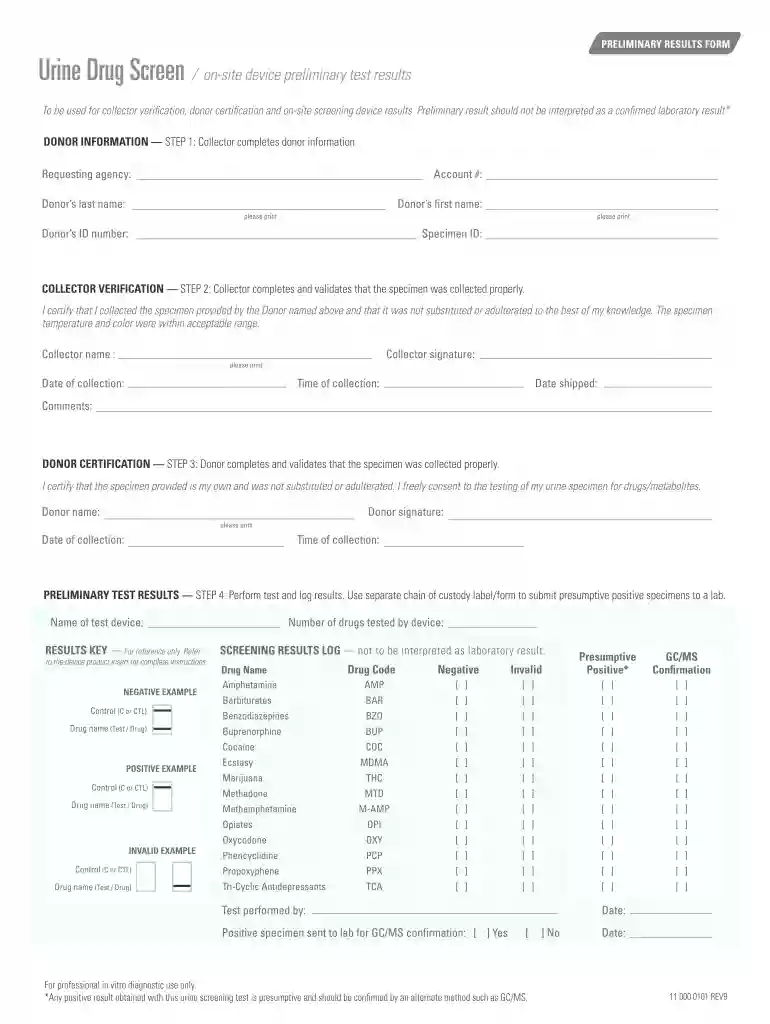
The drug results form, often referred to in various contexts including employment screening and legal compliance, captures the outcome of a drug screening process. This form is crucial for employers, healthcare providers, and individuals as it provides verification of drug test results, ensuring that proper protocols are followed. Here are the main components of a drug results form.
Information Required from the Tester: The form should gather essential details from the individual administering the test, including their name, title, and contact information. It may also require the facility's name and location where the test was conducted.
Donor Information: The tester must provide clear identification for the donor, including their full name, date of birth, and identification number. This information is vital for ensuring that results are accurately attributed to the correct individual.
Test Details: The form needs to specify the type of drug test administered, such as a 5-panel, 10-panel, or 12-panel drug test. Details about the method of testing (urine, saliva, or hair) should also be recorded.
Result Summary: Test outcomes should be clearly documented, indicating whether the results were positive, negative, or inconclusive. If the result is positive, it’s important to include which substances were identified.
Confirmation and Authorization: A section for both the collector and the donor’s signatures is necessary to confirm that the test was completed. This serves as an acknowledgment of understanding the results and agreeing to any subsequent actions.
Designing a drug results form that allows for easy completion is essential for efficiency in handling test results. Creating this form with fillable fields can streamline the data entry process.
Form Layout: Begin by creating sections for all essential elements, such as donor information, test details, and result summary. Using tables can help neatly organize large amounts of data.
Fillable Fields: Incorporate different types of fillable fields, including text fields for names, dropdown menus for test types, and checkboxes for indicating results. This ensures that users can easily input information without errors.
Field Requirements: Specify which fields are mandatory to fill out before submission. For instance, it should be mandatory for the donor's name and test type fields to be completed.
Validation Rules: Implement validation checks to avoid incorrect submissions. For example, if the test type selected does not correspond to the fields available for test results, a warning should be displayed.
Multi-Recipient Capability: Allow for multiple recipients to add information to the form. If different parties are responsible for varied sections, this feature enhances usability.
Interpreting the results of a drug test is critical for making informed decisions, especially in workplaces or healthcare settings. This section provides guidance on how to understand and act upon the findings of the drug results form.
Negative Results: A negative result indicates no drugs were detected in the donor’s system. This outcome typically complies with drug testing policies for employment or medical purposes.
Positive Results: A positive result indicates the presence of one or more drugs, which may lead to a retest or confirmation testing. Often, initial positive results do not automatically imply drug use, as various factors such as prescription medications or food can cause false positives.
Inconclusive Results: This indicates that the test did not yield a clear positive or negative outcome. In such cases, a follow-up test is usually recommended to provide a definitive result.
Confirmation Tests: Discuss the importance of conducting confirmation tests using methods such as Gas Chromatography-Mass Spectrometry (GC-MS) for positive results to reinforce accuracy before making decisions based on these findings.
Adhering to legal requirements is vital when handling drug results forms, particularly in workplace settings. Understanding the regulatory landscape ensures compliance and protects against liability.
Compliance with Federal Laws: Familiarize yourself with the Drug-Free Workplace Act and its requirements. Employers must maintain proper documentation and follow prescribed policies regarding drug testing.
State-Specific Regulations: Different states may have varying laws regarding drug testing. Employers should be aware of the regulations applicable in their state to avoid legal complications.
Privacy Considerations: Ensure that the drug results form is compliant with the Health Insurance Portability and Accountability Act (HIPAA), especially if health information is involved. Protecting the confidentiality of test results is paramount.
Right to Challenge Results: Donors may have the right to request a review or challenge positive results. Clearly outline the procedures for appealing results within the form.
Retention of Records: Establish guidelines for how long drug test results must be kept in accordance with applicable laws. Regular audits of these records can help maintain compliance.
Understanding real-world applications of the drug results form can help clarify its role in various settings. Here are several illustrative scenarios:
Employment Screening: An employer administers a drug test during the hiring process. The results are documented, and a negative result allows for the candidate to proceed with the hiring process seamlessly.
Post-Incident Testing: After an employee is involved in an accident, a random drug test is conducted. The drug results form provides essential documentation for the employer to evaluate if substance use contributed to the incident.
Substance Abuse Programs: Individuals entering rehabilitation programs are often required to submit drug test results periodically. The documentation plays a critical role in assessing compliance with treatment protocols.
Legal Case: In a legal dispute related to employment termination due to a positive drug test, the documented results and the procedure outlined on the drug results form become essential in establishing the case.
Pre-Employment Screenings for Federal Jobs: Certain federal employment positions require rigorous drug testing, where the drug results form becomes necessary to demonstrate compliance with federal standards.
Proper utilization of drug results forms is essential for maintaining compliance with industry standards and internal policies. Here is a breakdown of effective practices for using these forms.
Standardizing Formats: Creating a standard format for drug results forms across the organization helps ensure consistency in documentation and simplifies data retrieval during audits.
Electronic Filing Systems: Implement electronic records systems to store drug results securely. Digital forms can simplify the retrieval process and reduce physical storage requirements.
Training Personnel: Ensure that all personnel involved in drug testing are trained on how to accurately complete and interpret the drug results forms. A clear understanding of the procedure helps maintain integrity throughout the process.
Regular Reviews of Drug Testing Policies: Conduct periodic reviews of existing drug testing policies to align them with evolving legal requirements and organizational needs.
Facilitating Communication: Establish clear channels for communicating results to involved parties. If results need to be shared with HR, ensure the process is secure and complies with data protection regulations.
At DocHub, your data security is our priority. We follow HIPAA, SOC2, GDPR, and other standards, so you can work on your documents with confidence.


Page 1. Example of Drug Screen Results (LabCorp results)Read more
After the Medical Review Officer receives the test results for the specimen identified by this form, he/she may contact you to ask about prescriptions and over-Read more
FDA Form. 3500 is used for voluntary reporting by both healthcare professionals and consumers and is the subject of the DQRS program. Important Note: FDA FormRead more


