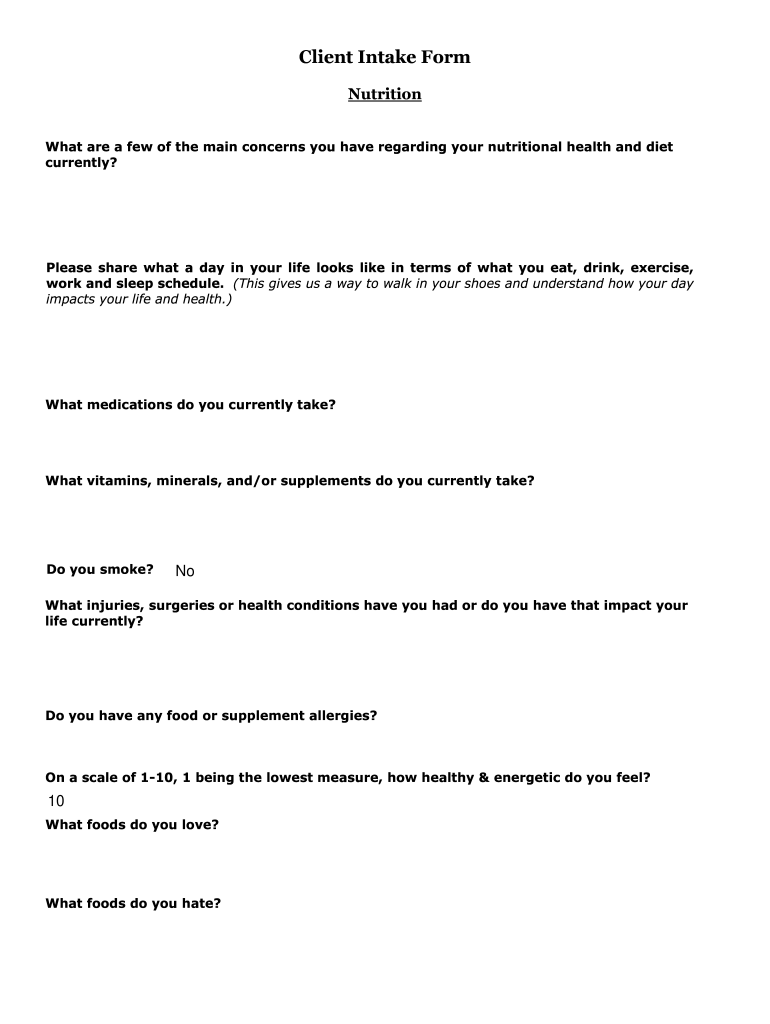
RB Nutrition Intake Form doc 2026

Get Form
RB Nutrition Intake Form doc Preview on Page 1

Here's how it works

01. Edit your form online
Type text, add images, blackout confidential details, add comments, highlights and more.
02. Sign it in a few clicks
Draw your signature, type it, upload its image, or use your mobile device as a signature pad.
03. Share your form with others
Send it via email, link, or fax. You can also download it, export it or print it out.

How to use or fill out RB Nutrition Intake Form doc with our platform

Form edit decoration
9.5
Ease of Setup
DocHub User Ratings on G2
9.0
Ease of Use
DocHub User Ratings on G2
  1. Click ‘Get Form’ to open the RB Nutrition Intake Form in our editor.
  2. Begin by addressing your main nutritional health concerns in the designated field. This helps us understand your priorities.
  3. In the next section, describe a typical day regarding your meals, drinks, exercise, work, and sleep. This provides insight into your daily routine.
  4. List any medications and supplements you currently take. This information is crucial for tailoring your nutrition plan.
  5. Indicate any allergies you have and rate your current health and energy levels on a scale of 1-10.
  6. Share your food preferences by listing foods you love and hate. This will help us create a personalized approach.
  7. Identify changes you wish to make in your health and nutrition, along with any barriers that may hinder these changes.
  8. Finally, express how we can best support you in achieving your health goals.

Start filling out the RB Nutrition Intake Form today for free using our platform!

be ready to get more

Complete this form in 5 minutes or less

Get form

Got questions?

We have answers to the most popular questions from our customers. If you can't find an answer to your question, please contact us.
Contact us

Yes, a typed name is recognized as a legitimate electronic signature when you create it on your paperwork utilizing a compliant solution like DocHub. Simply add your RB Nutrition Intake Form doc to our editor, click Sign in the top tool pane → Create your signature → Type your name in the appropriate tab, and select how it will look on your document.

Apart from an extensive toolset for editing PDFs on mobile devices, DocHub allows you to sign your RB Nutrition Intake Form doc along the way. Open our editor in your browser, make modifications using DocHub’s toolset, and finish your editing by eSigning the completed form.

Write down what you eat and drink on paper, keep notes on your computer or digital device or use a food tracking website or app. Track what you ate, the times you ate and portion sizes. Add notes about what you were doing while you were eating.
Dietary reference intakes (DRIs) are a set of scientifically developed reference values for nutrients. DRI values provide the scientific basis for nutrition professionals, governments, and non-governmental organizations to carry out activities such as: Developing nutrition labels.
Five Domains of Nutrition Assessment. 1) Food and Nutrition Related History. 2) Anthropometric Assessment. 3) Biochemical data, medical tests and procedure assessment. 4) Nutrition-focused physical examination (NFPE) 5) Persons history.

Security and compliance

At DocHub, your data security is our priority. We follow HIPAA, SOC2, GDPR, and other standards, so you can work on your documents with confidence.

Learn more
ccpa2
pci-dss
gdpr-compliance
hipaa
soc-compliance

People also ask

Theres a mnemonic you can use to remember the different components of a complete nutritional assessment ABCD: anthropometric, biochemical, clinical, and dietary.
An easy way to remember types of nutrition assessment is ABCD: Anthropometric, biochemical, clinical, and dietary. Anthropometry is the measurement of the size, weight, and proportions of the body. Common anthropometric measurements include weight, height, MUAC, head circumference, and skinfold.
The four primary components of the nutritional assessment are summarized by the mnemonic ABCD, with A standing for anthropometric measurements such as height and weight; B for biochemical parameters such as the serum albumin level and the hemoglobin count; C for clinical evaluation, including an assessment of
These tools include anthropometric, biochemical, clinical/physical, and dietary assessments to screen and evaluate undernutrition, diet quality, and food insecurity effectively.

Related links