




01. Edit your form online
Type text, add images, blackout confidential details, add comments, highlights and more.

Type text, add images, blackout confidential details, add comments, highlights and more.

Draw your signature, type it, upload its image, or use your mobile device as a signature pad.

Send it via email, link, or fax. You can also download it, export it or print it out.
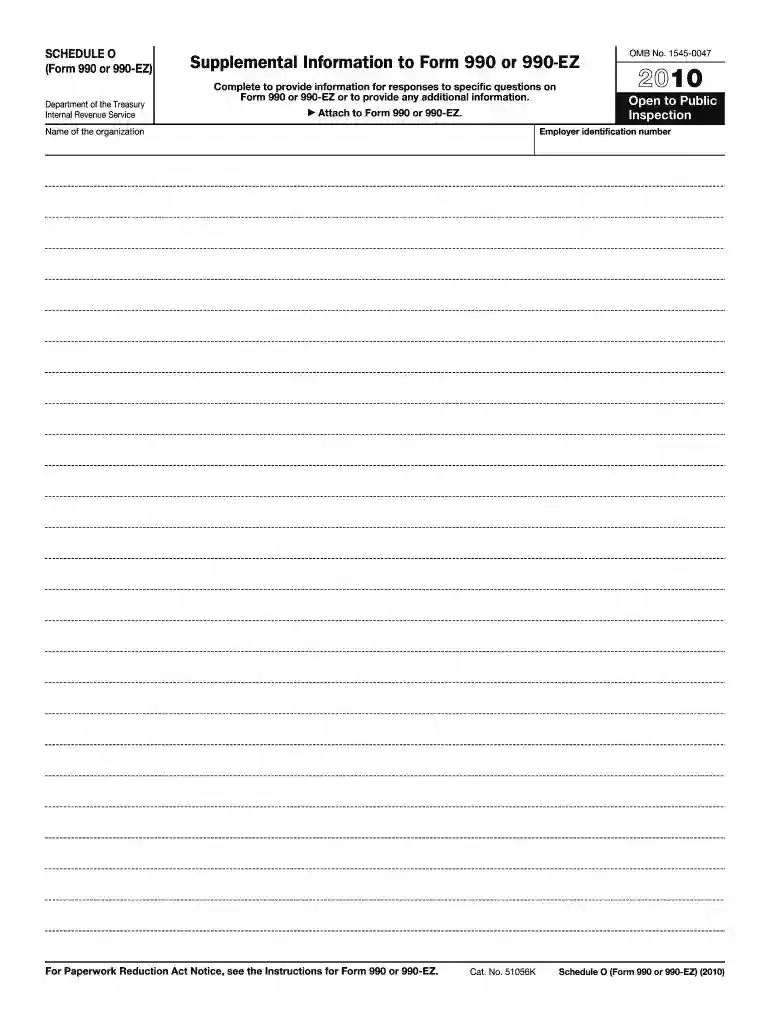
The 2010 Form 990 is a comprehensive tax document used by tax-exempt organizations, non-profit entities, and other groups to provide the Internal Revenue Service (IRS) with a detailed view of their financial and operational activities. Organizations exempt from income tax under section 501(c) are typically required to file this form annually. It is crucial for transparency as it informs the public about the organization's mission, programs, and finances. This form helps ensure that organizations adhere to standards that qualify them for tax-exempt status, and it provides stakeholders with a snapshot of an organization’s fiscal health and governance practices.
The 2010 Form 990 comprises multiple sections that collect detailed information about different aspects of an organization's operations.
These sections come together to depict a clear picture of financial activities, governance practices, and mission-related achievements.
Filing the 2010 Form 990 accurately is crucial for maintaining tax-exempt status.
Completing these steps ensures the form is filed correctly and reduces the risk of errors that could lead to penalties.
Timeliness is critical when filing Form 990 to avoid penalties.
Understanding these timelines helps organizations remain compliant and avoid unnecessary financial consequences.
Failure to comply with filing duties can result in serious consequences.
Organizations must prioritize filing requirements to avoid these penalties and ensure continued tax-exempt benefits.
The 2010 Form 990 is utilized by a diverse range of tax-exempt organizations.
Filing is mandatory for most of these entities except for those with gross receipts normally under $50,000 or certain faith-based organizations.


The IRS provides comprehensive instructions to guide organizations in completing the Form 990 correctly.
These guidelines help organizations complete the form properly, ensuring compliance with IRS requirements.
Organizations must choose appropriate methods and tools to file Form 990.
Leveraging compatible software ensures that the filing process is efficient, reducing the likelihood of errors and delays.
We've got more versions of the 2010 form 990 form. Select the right 2010 form 990 version from the list and start editing it straight away!
| Versions | Form popularity | Fillable & printable |
|---|---|---|
| 2024 | 4.9 Satisfied (27 Votes) | |
| 2023 | 4.2 Satisfied (52 Votes) | |
| 2022 | 4.7 Satisfied (40 Votes) | |
| 2021 | 4.8 Satisfied (196 Votes) | |
| 2020 | 4.2 Satisfied (46 Votes) | |
| 2019 | 4.4 Satisfied (84 Votes) | |
| 2018 | 4.4 Satisfied (239 Votes) | |
| 2017 | 4.4 Satisfied (204 Votes) | |
| 2016 | 4.4 Satisfied (331 Votes) | |
| 2015 | 4 Satisfied (42 Votes) | |
| 2014 | 4 Satisfied (50 Votes) | |
| 2013 | 4.4 Satisfied (38 Votes) | |
| 2012 | 4 Satisfied (26 Votes) | |
| 2011 | 4 Satisfied (28 Votes) | |
| 2010 | 4 Satisfied (60 Votes) |
At DocHub, your data security is our priority. We follow HIPAA, SOC2, GDPR, and other standards, so you can work on your documents with confidence.


