How to form 990 information 2026

Get Form
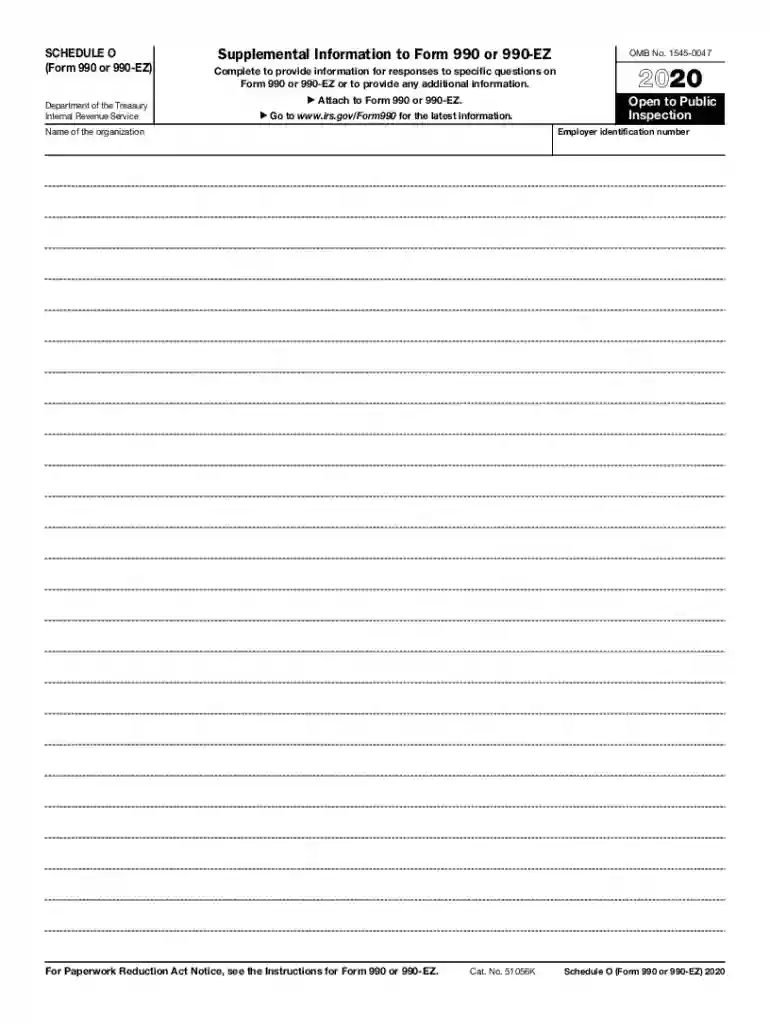
schedule o form 990 ez 2020 Preview on Page 1

Here's how it works

01. Edit your schedule o form 990 ez 2020 online
Type text, add images, blackout confidential details, add comments, highlights and more.

02. Sign it in a few clicks
Draw your signature, type it, upload its image, or use your mobile device as a signature pad.

03. Share your form with others
Send 2020 form 990 schedule o via email, link, or fax. You can also download it, export it or print it out.

What is Form 990?

Form 990 is an essential tax document used by tax-exempt organizations to provide the Internal Revenue Service (IRS) with detailed information about their financial activities and operations. This form is crucial for ensuring transparency in the nonprofit sector, which allows donors and the public to assess how these organizations use their funds. Form 990 also helps maintain the tax-exempt status of nonprofits by demonstrating compliance with various IRS rules and regulations.

Key Components of Form 990

  • Part I: Summary of key financial activities of the organization.
  • Part II: Signature block for officers to certify form accuracy.
  • Part III: A detailed statement of program accomplishments.
  • Part IV: Compliance checklists regarding specific IRS requirements.
  • Part V: Declaration of organizational policies and procedures.
  • Part VI: Governance information, such as details about the board and management.
  • Part VII: Information on compensation for officers, directors, and key employees.
  • Part VIII: Detailed financial statements, including income and expenses.
  • Part IX: Financial breakdown of functional expenses.
  • Part X: Balance sheet containing assets, liabilities, and net assets.

IRS Guidelines for Completing Form 990

To ensure compliance, organizations must carefully follow IRS guidelines when completing Form 990. These guidelines cover everything from understanding the form's different parts to ensuring accurate financial reporting.

Important IRS Instructions

  1. Complete all applicable sections: Ensure each section is filled out based on the activities and financial transactions of the organization.
  2. Review definitions and terms: Use IRS definitions to accurately fill out specific lines and check for required attachments.
  3. Attach necessary schedules: Depending on the organization’s activities, additional schedules may be required, such as Schedule O for narrative responses.
  4. Maintain detailed records: Backup information provided in the form with precise records and documentation.

Steps to Complete Form 990

Completing Form 990 involves a structured process requiring attention to detail and accuracy. Here’s a comprehensive procedure to guide organizations:

  1. Collect necessary financial documents: Gather annual financial statements, records of income, and expenses.
  2. Identify applicable sections and schedules: Based on organizational activities, determine which parts and additional forms are necessary.
  3. Fill out basic information: Provide general details such as the organization’s name, address, and tax-exempt status.
  4. Report on specific financial activities: Complete relevant parts concerning revenue, expenditures, and specific program service accomplishments.
  5. Review compliance questions: Check that the organization adheres to regulations pertaining to governance, management, and oversight.

Filing Deadlines and Important Dates

Staying on top of filing deadlines ensures proper compliance with IRS requirements. It’s vital for organizations to understand these dates to avoid penalties:

  • Regular deadline: Form 990 must typically be filed by the 15th day of the 5th month after the end of the organization’s accounting period.
  • Extensions: Organizations may request a six-month extension by filing Form 8868 prior to the original due date.
  • Late penalties: Failure to file on time can result in financial penalties that may accumulate daily.

Obtaining Form 990

Organizations need to know where and how they can obtain Form 990. The IRS provides several ways to access the form for convenience:

Methods to Obtain the Form

  • IRS official website: Download directly from the IRS’s official site in PDF format.
  • Third-party vendors: Accounting software such as TurboTax and QuickBooks often include Form 990 within their suite of services.
  • Digital tax filing services: Various platforms offer electronic submission, allowing for easy filing and submission.

Penalties for Non-Compliance

Nonprofit organizations may face significant consequences if they fail to comply with Form 990 filing requirements. Understanding these penalties is crucial:

Common Penalties

  • Monetary fines: Daily penalties for late submissions can severely impact an organization’s finances.
  • Loss of tax-exempt status: Repeated failure to file may result in suspension of tax-exempt status.
  • Public disclosure consequences: Delays or inaccuracies can lead to public scrutiny and damage to reputation.

Digital vs. Paper Filing Options

Organizations have the option to either file Form 990 digitally or through traditional paper methods. Here’s a comparison of the two:

Digital Filing Advantages

  • Faster processing: Digital submissions are processed quicker by the IRS, leading to faster confirmations.
  • Electronic records: Provides immediate digital record, ensuring easy access and retrieval.
  • Reduced errors: Built-in checks in digital platforms often reduce the risk of errors.

Paper Filing Considerations

  • Longer processing time: Mailing the form can extend processing periods.
  • Manual record-keeping: Requires physical storage space and increased potential for filing mistakes.

Key Elements and Terms in Form 990

Several elements and terms are critical when completing Form 990. Understanding these can greatly enhance accuracy and compliance:

  • Public support: Reflects income from the public and government, impacting tax-exempt status.
  • Unrelated business income: Separate reporting is necessary for income from unrelated trades or businesses.
  • Direct public support: Contributions received directly from the public without mediation.

Ensuring a thorough understanding of Form 990's requirements and contents can substantially aid nonprofit organizations in maintaining compliance with IRS filing demands, ultimately ensuring the longevity and public confidence in their operations.

See more how to form 990 information versions

We've got more versions of the how to form 990 information form. Select the right how to form 990 information version from the list and start editing it straight away!
Versions Form popularity Fillable & printable
2023 4.2 Satisfied (52 Votes)
2022 4.7 Satisfied (40 Votes)
2021 4.8 Satisfied (196 Votes)
2020 4.2 Satisfied (46 Votes)
2019 4.4 Satisfied (84 Votes)
2018 4.4 Satisfied (239 Votes)
2017 4.4 Satisfied (204 Votes)
2016 4.4 Satisfied (331 Votes)
2015 4 Satisfied (42 Votes)
2014 4 Satisfied (50 Votes)
2013 4.4 Satisfied (38 Votes)
2012 4 Satisfied (26 Votes)
2011 4 Satisfied (28 Votes)
2010 4 Satisfied (60 Votes)
be ready to get more

Complete this form in 5 minutes or less

Get form

Got questions?

We have answers to the most popular questions from our customers. If you can't find an answer to your question, please contact us.
Contact us
Tax-exempt organizations, nonexempt charitable trusts, and section 527 political organizations file Form 990 to provide the IRS with the information required by section 6033.
Your Form 990 should include your organizations mission statement, all financial data, a summary of activities, specifics of your nonprofits governing body, and your organizations accomplishments from the prior year.
Form 990 is the IRS primary tool for gathering information about tax-exempt organizations, educating organizations about tax law requirements and promoting compliance. Organizations also use the Form 990 to share information with the public about their programs.
Limited Reporting: Form 990-N is very basic and requires minimal reporting. Organizations typically need to provide their contact information, confirm their tax-exempt status, and state whether theyve had any gross receipts during the reporting year.
The 990 form includes the standard financial statement, balance sheet, profit and loss statement (PL), and the schedule of functional expenses. The schedule of functional expenses will show the operating efficiency of every dollar spent with respect to administrative, development, and program expenses.

Security and compliance

At DocHub, your data security is our priority. We follow HIPAA, SOC2, GDPR, and other standards, so you can work on your documents with confidence.

Learn more
ccpa2
pci-dss
gdpr-compliance
hipaa
soc-compliance
be ready to get more

Complete this form in 5 minutes or less

Get form

People also ask

Information for tax professionals Tax professionals who plan to file Forms 990, 990-EZ, 990-PF, 990-T,1120-POL or 4720 electronically must submit a new or revised electronic IRS e-file application using the electronic e-Services application.
Nonprofits with annual revenue of less than $200,000 and assets valued at less than $500,000 may file the Form 990-EZ, or may elect to file the Form 990. Nonprofits with annual revenue of $500,000 or more must file the Form 990.

form 990 schedule o 2020