




01. Edit your 990ez 2016 online
Type text, add images, blackout confidential details, add comments, highlights and more.

Type text, add images, blackout confidential details, add comments, highlights and more.

Draw your signature, type it, upload its image, or use your mobile device as a signature pad.

Send it via email, link, or fax. You can also download it, export it or print it out.
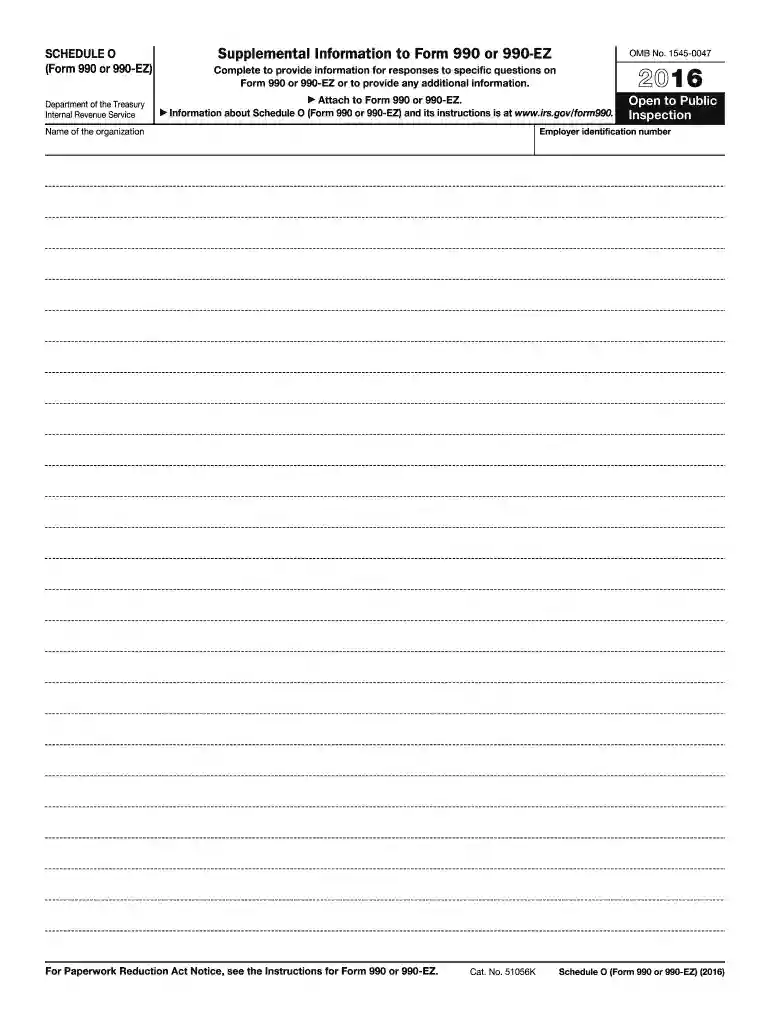
Schedule O (Form 990) is a crucial component filed alongside IRS Form 990, used by tax-exempt organizations. It allows these entities to provide additional narrative information to explain their operations and responses to certain questions. This filing ensures transparency, helping organizations comply with the IRS's financial reporting, governance, and program services requirements. Its inclusion is mandatory for detailed explanations, further ensuring adherence to the objectives of tax code compliance.
Using Schedule O on DocHub can significantly streamline the filing process. DocHub provides tools for editing, signing, and sharing documents in PDF and other formats, ensuring that you complete the form with ease.
Import the Form: Upload Schedule O directly from your computer or cloud storage like Google Drive or Dropbox.
Edit and Annotate: Use DocHub’s editing tools to fill out the form. Add text, images, or annotations to provide the necessary information required by the IRS.
Signature Application: Apply legally binding electronic signatures using DocHub's intuitive options, ensuring compliance with the ESIGN Act.
Sharing and Collaboration: Collaborate with stakeholders by sharing the document directly through DocHub. Track changes and keep everyone updated with real-time synchronization.
Completing Schedule O requires attention to detail to ensure compliance:
Gather Information: Collect all relevant organizational details required to complete the form, such as financial statements and governance procedures.
Draft Responses: Use concise and clear language to answer questions that need further explanation. Each response should align with how the organization is described in other parts of Form 990.
Review IRS Guidelines: Familiarize yourself with any specific IRS instructions for Schedule O to ensure your explanations cover required elements.
Finalize and Review: Double-check all entries for accuracy. Any inconsistencies might lead to further inquiries from the IRS.
Submit: Once finalized, submit the form through your preferred method—online via the IRS portal if available, or via mail where applicable.
Schedule O primarily includes:
Filing Schedule O is essential for:
This form is primarily used by:
Real-world application of Schedule O includes:
Understanding IRS guidelines regarding Schedule O is vital:
We've got more versions of the 990ez 2016 form. Select the right 990ez 2016 version from the list and start editing it straight away!
| Versions | Form popularity | Fillable & printable |
|---|---|---|
| 2024 | 4.9 Satisfied (27 Votes) | |
| 2023 | 4.2 Satisfied (52 Votes) | |
| 2022 | 4.7 Satisfied (40 Votes) | |
| 2021 | 4.8 Satisfied (196 Votes) | |
| 2020 | 4.2 Satisfied (46 Votes) | |
| 2019 | 4.4 Satisfied (84 Votes) | |
| 2018 | 4.4 Satisfied (239 Votes) | |
| 2017 | 4.4 Satisfied (204 Votes) | |
| 2016 | 4.4 Satisfied (331 Votes) | |
| 2015 | 4 Satisfied (42 Votes) | |
| 2014 | 4 Satisfied (50 Votes) | |
| 2013 | 4.4 Satisfied (38 Votes) | |
| 2012 | 4 Satisfied (26 Votes) | |
| 2011 | 4 Satisfied (28 Votes) | |
| 2010 | 4 Satisfied (60 Votes) |
At DocHub, your data security is our priority. We follow HIPAA, SOC2, GDPR, and other standards, so you can work on your documents with confidence.


