
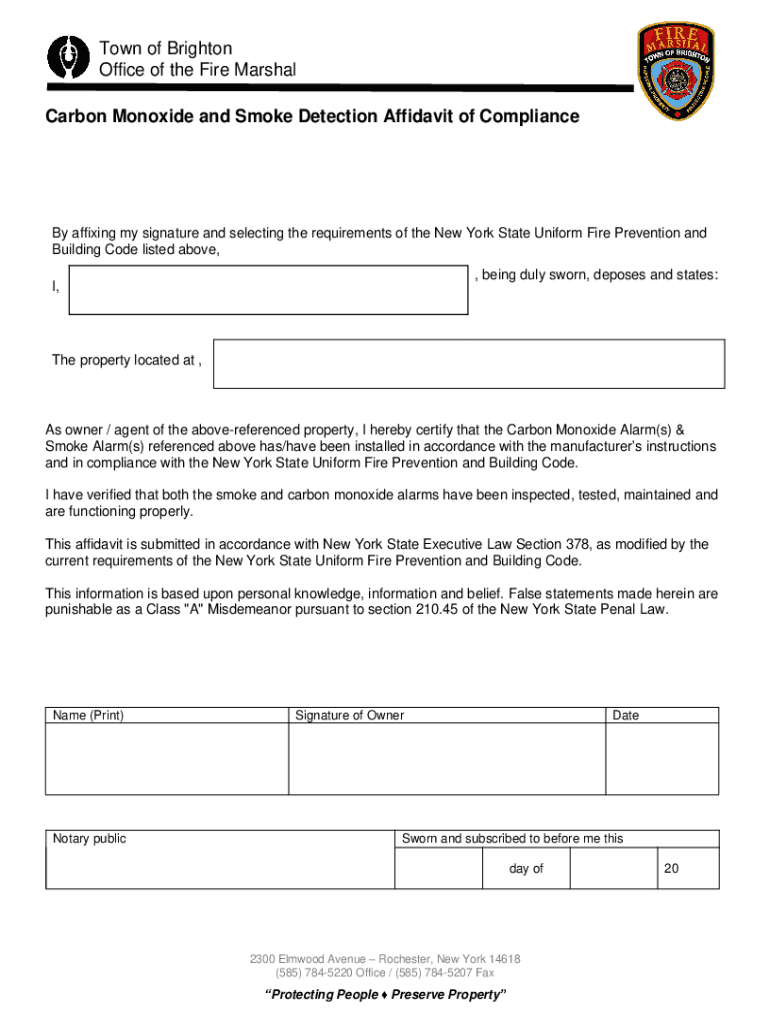





Smoke Detector bAffidavitb - Brighton - townofbrighton 2026

Get Form
Smoke Detector bAffidavitb - Brighton - townofbrighton Preview on Page 1

Here's how it works

01. Edit your form online
Type text, add images, blackout confidential details, add comments, highlights and more.
02. Sign it in a few clicks
Draw your signature, type it, upload its image, or use your mobile device as a signature pad.
03. Share your form with others
Send it via email, link, or fax. You can also download it, export it or print it out.

How to use or fill out Smoke Detector Affidavit - Brighton - townofbrighton

Form edit decoration
9.5
Ease of Setup
DocHub User Ratings on G2
9.0
Ease of Use
DocHub User Ratings on G2
  1. Click ‘Get Form’ to open it in the editor.
  2. Begin by entering your name and the property address in the designated fields. Ensure accuracy as this information is crucial for compliance.
  3. In the section regarding smoke alarms, confirm that smoke detectors are installed in all required locations. Check each box that applies based on your dwelling's layout.
  4. Next, move to the carbon monoxide detector section. Answer the checklist questions regarding potential carbon monoxide sources in your unit.
  5. Finally, review all entries for correctness. Once satisfied, sign and date the affidavit at the bottom of the form. This step certifies your compliance with New York State regulations.

Start using our platform today to complete your Smoke Detector Affidavit quickly and efficiently!

be ready to get more

Complete this form in 5 minutes or less

Get form

Got questions?

We have answers to the most popular questions from our customers. If you can't find an answer to your question, please contact us.
Contact us

Electronic signatures are an excellent replacement for traditional signing, as they save time, effort, and money people spend on printing, scanning, and paper delivery. You can eSign your Smoke Detector bAffidavitb - Brighton - townofbrighton using a reliable and robust online document processing services like DocHub. It complies with main eSignature regulations (ESIGN and UETA), so all forms approved there are legally binding and have the same validity as manually signed ones.

If you are searching for a state-specific Smoke Detector bAffidavitb - Brighton - townofbrighton sample, you can find it in our DocHub Forms & Templates catalog. Use the search field, key in your form’s name, and search through the results for your state. You can also filter out irrelevant results while exploring our catalog by categories.

Smoke alarms are to be installed in all residential dwellings (single family homes, multi-family homes, hotels, rental properties, dormitories, etc.). Smoke alarms in newly constructed or renovated dwellings are required to be hardwired with a battery back-up, interconnected, and UL-listed. NFPA 720 (2015 ed.).
New battery-powered combination smoke and CO alarms must have a 10-year, sealed, non-replaceable battery. Wireless smoke alarms or networked smoke alarms with photoelectric sensing technology can have a replaceable battery as long as the battery lasts for at least one year.
Smoke alarms should be on every level of the home, outside sleeping areas and inside each bedroom. CO alarms should be installed on each level of the home and outside sleeping areas. CO alarms should not be installed in attics or basements unless they include a sleeping area.

Security and compliance

At DocHub, your data security is our priority. We follow HIPAA, SOC2, GDPR, and other standards, so you can work on your documents with confidence.

Learn more
ccpa2
pci-dss
gdpr-compliance
hipaa
soc-compliance
be ready to get more

Complete this form in 5 minutes or less

Get form

People also ask

Every Home Needs Working Smoke Carbon Monoxide Alarms Every home should have working smoke and CO alarms. You must have a certificate of compliance that shows your smoke and CO alarms meet certain standards when you sell or transfer a home.
Minimum Smoke Detector Requirements The new regulation requires all owners of a residential building to either photoelectric or combination detectors (which is both photoelectric and ionization). Additionally, any ionization detectors must be placed a minimum of 20 feet away from a kitchen or bathroom.
For many years NFPA 72, National Fire Alarm and Signaling Code, has required as a minimum that smoke alarms be installed inside every sleep room (even for existing homes) in addition to requiring them outside each sleeping area and on every level of the home.

Related links

