Naukeag community referral 2026

Get Form
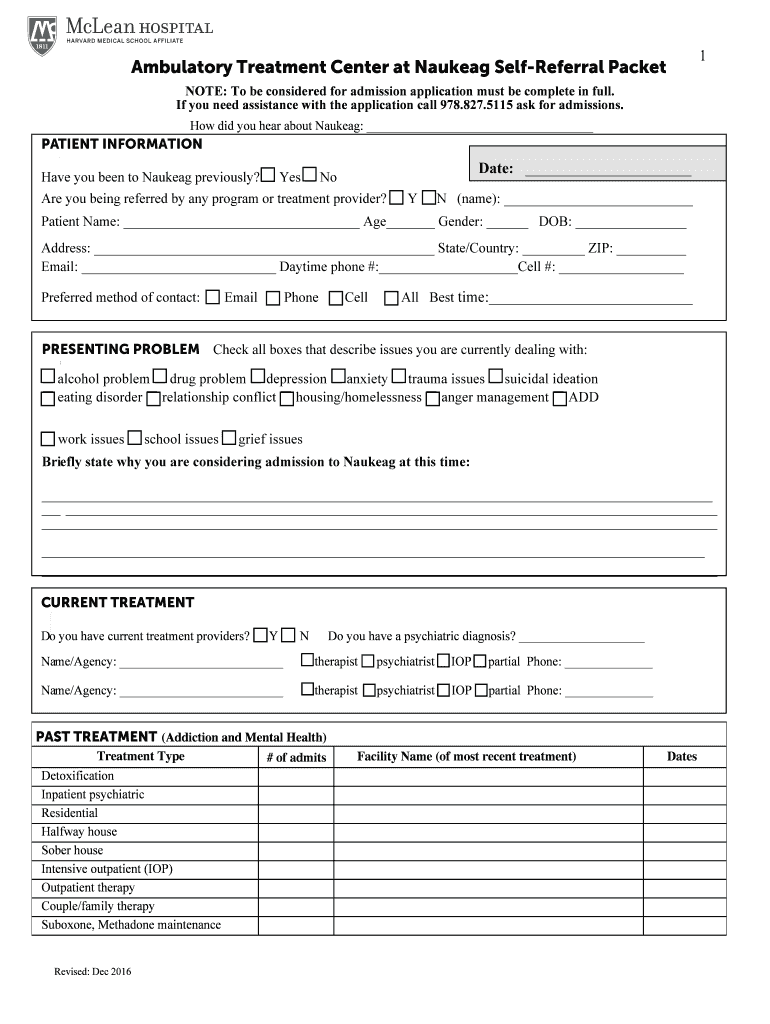
naukeag community referral Preview on Page 1

Here's how it works

01. Edit your form online
Type text, add images, blackout confidential details, add comments, highlights and more.
02. Sign it in a few clicks
Draw your signature, type it, upload its image, or use your mobile device as a signature pad.
03. Share your form with others
Send it via email, link, or fax. You can also download it, export it or print it out.

How to use or fill out naukeag community referral with our platform

Form edit decoration
9.5
Ease of Setup
DocHub User Ratings on G2
9.0
Ease of Use
DocHub User Ratings on G2
  1. Click ‘Get Form’ to open the naukeag community referral in the editor.
  2. Begin by filling out the 'Patient Information' section. Enter the date, your name, age, gender, and date of birth. Provide your address, email, and phone numbers. Select your preferred method of contact.
  3. In the 'Presenting Problem' section, check all boxes that apply to your current issues and briefly explain why you are considering admission.
  4. Complete the 'Current Treatment' section by indicating if you have treatment providers and listing any psychiatric diagnoses along with their contact information.
  5. Fill out the 'Drug Use History' by detailing your primary and secondary drug use, including frequency and last use dates.
  6. Provide medical information such as your last physical date and current medications in the respective sections.
  7. Address any risk factors or legal issues as applicable before moving on to aftercare plans for housing and treatment options.

Start using our platform today to complete your naukeag community referral form easily and for free!

be ready to get more

Complete this form in 5 minutes or less

Get form

Got questions?

We have answers to the most popular questions from our customers. If you can't find an answer to your question, please contact us.
Contact us
Typically, a referral is required when your primary care physician or another medical professional believes that psychological care is necessary to address your mental health concerns.
Talk with your health care provider or see a mental health provider, such as a doctor who specializes in addiction medicine or addiction psychiatry, or a licensed alcohol and drug counselor. Make an appointment to see a provider if: You cant stop using a drug. You continue using the drug despite the harm it causes. Drug addiction (substance use disorder) - Symptoms and causes Mayo Clinic syc-20365112 Mayo Clinic syc-20365112
Primary care provider: A primary care provider can perform an initial mental health screening and refer you to a mental health professional (such as a social worker, psychologist, or psychiatrist). Help for Mental Illnesses - National Institute of Mental Health (NIMH) National Institute of Mental Health - National Institutes of Health | health find-help National Institute of Mental Health - National Institutes of Health | health find-help
Treatment in a rehab program aims to help someone quit using substances and remain in long-term recovery. Common treatment methods in rehab include behavioral therapy, medications for substance use disorder, peer support, and more. Drug Alcohol Rehab Guides for Addiction Mental Health American Addiction Centers rehab-guide American Addiction Centers rehab-guide
The National Helpline1-800-662-HELP (4357)provides 24-hour free and confidential treatment referral and information about mental and/or substance use disorders, prevention, and recovery in English and Spanish. Frequently Asked Questions - SAMHSA SAMHSA about faqs SAMHSA about faqs

Security and compliance

At DocHub, your data security is our priority. We follow HIPAA, SOC2, GDPR, and other standards, so you can work on your documents with confidence.

Learn more
ccpa2
pci-dss
gdpr-compliance
hipaa
soc-compliance

People also ask

If you feel someone is at serious, immediate risk and will not approach anyone for help, you can contact their local social services, who can decide to arrange an assessment (you can usually find the number for social services on the local councils website).
In that case, take your loved one to the hospital, contact the Suicide Crisis Lifeline at 988, or call 911. Depending on where you live, you may be able to contact a mobile crisis team for help. These teams have training in how to intervene in a mental health emergency.

Related links