
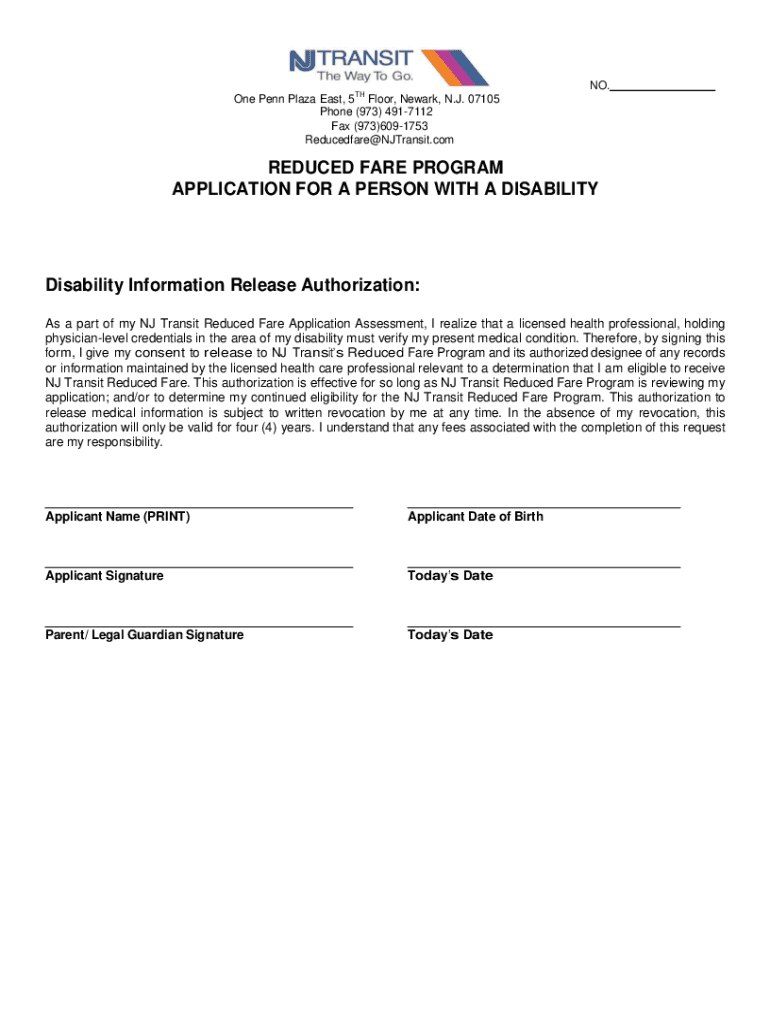







Definition and Meaning of Fare Application Disability
The "fare application disability" typically refers to the process and documentation required for individuals with disabilities to apply for reduced transportation fares. Such applications are crucial for ensuring that eligible individuals can access affordable public transport. The term encompasses both the formal application procedure and the documentation needed as part of this process. This program is integral in promoting transportation equity among disabled individuals, empowering them to travel independently at a lower cost.
How to Use the Fare Application Disability
Using the fare application involves a series of steps designed to verify the eligibility of the applicant and streamline the provision of discounted fares. Applicants must first gather the required information and documents:
- Proof of disability, such as a certification from a healthcare provider.
- Personal identification documents like a state-issued ID or driver's license.
- A completed application form specific to the public transportation provider.
Once collected, these documents are submitted to the provider's customer service or online portal, depending on their preferred method of application submission.
How to Obtain the Fare Application Disability
Obtaining the fare application typically involves accessing it from the transportation provider's website or customer service office. For instance, many transit authorities in the U.S. allow users to download the application form directly from their websites. Alternatively, physical copies can be obtained at designated customer service centers. Some providers may also offer phone or mail options to request an application form. It's crucial to follow specific instructions, as failure to submit complete forms will delay processing.
Steps to Complete the Fare Application Disability
Completing this application requires careful attention to detail:
- Download or retrieve the application form: Acquire the form from the relevant public transport authority's website or office.
- Fill out personal information: Include full name, contact details, and identification number.
- Attach documentation: Provide proof of disability certified by a physician or relevant healthcare professional.
- Include a photograph: A passport-sized photo may be required for identification purposes.
- Submit the application: Follow submission instructions precisely—either online, by mail, or in person—to avoid processing delays.
- Wait for a decision: The provider will review the application and communicate the outcome.
Eligibility Criteria for Fare Application Disability
Eligibility for fare application disability is generally determined based on the applicant’s physical or mental condition. Criteria often include:
- Permanent disabilities that limit mobility.
- Specific chronic medical conditions as mentioned by the health authorities.
- Temporary disabilities resulting due to injury might be eligible but require timely reevaluation.
Proof of these conditions is generally verified by a certification from a qualified healthcare provider and might need renewal annually or bi-annually to maintain eligibility.


Legal Use of the Fare Application Disability
The fare application disability serves as a legal document providing proof of eligibility for reduced fares under respective laws that govern transportation equity and accessibility. Misuse, such as falsifying information to avail discounts unjustly, can lead to penalties or revocation of the reduced fare privilege. It is vital to adhere to the guidelines provided by the local transit authority to avoid any legal issues.
Key Elements of the Fare Application Disability
Key elements of the fare application disability form include:
- Identifying Information: Applicant’s name, contact details, and identification number.
- Medical Certification: Documentation or certification from a healthcare provider confirming the disability.
- Signature: Applicant's and sometimes physician's signatures are required to validate the application.
- Supporting Documents: Any additional documentation requested by the authority to verify identity and need.
Understanding these key elements ensures that applicants complete the form correctly, avoiding processing delays or rejections.
Examples of Using the Fare Application Disability
To illustrate, consider:
- Scenario 1: A visually impaired individual in New York applies for the Metrocard reduced fare program. They submit a certification from their optometrist along with a completed application to the Metropolitan Transportation Authority.
- Scenario 2: A person recovering from surgery uses their temporary disabled identification to apply for reduced fare in San Francisco’s BART, applying in person for verification. These are practical applications that showcase how different situations necessitate the use of fare application disability forms in varying geographical locations.
Application Process and Approval Time
The application process can vary depending on the transportation authority but generally involves submission and review stages. After submitting the complete application with all necessary documents, the approval can take anywhere from two weeks to two months. Applicants will usually receive a notification regarding the status of their application and, upon approval, they might receive a card or documentation to present when purchasing tickets or passes.




