




01. Edit your cg2503 online
Type text, add images, blackout confidential details, add comments, highlights and more.

Type text, add images, blackout confidential details, add comments, highlights and more.

Draw your signature, type it, upload its image, or use your mobile device as a signature pad.

Send per location aggregate endorsement form via email, link, or fax. You can also download it, export it or print it out.
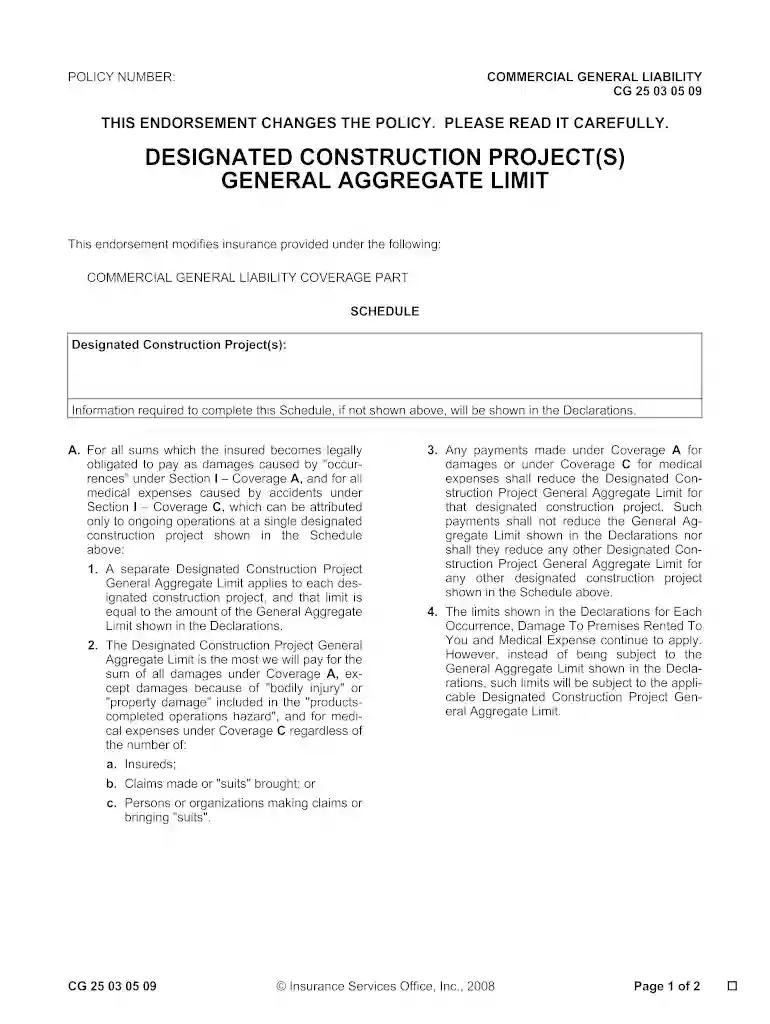
The CG2503 form, also known as the Per Project Aggregate Endorsement, is a critical document in the realm of construction and general liability insurance. It specifically addresses the coverage limits applicable to individual construction projects and outlines the specific conditions under which claims may be made. This form is particularly important for contractors or businesses involved in multiple construction projects, as it delineates how general liability coverage applies per project rather than a blanket aggregate limit.
Separate Aggregate Limits: Each project covered under the CG2503 has its own specific aggregate limit. This means that if a claim is made on one project, the limit on that project is reduced without impacting the overall limits on other projects.
Coverage for Ongoing Operations: The form clearly states that it covers damages and medical expenses incurred during ongoing operations at covered construction projects. This provision is essential for maintaining project continuity and mitigating financial risks.
Products-Completed Operations: The CG2503 form addresses coverage implications related to products-completed operations, ensuring that contractors are protected from claims arising after project completion, potentially safeguarding against future liabilities.
The use of the CG2503 form introduces a layer of specificity that is critical for risk management in construction:
When utilizing the CG2503 form, specific information must be provided to ensure its effectiveness:
Project Information: Each project must be accurately detailed, including project name, location, and description. This information allows insurers to assess risk appropriately and adjust limits as necessary.
Policy Number: The endorsement must reference the associated policy number to maintain accurate records and ensure that claims are processed under the correct insurance coverage.
Duration of Coverage: Specifying the effective dates of coverage is vital, especially for projects that may span multiple years or involve lengthy completion timelines.
Using the CG2503 form appropriately is essential for legal compliance in the U.S. insurance landscape:
ESIGN Act Compliance: The electronic versions of the CG2503 must be compliant with the ESIGN Act, ensuring that electronic signatures and filings are legally recognized.
State-Specific Regulations: Variations in the implementation of the CG2503 may exist depending on state regulations. It's crucial for users to be aware of any local laws that may influence how the CG2503 is used or interpreted.
Real-world scenarios can illustrate the practical implications of using the CG2503:
Multiple Concurrent Projects for a Contractor: Imagine a contractor managing three projects simultaneously. By applying the CG2503 form, they can ensure that if an incident occurs on one project, it does not deplete the aggregate limit available for the other two projects.
Claims Investigation Process: If a claim arises from a project covered under the CG2503, the process involves notifying the insurer with the relevant project information to initiate the investigation and potentially honor the claim based on the specific project limit.
The CG2503 form plays an essential role in navigating the complexities of general liability insurance in the construction industry. By leveraging this endorsement, businesses can tailor their coverage to fit individual project needs, manage risks more effectively, and ensure compliance with legal standards.
At DocHub, your data security is our priority. We follow HIPAA, SOC2, GDPR, and other standards, so you can work on your documents with confidence.
CG 25 03 03 97. Copyright, Insurance Services Office, Inc., 1996. Figure 1030.1. DESIGNATED CONSTRUCTION PROJECT(S) GENERAL AGGREGATE LIMIT. 57. POLICY NUMBERRead more
A. For all sums which the insured becomes legally obligated to pay as damages caused by occur- rences under Section I Coverage A, and for all.Read more


