




01. Edit your 2010 w2 online
Type text, add images, blackout confidential details, add comments, highlights and more.

Type text, add images, blackout confidential details, add comments, highlights and more.

Draw your signature, type it, upload its image, or use your mobile device as a signature pad.

Send 2010 w2 form via email, link, or fax. You can also download it, export it or print it out.
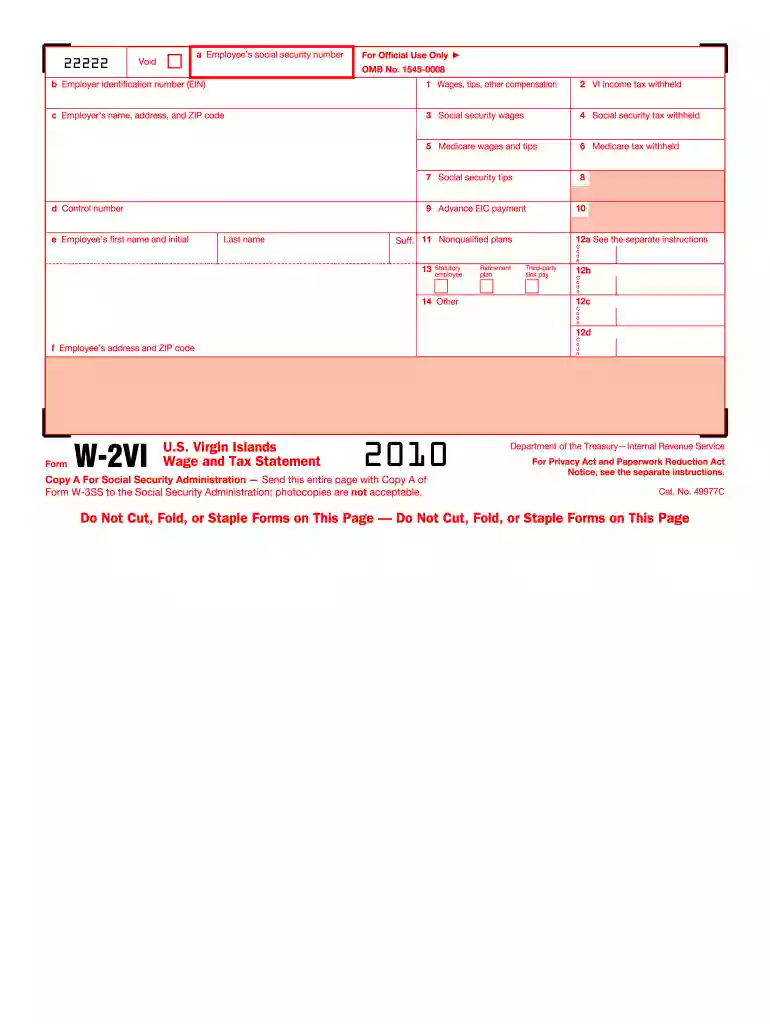
The 2010 W-2 template form serves as a critical document used by employers in the United States to report an employee’s annual wages and the amount of taxes withheld from them. Officially known as the Wage and Tax Statement, the W-2 form is a crucial component of tax reporting and administration. Employees rely on this form to file their federal and state income tax returns.
Each W-2 form contains detailed information, such as the employer's identification and contact details, the employee's Social Security number, and all pertinent income details. This form ensures that the Internal Revenue Service (IRS) receives consistent data about each taxpayer, thus maintaining the integrity of the tax system.
A comprehensive understanding of the key elements within the 2010 W-2 template form is essential for accurate completion. Some of the primary components include:
Gathering all relevant financial data and understanding where it fits on the form streamlines the filing process and reduces the chances of errors or omissions.
Completing the 2010 W-2 template form involves several structured steps to ensure accuracy:
Crafting a detailed step-by-step guide enhances the clarity and efficiency of completing the W-2 form.
When preparing to complete the 2010 W-2 form, having the correct documents on hand is essential:
Being well-prepared with these documents ensures a more seamless and accurate completion process.
Understanding the legal implications of W-2 filing is pivotal. Employers are legally obligated to provide a W-2 form to any employee who receives a salary, wages, or other types of remuneration. The W-2 form fulfills tax liability requirements, acting as a formal statement of income and taxes for both employees and the IRS.
Failure to issue or accurately report W-2 forms can lead to significant penalties. Hence, ensuring strict adherence to legal requirements protects both employers and employees from legal complications.
Timeliness is important when dealing with W-2 forms. Employers must provide completed W-2 forms to employees by January 31st of the following year. Moreover, they must file these forms with the Social Security Administration (SSA) by the same deadline.
Late submissions can lead to penalties. Therefore, maintaining awareness of these important dates is crucial for compliance and avoiding fines.
Non-compliance with W-2 form submissions can result in penalties. Based on the nature and duration of the delay, fines can apply ranging from tens to thousands of dollars per form. Common reasons for fines include late submissions, incorrect information, and failure to submit.
Understanding these penalties motivates timely and accurate W-2 form submissions. Ensuring compliance safeguards the employer from potential legal and financial repercussions.
The IRS provides clear guidelines on filing the W-2 form. Understanding these guidelines not only ensures compliance but also aids in preventing common filing mistakes. According to the IRS, accurate reporting of earnings and withholdings is necessary, and any corrections should be promptly communicated through a W-2c form.
These guidelines are an indispensable resource, helping both employers and employees navigate the complexities of tax documentation effectively.
The submission of the 2010 W-2 form can be accomplished through various methods:
Each submission method has its benefits and drawbacks. Online submission is generally the most efficient, while mailing and in-person drop-offs offer more direct oversight.
We've got more versions of the 2010 w2 form. Select the right 2010 w2 version from the list and start editing it straight away!
| Versions | Form popularity | Fillable & printable |
|---|---|---|
| 2025 | 4.8 Satisfied (41 Votes) | |
| 2024 | 4.2 Satisfied (57 Votes) | |
| 2023 | 4.7 Satisfied (33 Votes) | |
| 2022 | 4.4 Satisfied (58 Votes) | |
| 2021 | 4.8 Satisfied (128 Votes) | |
| 2020 | 4.4 Satisfied (279 Votes) | |
| 2019 | 4.4 Satisfied (84 Votes) | |
| 2018 | 4.4 Satisfied (156 Votes) | |
| 2017 | 4.1 Satisfied (84 Votes) | |
| 2016 | 4.3 Satisfied (70 Votes) | |
| 2015 | 4.2 Satisfied (73 Votes) | |
| 2014 | 4 Satisfied (46 Votes) | |
| 2013 | 4 Satisfied (27 Votes) | |
| 2012 | 4.4 Satisfied (50 Votes) | |
| 2011 | 4 Satisfied (34 Votes) |
Electronic signatures are a great alternative to traditional signing, as they save time, effort, and costs people spend on printing, scanning, and paper delivery. You can electronically sign your w2 form 2010 using a reliable and robust online document management tool like DocHub. It complies with primary eSignature regulations (ESIGN and UETA), so all documents approved there are legally binding and have the same validity as manually signed ones.
As a comprehensive document editing service, DocHub is available on mobile phones. Open DocHub in your choice of mobile browser and use our intelligent mobile-friendly toolset to complete your 2010 w2 template form.
At DocHub, your data security is our priority. We follow HIPAA, SOC2, GDPR, and other standards, so you can work on your documents with confidence.
Convenient Access W-2s online anytime, going back to 2010. ?️ Printable Download and print a PDF copy if needed. How to Enroll in Electronic W-2 Delivery.Read more
Aug 7, 2025 Find IRS forms, instructions, publications, and notices for prior years back to 1864. If a PDF file wont open, try downloading the file to your device.Read more
May 2, 2017 Do not use these forms to report wages subject to U.S. income tax withholding. Instead, use Form W-2 to show U.S. income tax withheld. TreatmentRead more


