




01. Edit your form w 2vi online
Type text, add images, blackout confidential details, add comments, highlights and more.

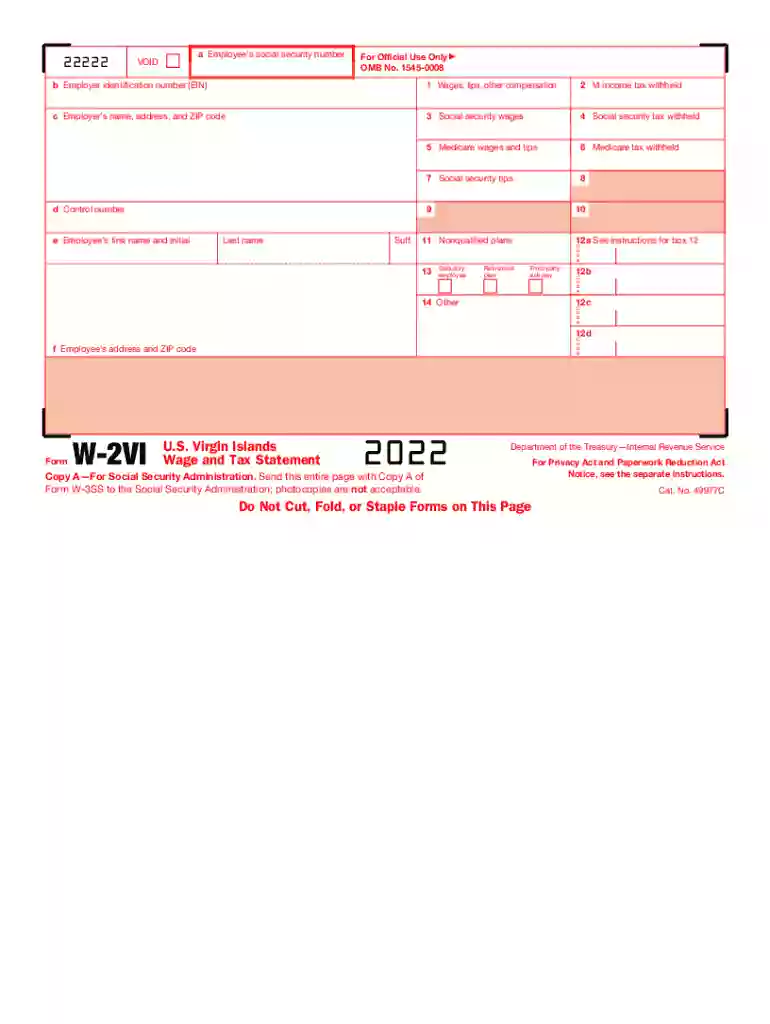
Type text, add images, blackout confidential details, add comments, highlights and more.

Draw your signature, type it, upload its image, or use your mobile device as a signature pad.

Send omb 1545 0008 via email, link, or fax. You can also download it, export it or print it out.
The W-2 form, also known as the Wage and Tax Statement, is important for taxpayers in the United States. It details the wages paid to employees and the taxes withheld by employers. The W-3 form, or Transmittal of Wage and Tax Statements, is a summary of all W-2 forms submitted by an employer to the Social Security Administration. These documents ensure that both the IRS and employees have accurate records of earnings and taxes paid.
Filing W-2 and W-3 forms electronically offers several advantages, such as faster processing times and reduced errors. The Social Security Administration's Business Services Online (BSO) provides a secure platform for electronic submission. Employers can submit these forms directly without needing to mail paper copies. This efficiency is particularly beneficial as it reduces administrative tasks and allows quicker corrections if necessary.
Steps to Complete the Process require attention to detail, ensuring all employee details and tax information conform to SSA standards, minimizing the risk of rejections or penalties.
Employers must distribute W-2 forms to employees by January 31 each year. The deadline aligns with tax season, ensuring that employees have sufficient time to prepare their returns. It’s also critical for employers to submit the W-2 and W-3 forms to the SSA by this date to avoid penalties and compliance issues.
Primarily, the forms are used by employers and employees. Employers issue these forms to report annual wages and taxes withheld to employees and the SSA. Employees use the W-2 form data to complete their personal tax returns. These forms are essential for maintaining transparency in earnings and withholding across all employment sectors.
The IRS provides detailed instructions for completing W-2 and W-3 forms, ensuring correct data entry and compliance. Following these guidelines minimizes errors and supports smooth submission and processing. They include specifics about coding different types of compensation and tax withholdings.
Non-compliance, such as failing to issue W-2s by the deadline or submitting incorrect information, can lead to significant penalties. These penalties increase with the delay and volume of late or incorrect submissions. Avoiding penalties requires timely submission and accuracy, underscoring the importance of careful preparation and record-keeping.
Electronic submissions provide greater efficiency and accuracy compared to paper submissions. They allow for quicker processing and error checking, and facilitate the easy correction of errors. However, some small businesses may still use paper submissions due to limited digital capabilities.
Completing these forms requires precise employee data, such as Social Security numbers, total earnings, and withholding amounts. Employers must ensure all information is current and accurate to avoid discrepancies that could affect the employee's tax filings or result in SSA inquiries.
We've got more versions of the form w 2vi form. Select the right form w 2vi version from the list and start editing it straight away!
| Versions | Form popularity | Fillable & printable |
|---|---|---|
| 2025 | 4.8 Satisfied (41 Votes) | |
| 2024 | 4.2 Satisfied (57 Votes) | |
| 2023 | 4.7 Satisfied (33 Votes) | |
| 2022 | 4.4 Satisfied (58 Votes) | |
| 2021 | 4.8 Satisfied (128 Votes) | |
| 2020 | 4.4 Satisfied (279 Votes) | |
| 2019 | 4.4 Satisfied (84 Votes) | |
| 2018 | 4.4 Satisfied (156 Votes) | |
| 2017 | 4.1 Satisfied (84 Votes) | |
| 2016 | 4.3 Satisfied (70 Votes) | |
| 2015 | 4.2 Satisfied (73 Votes) | |
| 2014 | 4 Satisfied (46 Votes) | |
| 2013 | 4 Satisfied (27 Votes) | |
| 2012 | 4.4 Satisfied (50 Votes) | |
| 2011 | 4 Satisfied (34 Votes) |
Upload your vibir to DocHub (after you’ve set up an account for this). If you need to complete fields in it, use proper tools from the upper pane. For instance, add Signature Fields, assign each to specific party, and click on Sign → Request signatures from others. Change your message for your recipients and click Send Request. You can also send your paperwork by fax or as a Signing link instead of using email (you’ll find these options by navigating to the Menu → Send)
If you need to edit your omb 1545 0008 form online swiftly, it does not matter what web browser you employ. DocHub’s simple editing instruments are accessible using any internet browser. Simply open the appropriate tab within our editor, add your file, and fill it out without stress.
At DocHub, your data security is our priority. We follow HIPAA, SOC2, GDPR, and other standards, so you can work on your documents with confidence.
W SERIES. WET II. Premium Quality All-Weather/All-Purpose. Installation Loudspeakers. Weather Environmental Technology. Operation and Installation Manual
Attention: You may file Forms W-2 and W-3 electronically on the SSAs Employer W-2 Filing Instructions and Information web page, which is also accessible.
by WS NEW Note: You may owe a penalty for each Form W-2 that you file late. file a paper Form W-3/ W-2 in addition to my electronic file upload?


