




01. Edit your form online
Type text, add images, blackout confidential details, add comments, highlights and more.

Type text, add images, blackout confidential details, add comments, highlights and more.

Draw your signature, type it, upload its image, or use your mobile device as a signature pad.

Send it via email, link, or fax. You can also download it, export it or print it out.
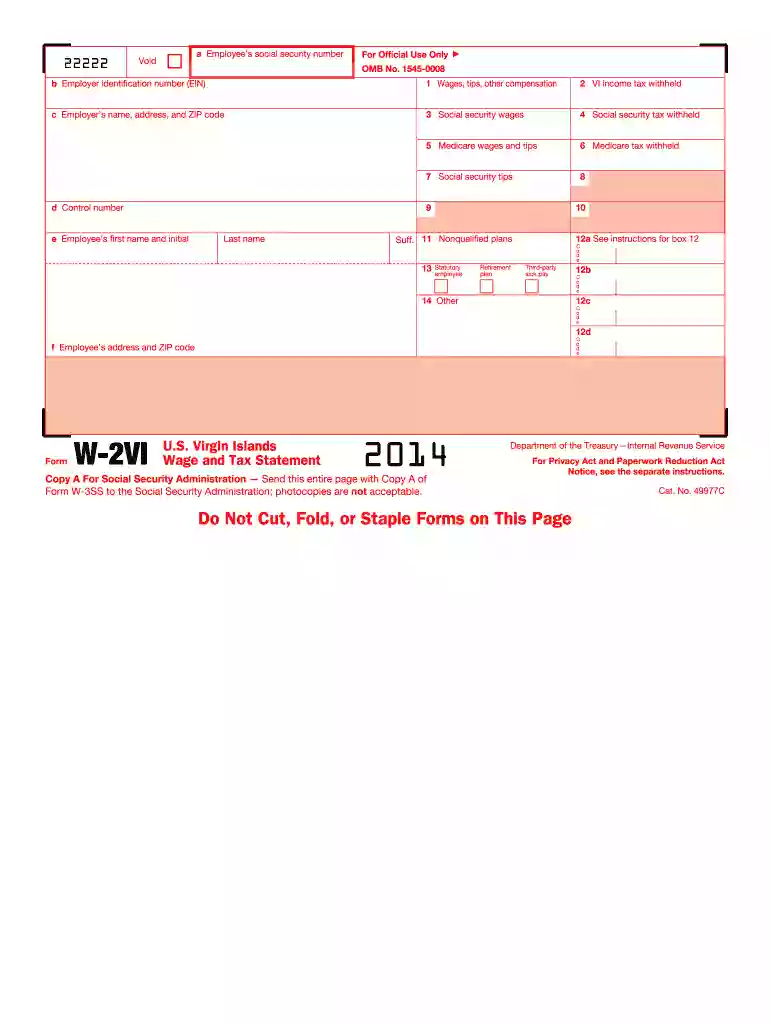
The 2014 W-2VI form, officially known as the Wage and Tax Statement for employers and employees in the U.S. Virgin Islands, is a vital document used for tax reporting purposes. This form serves employers by detailing the wages paid to employees and the taxes withheld over the course of the year. Employees receive this form to report their wages and withheld taxes when filing individual tax returns. The 2014 version of the form maintains consistent formatting to ensure clarity and ease of use, aligning with IRS standards for wage reporting in territories outside the mainland U.S.
Employers and employees should use the 2014 W-2VI form to accurately report wage-related tax information. Employers utilize the form to convey each employee’s total wages, tips, and other applicable compensation earned over the year, alongside withheld federal income tax, Social Security tax, and any other applicable taxes.
Employees should review this information upon receipt to ensure its accuracy before using it to file their individual tax returns. Correct and timely use of this form ensures compliance with IRS reporting requirements, helping to prevent audits and penalties.
Employers need to order official copies of the 2014 W-2VI form through authorized IRS channels to ensure they meet submission standards. It's essential for employers to use the correct form version for wage reporting to the Social Security Administration (SSA) and for dispersing copies to their employees.
Meanwhile, employees receive their copies directly from their employers, who are responsible for distributing them by the end of January following the tax year.
The 2014 W-2VI form is legally requisite for wage reporting in the U.S. Virgin Islands. Employers are required by law to furnish accurate forms to their employees and file copies with the SSA by the designated deadline. Adhering to these requirements ensures legal compliance and aids in the prevention of penalties or audits by the IRS. Employers should understand that filing incorrect information could lead to financial penalties and complicate employees' tax filing processes.
Failure to file, late submission, or incorrect information on the 2014 W-2VI form can result in substantial penalties. Employers may face fines depending on the severity of non-compliance and the time taken to correct or submit the necessary forms. Ensuring timely and accurate filing is critical to avoid these penalties, which increase the longer the lapse remains uncorrected.
Following IRS guidelines for the 2014 W-2VI form is essential for compliance. This includes maintaining up-to-date records of employee earnings and withholdings, verifying all details before submission, and understanding territory-specific requirements. Abiding by these guidelines ensures the legitimacy and accuracy of wage reporting in compliance with federal tax laws.
Employers must provide employees with their respective W-2VI forms by January 31 of the year following the earning year. The deadline for submitting forms to the SSA is typically the same date, though exceptions may apply if the date falls on a weekend or public holiday. Familiarity with these deadlines is critical for employers to remain compliant and for employees to file timely tax returns.
Employers can choose between electronic filing and traditional mail for submitting the 2014 W-2VI form. Electronic filing is recommended for its efficiency and reduces the risk of errors. It also expedites processing times. However, smaller businesses may still opt for paper submissions. Each method has specific requirements dictated by the IRS to ensure forms are processed accurately.
We've got more versions of the 2014 w2vi form form. Select the right 2014 w2vi form version from the list and start editing it straight away!
| Versions | Form popularity | Fillable & printable |
|---|---|---|
| 2025 | 4.8 Satisfied (41 Votes) | |
| 2024 | 4.2 Satisfied (57 Votes) | |
| 2023 | 4.7 Satisfied (33 Votes) | |
| 2022 | 4.4 Satisfied (58 Votes) | |
| 2021 | 4.8 Satisfied (128 Votes) | |
| 2020 | 4.4 Satisfied (279 Votes) | |
| 2019 | 4.4 Satisfied (84 Votes) | |
| 2018 | 4.4 Satisfied (156 Votes) | |
| 2017 | 4.1 Satisfied (84 Votes) | |
| 2016 | 4.3 Satisfied (70 Votes) | |
| 2015 | 4.2 Satisfied (73 Votes) | |
| 2014 | 4 Satisfied (46 Votes) | |
| 2013 | 4 Satisfied (27 Votes) | |
| 2012 | 4.4 Satisfied (50 Votes) | |
| 2011 | 4 Satisfied (34 Votes) |
You need to use only trustworthy software solutions with strong security compliance to approve your paperwork electronically. DocHub is just the type of service you need! It stores data on Amazon Web Servers and complies with all required security standards and eSignature laws, so it’s a reliable way to eSign your 2014 w2vi form or other forms with this tool.
You need only a web connection and a browser to complete your 2014 w2vi form by using an iOS phone. Open the DocHub website and authenticate. Then, add your document or select it from the list in your dashboard. Then use our editing instruments to complete your form and preserve all your modifications. You may also send it to a specified recipient straight away.
At DocHub, your data security is our priority. We follow HIPAA, SOC2, GDPR, and other standards, so you can work on your documents with confidence.
Keep Copy C of Form W-2VI for at least 3 years after the due date for filing your income tax return. However, to help protect your social security benefits,Read more
May 2, 2017 Forms W-2AS, W-2CM, W-2GU, and W-2VI). You must notify employees who have no income tax withheld that they may be able to claim an income taxRead more


