Protein synthesis worksheet 2025

Get Form
protein synthesis worksheet pdf Preview on Page 1

Here's how it works

01. Edit your protein synthesis worksheet pdf online
Type text, add images, blackout confidential details, add comments, highlights and more.
02. Sign it in a few clicks
Draw your signature, type it, upload its image, or use your mobile device as a signature pad.
03. Share your form with others
Send protein synthesis worksheet via email, link, or fax. You can also download it, export it or print it out.

How to use or fill out protein synthesis worksheet with our platform

Form edit decoration
9.5
Ease of Setup
DocHub User Ratings on G2
9.0
Ease of Use
DocHub User Ratings on G2
  1. Click ‘Get Form’ to open the protein synthesis worksheet in the editor.
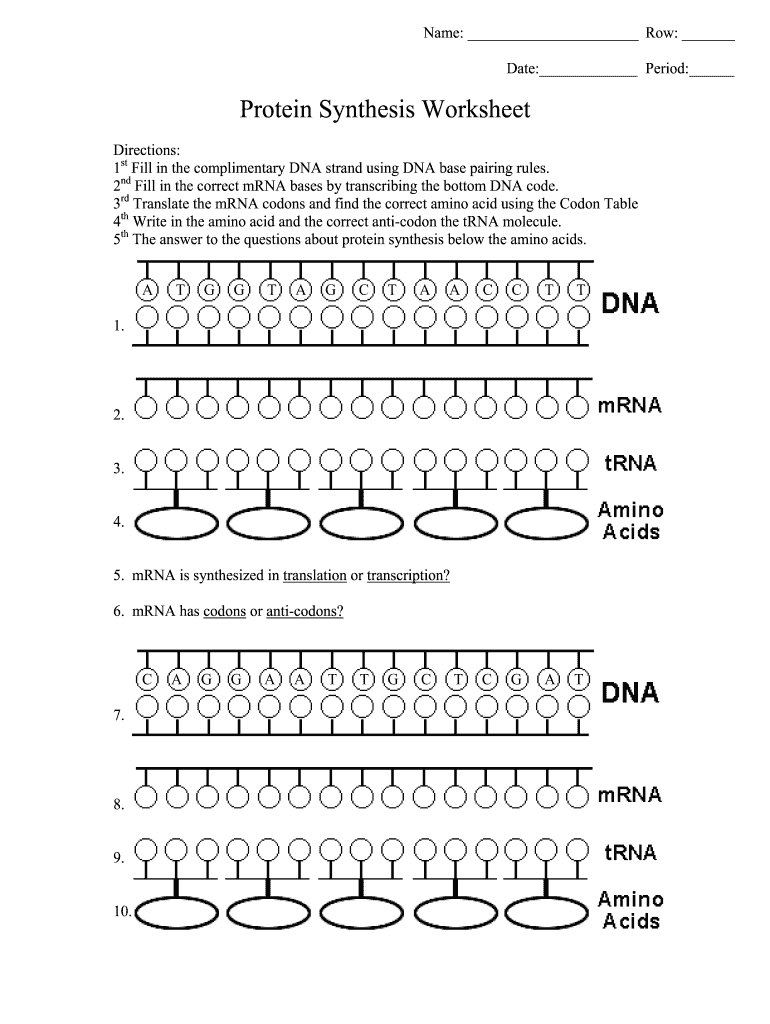
  2. Begin by filling in your name, row, date, and period at the top of the worksheet. This personal information is essential for tracking your progress.
  3. Follow the directions to fill in the complimentary DNA strand using base pairing rules. Use our platform's text tool to input your answers directly into the designated fields.
  4. Next, transcribe the bottom DNA code into mRNA bases. Ensure accuracy as this step is crucial for understanding protein synthesis.
  5. Translate the mRNA codons using the Codon Table provided. Input the corresponding amino acids in the specified section of the worksheet.
  6. Write down both the amino acid and its correct anti-codon for each tRNA molecule as indicated on the form.
  7. Finally, answer all questions regarding protein synthesis below the amino acids section. This will reinforce your understanding of key concepts.

Start editing your protein synthesis worksheet online for free today!

be ready to get more

Complete this form in 5 minutes or less

Get form

Got questions?

We have answers to the most popular questions from our customers. If you can't find an answer to your question, please contact us.
Contact us

Upload your protein synthesis practice worksheet to DocHub (after you’ve created an account for this). If you need to fill out fields in it, use appropriate tools from the upper pane. For instance, drop Signature Fields, assign each to specific party, and click on Sign → Request signatures from others. Personalize your message for your recipients and click Send Request. You can also send your form by fax or as a Signing link instead of using email (you’ll locate these options by navigating to the Menu → Send)

It is a no-brainer on a computer or via a mobile phone to complete a protein synthesis review worksheet with DocHub. All you need to do is open any installed browser on your smartphone and proceed to the DocHub site. Once authenticated, add your document and open it in editing mode. Use our toolbar to make your edits and save modifications. Optionally, keep your file in your files or send it to a recipient on the spot.

Protein synthesis is the creation of proteins by cells that uses DNA, RNA, and various enzymes. It generally includes transcription, translation, and post-translational events, such as protein folding, modifications, and proteolysis.
During transcription, DNA is used as a template to make a molecule of messenger RNA (mRNA). The molecule of mRNA then leaves the nucleus and goes to a ribosome in the cytoplasm, where translation occurs. During translation, the genetic code in mRNA is read and used to make a protein.
It includes three steps: initiation, elongation, and termination. After the mRNA is processed, it carries the instructions to a ribosome in the cytoplasm. Translation occurs at the ribosome, which consists of rRNA and proteins.

People also ask

Translation: RNA \u2192 Protein Initiation: mRNA is transported to the cytoplasm and attaches to a ribosome so that the start codon is read first. ... Elongation: The ribosome moves along the mRNA strand, reading the next codon of the mRNA in order. ... Termination: When the stop codon is reached, translation stops.
The steps are illustrated in the figure below. Initiation is the beginning of transcription. It occurs when the enzyme RNA polymerase binds to a region of a gene called the promoter. ... Elongation is the addition of nucleotides to the mRNA strand. Termination is the ending of transcription.
It includes three steps: initiation, elongation, and termination. After the mRNA is processed, it carries the instructions to a ribosome in the cytoplasm. Translation occurs at the ribosome, which consists of rRNA and proteins.
The major steps are: (a) Activation of amino acids: (b) Transfer of amino acid to tRNA: (c) Initiation of polypeptide chain: (d) Chain Termination: (e) Protein translocation:

protein synthesis worksheet biology