
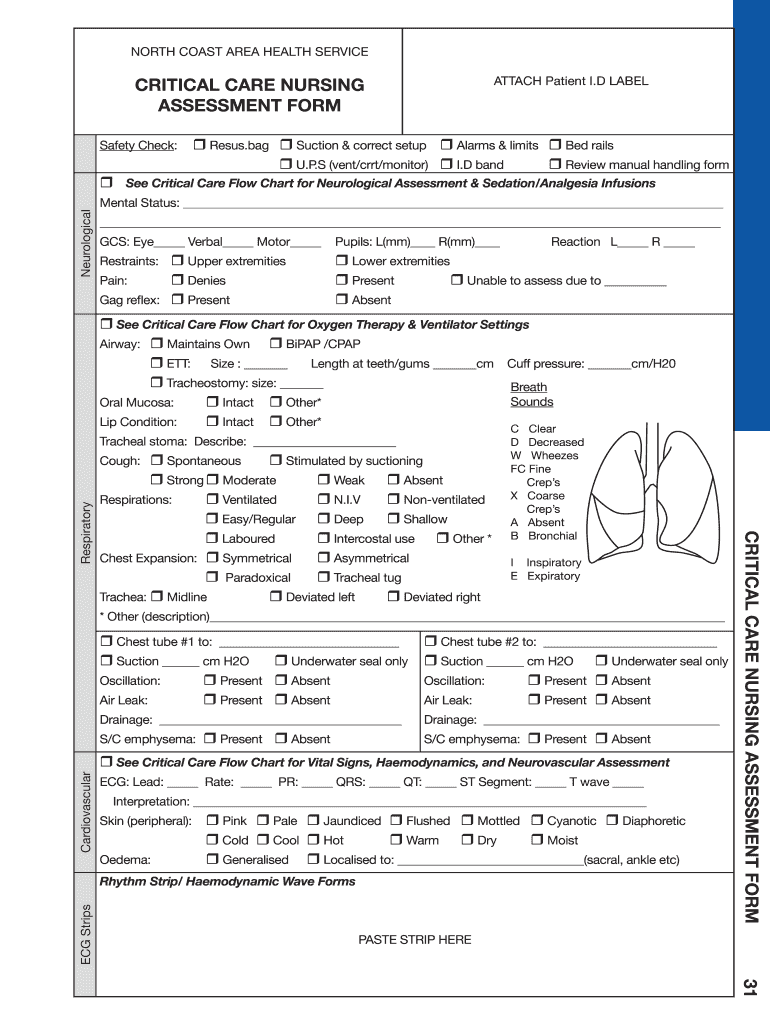







Definition and Meaning of the Critical Care Assessment Form
The Critical Care Assessment Form is a specialized tool used by healthcare professionals to systematically evaluate patients in critical care environments, such as emergency rooms or intensive care units (ICUs). This structured form ensures comprehensive documentation of vital assessments necessary for delivering high-quality patient care. Key components of the form include detailed sections for neurological, cardiovascular, respiratory, and gastrointestinal evaluations, alongside essential safety checks.
By guiding healthcare workers through essential evaluations, the form facilitates effective monitoring and timely interventions in critical scenarios. This structured approach is crucial for maintaining patient safety and optimizing care outcomes, particularly for those with complex medical needs.
Key Features of the Critical Care Assessment Form
- Holistic Patient Evaluation: Each section of the form targets specific areas of assessment, covering head-to-toe evaluations.
- Safety Checks: Ensures critical system evaluations such as airway management and cardiovascular stability are monitored.
- Documentation Support: Provides a structured way to document assessments for legal and medical record-keeping.
- Collaboration Facilitation: Aids multiple healthcare providers in sharing precise patient information while ensuring continuity of care.
How to Use the Critical Care Assessment Form
Using the Critical Care Assessment Form appropriately requires understanding each section's purpose and applying the necessary evaluations accurately. Generally, the process involves the following steps:
- Patient Identification: Clearly state the patient's details at the top of the form for direct correlation of specific assessments.
- Complete Sections Methodically: Navigate through each section of the form, scoring or documenting assessments as appropriate. Assessments may include:
- Neurological Checks: Level of consciousness, pupil reaction, and motor functions.
- Cardiovascular Assessment: Heart rate, rhythm, and blood pressure readings.
- Respiratory Evaluation: Respiratory rate, oxygen saturation, and visual assessments of breathing patterns.
- Document Findings: Enter vital signs, observations, and notes in designated fields. Use the form to capture relevant patient history and current status.
- Review and Sign: Have the completed form reviewed by a second healthcare provider if required and include signatures or digital verification.
When using the form, it is essential to remain thorough and detail-oriented, as this documentation impacts subsequent care decisions.
Steps to Complete the Critical Care Assessment Form
Completing the Critical Care Assessment Form involves systematic and accurate documentation to ensure comprehensive patient evaluations. Below is a step-by-step guide to fulfilling the requirements of the form effectively:
-
Initiate with Patient Data:
- Gather and enter patient identification information, including name, age, date of admission, and medical record number.
-
Conduct Initial Assessments:
- Begin with vital signs such as temperature, pulse, respiratory rate, and blood pressure. Record these findings in the designated fields.
-
Perform Neurological Assessment:
- Evaluate the patient's level of consciousness using the Glasgow Coma Scale (GCS), noting any deviations from baseline neurological status.
- Document observations on pupil size and reaction, motor responses, and sensory function.
-
Evaluate Cardiovascular Health:
- Assess heart sounds, rhythm, and peripheral perfusion.
- Record relevant data on any signs of distress such as chest pain or dyspnea.
-
Address Respiratory Functioning:
- Measure respiratory rate and oxygen saturation.
- Note any use of accessory muscles or abnormal breath sounds.
-
Complete Additional Assessments:
- Document gastrointestinal, genitourinary, vascular access, and integumentary evaluations as per patient needs.
-
Final Review and Updates:
- Reassess the patient's data periodically, updating the form as new information arises or conditions change.
- Ensure the form reflects the most current patient status, allowing for informed clinical decisions.
Who Typically Uses the Critical Care Assessment Form
The Critical Care Assessment Form is primarily utilized by various healthcare professionals involved in the direct care of critically ill patients. Key users include:
- Critical Care Nurses: They perform initial assessments and continuous monitoring of patient status, ensuring accurate documentation for interventions.
- Physicians and Surgeons: They rely on filled forms to grasp the patient's baseline and any changes in their condition over time, aiding in treatment planning.
- Respiratory Therapists: Professionals in this field may use the form to record interventions made and patients' responses to respiratory therapies.
- Clinical Educators: Those involved in teaching may use versions of the form to train new healthcare staff on comprehensive assessment protocols.
Using this form supports collaborative care efforts and enhances communication among the multidisciplinary team, aligning all parties around a patient's complex needs.


Important Terms Related to the Critical Care Assessment Form
Understanding specific terminology associated with the Critical Care Assessment Form is vital for users to communicate effectively in a clinical setting. Some important terms include:
- Glasgow Coma Scale (GCS): A neurological scale for assessing a patient's level of consciousness based on verbal, motor, and eye-opening responses.
- Vital Signs: Key indicators of a patient's current health status, including temperature, heart rate, respiratory rate, and blood pressure.
- Intensive Care Unit (ICU): A specialized unit within a hospital that provides critical care and monitoring for severely ill patients.
- Comorbidities: Additional medical conditions or complications that may complicate a patient's critical care needs and management strategies.
- Evidence-Based Practice: Approaches fostered by using assessment forms to follow clinical guidelines and best practices in patient care.
Understanding these terms enhances clarity during discussion and documentation of patient care, empowering healthcare professionals in their critical care responsibilities.
Key Elements of the Critical Care Assessment Form
The Critical Care Assessment Form is structured to capture multiple facets of a patient's condition succinctly. Significant elements include:
- Patient Identification: Essential for linking assessments to the correct person without errors.
- Neurological Assessment Section: Evaluates consciousness, reaction, and sensory-motor functions, vital for critical care management.
- Cardiovascular Data: This includes heart rate, rhythm, blood pressure, and cardiac rhythm assessments critical for immediate interventions.
- Respiratory Evaluation: Captures rates and effort, enabling timely actions to support breathing and oxygenation.
- Gastrointestinal and Genitourinary Checks: These sections monitor fluid balance, dietary needs, and output measures essential for overall care.
Each of these elements is crucial in creating a holistic view of the patient and facilitating timely medical responses based on thorough evaluations documented during assessments.


