
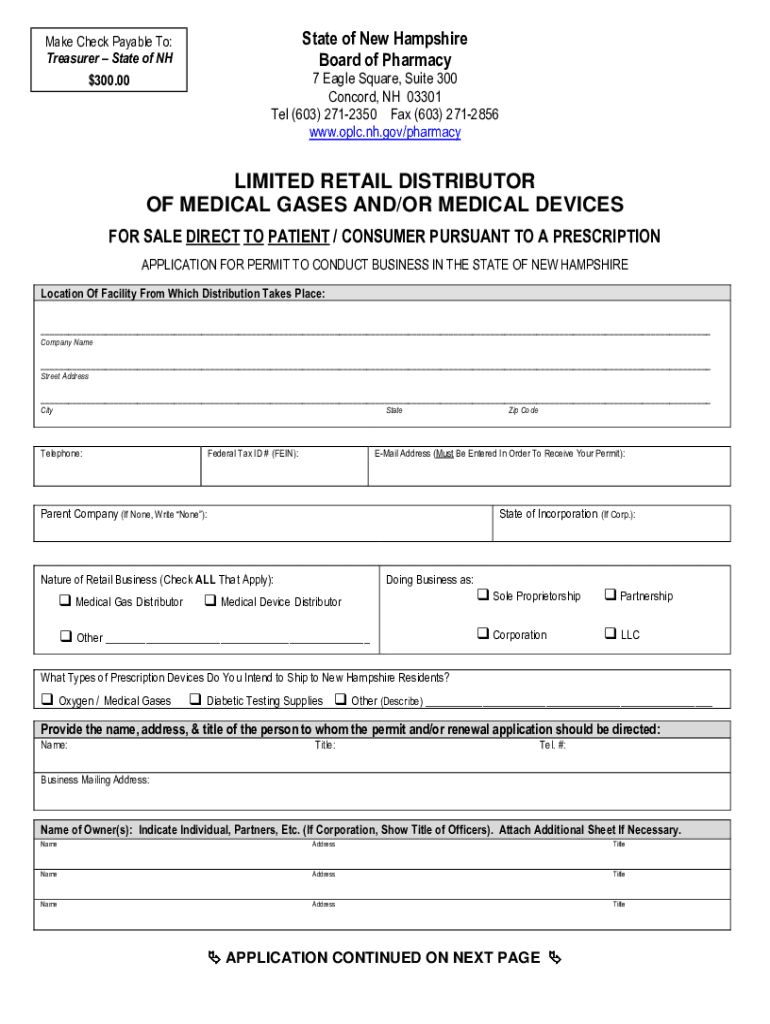







Definition & Meaning
The LIMITED RETAIL DISTRIBUTOR OF MEDICAL GASES AND/OR ... is a permit required for businesses engaged in distributing medical gases and potentially related medical devices. This form ensures that distributors comply with specific state guidelines, particularly those set by the State of New Hampshire. The permit is relevant to distributors managing gases used in medical treatments, requiring adherence to safety and legal standards.
Key Elements of the LIMITED RETAIL DISTRIBUTOR OF MEDICAL GASES AND/OR ...
The form requires comprehensive information from applicants, including:
- Company details: Name, address, and contact information.
- Product types: Specific medical gases and/or devices intended for distribution.
- Compliance declarations: Statements confirming adherence to state regulations.
Details must be precise, ensuring the proper identification of the distributing entity and the scope of its operations.
Required Documents
Supporting documentation is crucial when applying for this permit. Applicants need to provide:
- Business licenses: Current and valid business licenses.
- Proof of compliance: Certificates or reports demonstrating compliance with safety and regulatory standards.
- Identity verification: Proof of identity for company representatives making declarations.
Each document verifies a different aspect of the applicant's capability and legitimacy in handling medical gases and devices.
Steps to Complete the LIMITED RETAIL DISTRIBUTOR OF MEDICAL GASES AND/OR ...
- Gather Requirements: Collect all necessary documentation and information.
- Complete the Application: Fill in company details, product types, and relevant compliance details.
- Review for Accuracy: Double-check all entered information and attached documents.
- Submit the Form: Depending on the method, send the application online, via mail, or present it in person.
- Confirm Submission: Ensure receipt with a confirmation message or acknowledgment from the issuing body.
Following these steps ensures a smooth application process.
How to Obtain the LIMITED RETAIL DISTRIBUTOR OF MEDICAL GASES AND/OR ...
Participants can obtain this form through the appropriate state regulatory body’s website or office. Applicants will need to:
- Access the Form: Download it online or request a physical copy.
- Prepare Supporting Documents: As mentioned, essential for successful submission.
- Submit as Directed: Return the completed form via specified channels, either online, mail, or in-person delivery.
The availability of multiple submission methods caters to varying preferences and technological access levels.
Eligibility Criteria
To qualify for this permit, businesses must meet several criteria, including:
- Business Registration: Must be legally registered in the United States or specifically in the State of New Hampshire.
- Regulatory Compliance: Adherence to FDA regulations and local laws governing medical distribution.
- Financial Stability: Proof of financial standing may be required to ensure operational capability.
Meeting these criteria is crucial for approval and continued compliance within the industry.


State-Specific Rules for the LIMITED RETAIL DISTRIBUTOR OF MEDICAL GASES AND/OR ...
Regulations can vary substantially between states. In New Hampshire:
- Storage Requirements: Specific guidelines dictate how medical gases should be stored to ensure safety.
- Reporting Obligations: Regular reports may be required to demonstrate adherence to safety standards.
- Renewal Conditions: The permit may require renewal every few years, ensuring ongoing compliance with evolving standards.
These rules help maintain a high level of safety and compliance across the board.
Legal Use of the LIMITED RETAIL DISTRIBUTOR OF MEDICAL GASES AND/OR ...
Holders of the permit are legally permitted to distribute medical gases within the defined scope:
- Purpose Limitation: Gases must be used for medical purposes.
- Territorial Restrictions: Distribution is typically confined to the issuing state unless otherwise specified.
- Regulatory Adherence: Must continually adhere to FDA and state-specific regulations.
These legal stipulations ensure the permit's use aligns with public health objectives and regulatory frameworks.
Penalties for Non-Compliance
Failure to comply with regulations can result in:
- Fines and Penalties: Financial liabilities can be imposed for breaches of compliance.
- Permit Revocation: The permit may be revoked if ongoing compliance is not maintained.
- Legal Action: Severe breaches might lead to legal proceedings against the distributor.
Understanding these penalties is vital to prevent and address non-compliance effectively.
Application Process & Approval Time
Applicants should anticipate a multi-step process from submission to receipt of approval:
- Application Review: Initial processing typically involves verifying all information and documents.
- Assessment Period: Additional vetting may occur for complex applications, which can extend the timeline.
- Approval Notification: Once approved, applicants are notified and issued the permit.
The timeline can vary, hence early submission is advisable for time-sensitive operations.
Business Types That Benefit Most
Various business models may seek this permit, including:
- Pharmaceutical Distributors: Companies engaged in wide-scale distribution of medical gases.
- Hospitals & Clinics: Facilities managing their distribution channels for critical medical gases.
- Healthcare Suppliers: Retailers serving hospitals and clinics with specialized medical gases.
Each of these entities requires streamlined access to medical gases to function effectively.
Examples of Using the LIMITED RETAIL DISTRIBUTOR OF MEDICAL GASES AND/OR ...
Case scenarios where the permit proves essential include:
- Emergency Medical Supply: Distributing oxygen tanks to hospitals during increased demand.
- Therapeutic Supply Chains: Ensuring regular supply for clinics offering gaseous therapies.
- Health Crisis Response: Rapid distribution networks that meet urgent needs in crisis situations.
These scenarios highlight the critical role of distribution in healthcare functionality and response.




