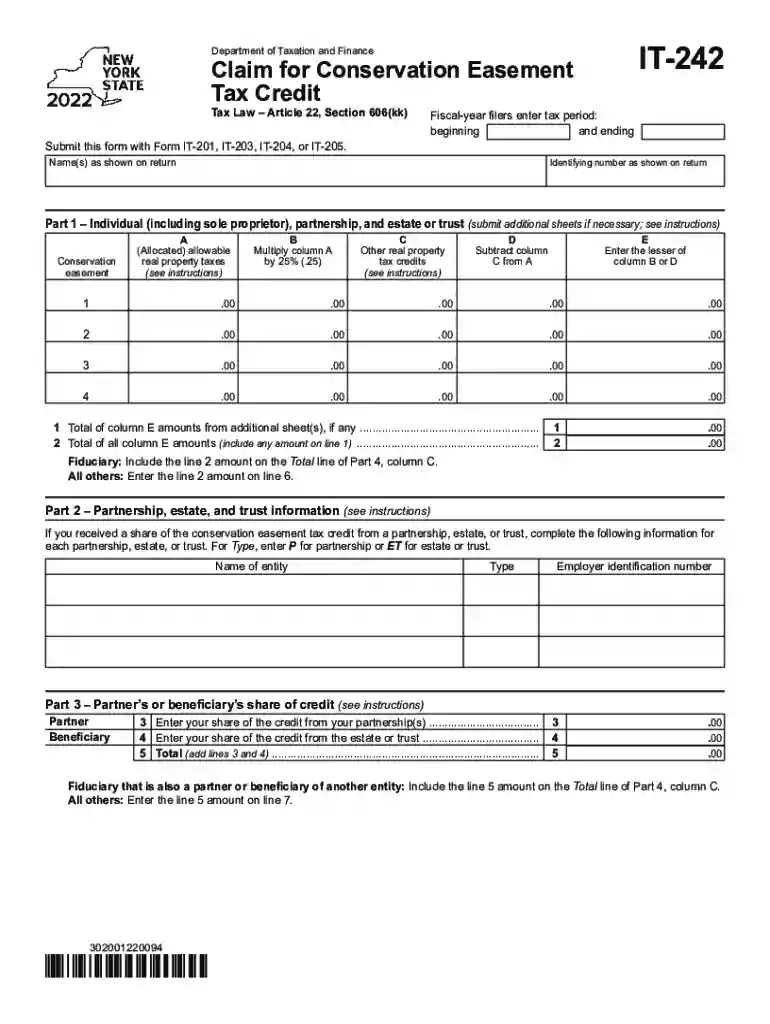
New York Form IT-242 (Claim for Conservation Easement Tax ... 2025

Get Form
New York Form IT-242 (Claim for Conservation Easement Tax ... Preview on Page 1

Here's how it works

01. Edit your form online
Type text, add images, blackout confidential details, add comments, highlights and more.

02. Sign it in a few clicks
Draw your signature, type it, upload its image, or use your mobile device as a signature pad.

03. Share your form with others
Send it via email, link, or fax. You can also download it, export it or print it out.

How to use or fill out New York Form IT-242 (Claim for Conservation Easement Tax Credit) with Our Platform

Form edit decoration
9.5
Ease of Setup
DocHub User Ratings on G2
9.0
Ease of Use
DocHub User Ratings on G2
  1. Click ‘Get Form’ to open New York Form IT-242 in the editor.
  2. Begin by entering your name(s) and identifying number as shown on your tax return at the top of the form.
  3. In Part 1, input your allowable conservation real property taxes in column A. Multiply this amount by 25% and enter it in column C.
  4. Subtract the amount in column C from column A and record the result in column D. Then, enter the lesser of columns B or D in column E.
  5. For Part 2, if applicable, provide details about any partnerships, estates, or trusts that contributed to your conservation easement tax credit.
  6. Complete Part 3 by entering your share of credits from partnerships and estates or trusts as instructed.
  7. Proceed to Part 5 to compute your total conservation easement tax credit based on previous entries.
  8. Finally, review all sections for accuracy before submitting the completed form along with your tax return.

Start using our platform today to fill out New York Form IT-242 easily and for free!

See more New York Form IT-242 (Claim for Conservation Easement Tax ... versions

We've got more versions of the New York Form IT-242 (Claim for Conservation Easement Tax ... form. Select the right New York Form IT-242 (Claim for Conservation Easement Tax ... version from the list and start editing it straight away!
Versions Form popularity Fillable & printable
2023 4.3 Satisfied (21 Votes)
2022 4.3 Satisfied (30 Votes)
2021 4.8 Satisfied (192 Votes)
2020 4.2 Satisfied (65 Votes)
2019 4.4 Satisfied (135 Votes)
2018 4.3 Satisfied (137 Votes)
2016 4.1 Satisfied (31 Votes)
2015 4.4 Satisfied (323 Votes)
2014 4.2 Satisfied (37 Votes)
2013 4 Satisfied (56 Votes)
be ready to get more

Complete this form in 5 minutes or less

Get form

Got questions?

We have answers to the most popular questions from our customers. If you can't find an answer to your question, please contact us.
Contact us
Form 8283, Noncash Charitable Contributions, which must be filed by individual taxpayers who claim itemized deductions for donations of easements.
The Conservation Easement Credit (CEC) offers New York State taxpayers an annual income tax credit of 25% of their school district, county, and town property taxes up to $5,000. If a landowners tax credit exceeds the amount, the taxpayer owes in state income taxes, the landowner receives a payment for the difference.
Per IRS Publication 544 Sales and Other Dispositions of Assets, page 3: Easement. The amount received for granting an easement is subtracted from the basis of the property. If only a specific part of the entire tract of property is affected by the easement, only the basis of that part is reduced by the amount received.
What are the advantages of conservation easements from the landowners per- spective? Donations of conservation easement can reduce federal and state income taxes, capital gains taxes, estate taxes, and property taxes.
The value of the charitable deduction for a conservation easement is generally based on the difference between the propertys FMV before and after the easement is granted, commonly referred to as the before and after approach (Regs. Sec. 1.170A- 14(h)(3)(i)).
be ready to get more

Complete this form in 5 minutes or less

Get form

People also ask

For a conservation easement to be eligible for a tax deduction, the property rights must be donated for conservation purposes to what the tax code calls a qualified conservation organization. These can include certain: governmental units. charities. and some other tax-exempt groups.
The biggest disadvantage of creating a conservation easement is that once the entire plot or portion is put into the land trust, the agreement runs with the land. This means it is permanent and binding to all future land owners or heirs and they cannot adjust the terms or terminate.
Conservation easements facilitate other conservation tools Federal law allows an annual exclusion from the gift tax. In 2022 the exclusion amount is $16,000 per donor per donee. By reducing the value of land, a conservation easement allows more land to pass, tax free, to the next generation.

Related links