







Detailed Exploration of a Worksheet on Parallel Lines Cut by a Transversal
Definition and Purpose of the Worksheet
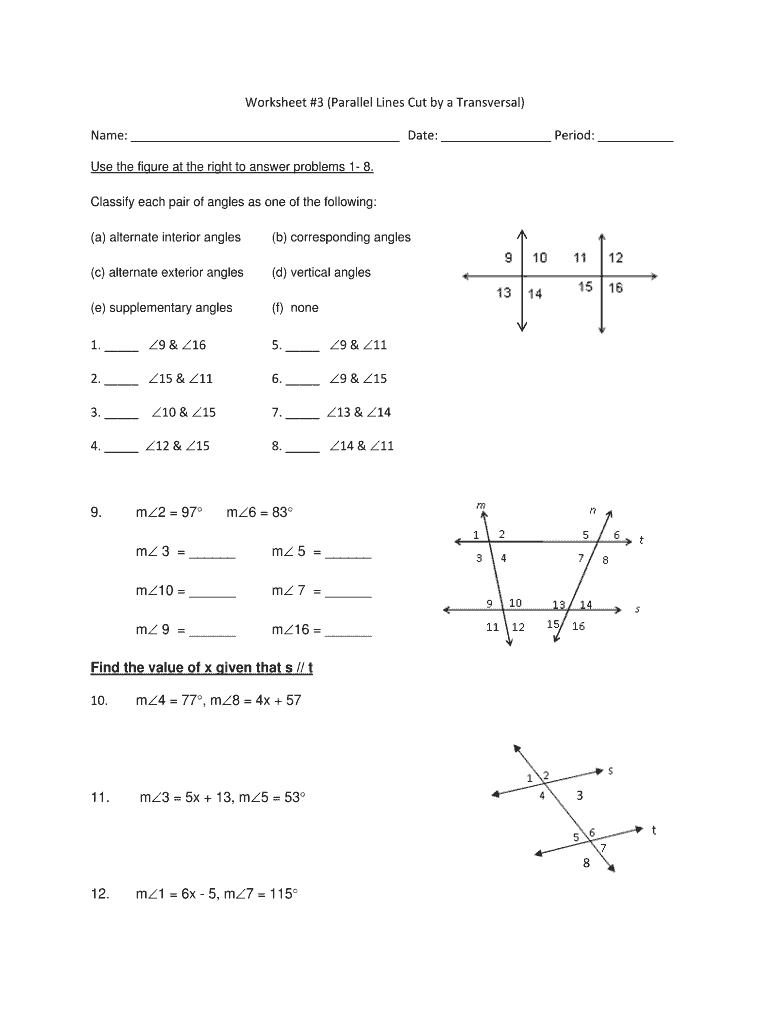
A "parallel lines cut by a transversal worksheet" is tailored for eighth-grade students to deepen their understanding of geometry, specifically concerning angles formed when a transversal intersects two parallel lines. The document is designed to engage students in recognizing various angle pair relationships, which are crucial for mastering properties of parallel lines and transversals. This knowledge is foundational for higher-level geometry and related mathematical concepts.
Types of Problems Included
The worksheet typically comprises several problem types aimed at identifying and calculating angle relationships. Key elements include:
- Angle Types: Students must identify angles as alternate interior, corresponding, alternate exterior, and vertical angles. Understanding these classifications enables students to recognize patterns in geometry.
- Calculation Exercises: Problems may require students to compute missing angle measures or solve for unknown variables, such as 'x', which ensures that lines remain parallel. For example, a problem might state, "If angle 3 is 70 degrees, what is the measure of angle 6?"
- Equations Involving Angles: Some exercises may necessitate setting up equations based on provided angle relationships. For instance, if angle 1 and angle 2 are supplementary, students would be asked to create an equation like x + (x + 20) = 180.
Structure and Format of the Worksheet
The worksheet is structured to facilitate comprehension and engagement.
- Clear Design: Problems are laid out logically, often with diagrams showing two parallel lines intersected by a transversal. Visual aids enhance understanding by providing a reference for the angle pairs being studied.
- Answer Key: Worksheets typically come with an answer key that allows for self-assessment. This feature is vital for students to check their work independently and gauge their understanding.
- Fillable Sections: Some versions may allow space for students to write answers or show their work, which encourages them to articulate their thought process and enhances problem-solving skills.
Techniques for Teaching with the Worksheet
Educators can employ various techniques to maximize the effectiveness of a parallel lines cut by a transversal worksheet:
- Collaborative Learning: Pairing students to solve problems fosters discussion about their reasoning, promoting collaborative learning and peer support.
- Interactive Demonstrations: Utilizing physical models or drawing diagrams can help illustrate the angles formed by transversals more dynamically.
- Incorporating Technology: Digital versions of the worksheet may include interactive elements or links to online resources that reinforce the concepts.
Key Vocabulary and Concepts
Students should become familiar with essential vocabulary:
- Transversal: A line that crosses at least two other lines.
- Supplementary Angles: Two angles that add up to 180 degrees.
- Complementary Angles: Two angles that add up to 90 degrees.
Fostering this vocabulary knowledge is crucial as it not only pertains to this topic but also supports overall mathematical fluency.
Additional Resources
To support the learning experience, supplemental materials can be advantageous:
- Further Practice Worksheets: Students may benefit from additional worksheets focusing on angle calculations and relationships.
- Online Quizzes: Interactive quizzes that provide instant feedback can reinforce the concepts learned in class and through the worksheet.
- Peer Tutoring Sessions: Advanced students can help peers struggling with the material, enhancing the understanding of both students involved.
Conclusion
A worksheet on parallel lines cut by a transversal is an instrumental teaching tool in the eighth-grade mathematics curriculum. It not only supports the learning of geometric concepts but also develops critical thinking and problem-solving abilities that are essential for academic success in mathematics and beyond.




