
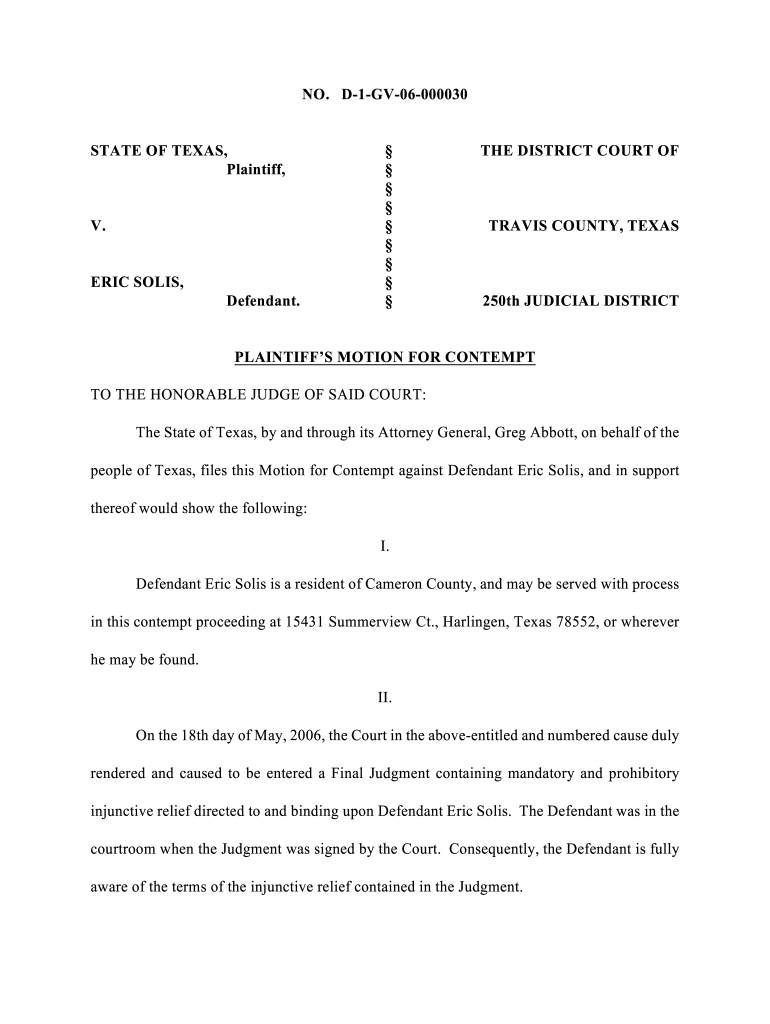







Definition and Meaning of Motion for Contempt in Texas
A motion for contempt in Texas is a legal request made to the court, asking it to hold an individual in contempt for failing to comply with a court order. This motion is typically filed in cases involving family law, such as divorce decrees, child custody arrangements, or child support obligations. The purpose of this motion is to seek enforcement of the court's prior directives and to ensure accountability for those who do not adhere to legal obligations.
In Texas, the law allows parties to request a hearing where the alleged non-compliant individual must explain why they have not followed the court order. If the court finds that the individual willfully failed to comply, it may impose penalties, which can include fines, modification of custody arrangements, or even jail time. Thus, a motion for contempt acts as a crucial mechanism to ensure compliance with legal orders and uphold the rule of law.
How to Use the Motion for Contempt Texas Form
Using the motion for contempt Texas form effectively requires understanding the specific circumstances that necessitate its use. Common scenarios include violations related to child custody, visitation rights, or failure to pay child support.
Essential Steps to Utilize the Form:
- Confirm Compliance Issue: Ensure there is a clear violation of a previous court order.
- Gather Documentation: Collect all relevant documentation supporting your claim, such as payment records or communication logs.
- Complete the Form: Fill out the motion for contempt form with accurate details, including the court order in question and specific violations.
Including supporting evidence strengthens your motion and helps the court understand the basis of your request.
Steps to Complete the Motion for Contempt Texas Form
Completing the motion for contempt Texas form involves several critical steps:
-
Obtain the Correct Form: Ensure you are using the up-to-date motion for contempt form specific to Texas courts.
-
Fill in Your Information:
- Input your name and contact details as the moving party.
- Include the respondent's name and any relevant case numbers.
-
Specify the Court Order:
- Clearly reference the original court order that is being violated.
- Include exact dates and details to provide context.
-
Outline the Violations:
- Detail how and why the other party is in contempt.
- Provide specific examples of non-compliance.
-
Sign and Date the Document: Ensure you provide your signature and the date of submission at the bottom of the form.
Accurate completion of the form increases the likelihood of a favorable outcome during your hearing.
Important Terms Related to Motion for Contempt Texas Form
Familiarizing yourself with key legal terms related to the motion for contempt is essential:
- Contempt of Court: This refers to actions that obstruct the court's authority or defy court orders.
- Court Order: A legal directive issued by a judge that must be followed.
- Affidavit: A written statement confirmed by oath, used as evidence in court.
- Hearing: A legal proceeding where both parties present their arguments.
- Sanctions: Penalties imposed by the court for non-compliance.
Understanding these terms can help you navigate the legal process more effectively.
Legal Use of the Motion for Contempt Texas Form
The legal use of the motion for contempt Texas form encompasses various family law contexts, predominantly focusing on compliance with court orders. The process is governed by the Texas Family Code, which outlines the rights and responsibilities of all parties involved. Common legal justifications for filing this motion include:
- Child Support Delinquency: A parent consistently failing to pay ordered child support.
- Non-Compliance with Custody Orders: A parent denying the other parent their custodial or visitation rights.
- Failure to Follow Court-Ordered Actions: Any order related to property division or conduct stipulated during divorce proceedings.
The motion for contempt serves to enforce these legal obligations and rectify instances of disobedience.
Examples of Using the Motion for Contempt Texas Form
Several real-world scenarios illustrate the practical applications of the motion for contempt:
- A custodial parent files a motion because the non-custodial parent has repeatedly missed scheduled visitations without notice. The motion seeks enforcement of the custody order.
- An individual requests the court to hold the other party in contempt for failing to pay agreed-upon child support since January, leading to financial distress.
These examples highlight the importance of the motion in ensuring compliance with judicial decisions and maintaining accountability among parties with legal obligations.




