
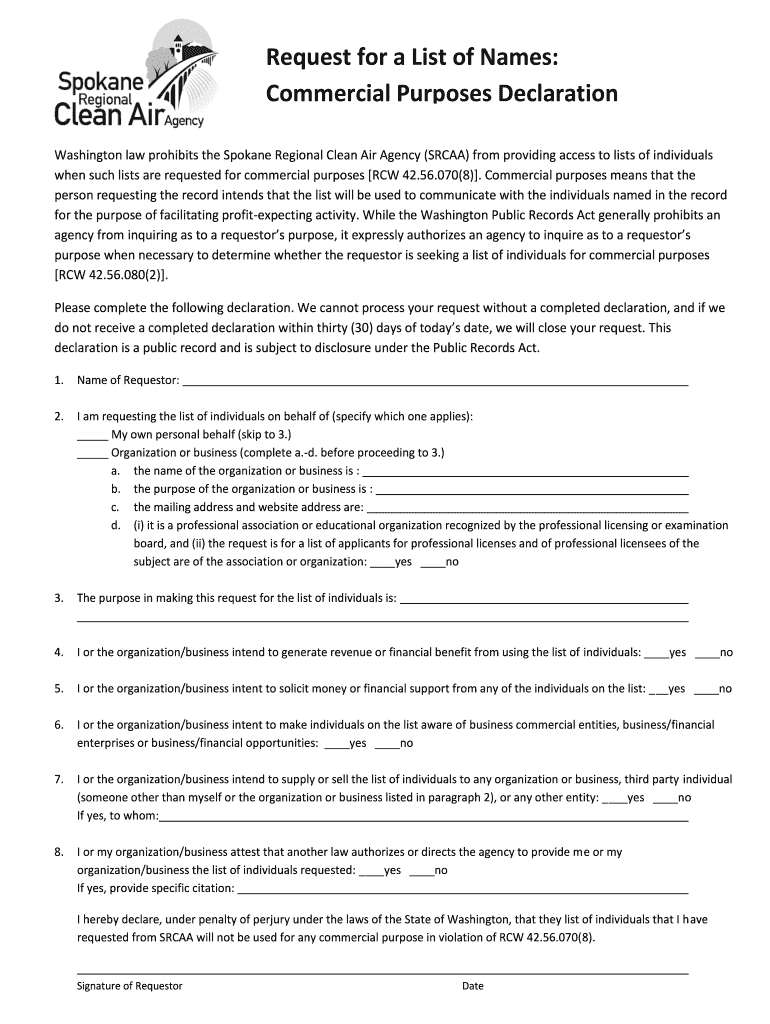







Definition & Purpose of the Commercial Purposes Declaration
The "Request for a List of Names: Commercial Purposes Declaration" serves as a formal document intended for entities looking to acquire lists of names for commercial purposes. This declaration is essential for verifying the legitimacy and intent behind such requests, ensuring compliance with legal frameworks that regulate the use of personal data for commercial activities. Typically, the form mandates disclosure of the requestor's identity, the specific purpose for obtaining the list, and assurances that the list will not be misused in violation of local statutes.
Key Components
- Identifying Information: Requestors must provide detailed identification, including name, organization, and contact details.
- Purpose Statement: A clear, concise description of the commercial intent behind acquiring the list.
- Compliance Assurance: Confirmation that the use of the list complies with state and federal regulations.
How to Use the Declaration Form
Utilizing the "Request for a List of Names: Commercial Purposes Declaration" involves several steps to ensure correct submission:
- Access and Download: Obtain the form from an authoritative source, such as a governmental or organizational website that handles public records.
- Complete All Sections: Fill in all mandatory fields, covering personal information, the intended use of the list, and acknowledgment of compliance with governing laws.
- Submit for Processing: Depending on guidelines, submit the form either online, via mail, or in person. Some jurisdictions may have specific portals for electronic submissions.
Obtaining the Declaration Form
Procurement of the form may vary based on jurisdiction but typically involves:
- Direct Download: Visiting the issuing agency’s website and downloading a PDF version.
- Physical Collection: In some regions, forms might be distributed at government offices or information centers.
Required Documents for Acquisition
- Identification Proof: A government-issued ID may be required.
- Business Credentials: Documentation proving the legitimacy of the business, such as registration certificates or business licenses.
Steps to Complete the Declaration
Filling out the "Request for List of Names: Commercial Purposes Declaration" should be done carefully, adhering to these steps:
- Review Instructions: Thoroughly read all form instructions to understand each required section.
- Complete Identification Details: Enter accurate personal and business information.
- Specify Commercial Intent: Clearly state the purpose for which the list will be used.
- Sign Declaration: Confirm the accuracy of the provided information by signing the form. Digital signatures might be acceptable depending on submission methods.
Legal Usage and Considerations
The declaration form is governed by both federal and state laws that seek to protect individuals' privacy. These laws ensure that:
- Purpose Limitation: The requested list is only utilized for the specified professional purpose.
- Compliance with Privacy Laws: Users must adhere to acts like the Consumer Privacy Act, ensuring no personal data is exploited unlawfully.
Consequences of Non-Compliance
Failing to abide by the stated laws carries serious repercussions, including fines or legal action, emphasizing the importance of honest disclosure and adherence.
Important Terms Related to the Declaration
Understanding specific terminology can clarify form completion:
- Requestor: The person or business entity submitting the request for the list.
- Commercial Use: Any activity aimed at generating revenue, direct or indirect.
- Declaration: A formal statement affirming the intent and compliance with legal standards.
Who Typically Uses the Declaration
Various parties may need to complete the "Request for a List of Names: Commercial Purposes Declaration," including:
- Marketing Firms: Looking to expand client outreach.
- Research Companies: Conducting surveys or demographic studies.
- Financial Institutions: Verifying customer information for compliance checks.


State-Specific Rules and Differences
Regulations surrounding the application of this declaration can differ across states:
- Washington State: Prohibits using such lists for extensive commercial solicitation, requiring clear documentation of compliance with local clean air laws.
- California: Stringent consumer privacy laws require additional consent forms alongside the declaration.
Examples of Using the Declaration
Real-world scenarios provide insight into practical applications:
- Research Institution: Collects names to invite participants for a study, ensuring all are informed and consent is obtained.
- Retail Businesses: Utilize customer lists to send promotional materials while adhering to opt-out guidelines mandated by privacy laws.




