







Definition & Meaning
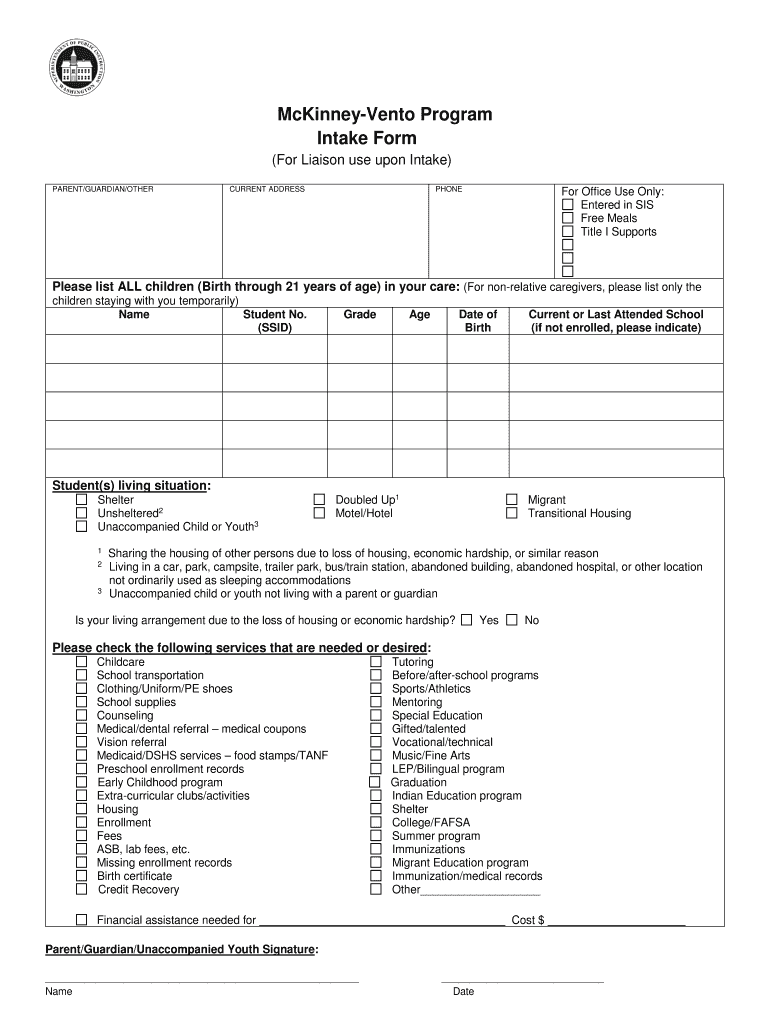
The McKinney-Vento Intake Form is a crucial document used by the McKinney-Vento Program to gather information about families and children experiencing homelessness or living in unstable conditions. This form collects essential data to assess the needs of those who may not have a permanent residence, enabling service providers to offer targeted assistance. Its primary function is to identify individuals eligible for various support services, such as education, shelter, and other aids that are part of the McKinney-Vento Homeless Assistance Act.
Steps to Complete the McKinney-Vento Intake Form
Completing the McKinney-Vento Intake Form involves a clear sequence of steps to ensure all necessary information is accurately captured:
- Provide Personal Details: Begin by filling out personal information, including the name, date of birth, and contact details of the parent or guardian.
- Residential Information: Describe the current living situation, specifying if it's a temporary shelter, motel, or other non-permanent housing.
- Child Information: List all children under the care of the parent/guardian, including their names, ages, and school information.
- Service Needs: Indicate any required services such as transportation to school, access to meals, or health care.
- Signatures: Ensure signatures from both the parent/guardian and the program liaison to validate the form's contents.
Sub-sections
- Verification: After completion, verify that all sections are filled accurately to avoid delays in processing.
- Submission: Submit the form according to the specified method by your local education agency, either online or in-person.
Key Elements of the McKinney-Vento Intake Form
The intake form includes several critical components that facilitate the identification of required services:
- Personal and Contact Information: Crucial for initial communications and follow-ups.
- Current Living Situation: Helps in determining the level and type of assistance needed.
- Child’s Educational Information: Ensures educational continuity and stability.
- Family Needs and Services: Identifies what additional supports are essential for the family.
- Emergency Contacts: Lists alternative contacts for effective communication.
How to Obtain the McKinney-Vento Intake Form
Acquiring the McKinney-Vento Intake Form is straightforward; it is typically available through:
- School Districts: Directly contact your child’s school or district’s homeless liaison.
- Online Resources: Visit the websites of local education agencies that may offer downloadable forms.
- Community Centers: Many community service centers provide these forms as part of their outreach.
Who Typically Uses the McKinney-Vento Intake Form
The form is primarily utilized by:
- Parents or Guardians: Seeking assistance for their children’s education and welfare.
- School Liaisons: Responsible for assessing needs and organizing support services.
- Social Workers: Involved in assisting families to obtain housing and other essential services.
- Community Organizations: Dedicated to supporting homeless individuals and families in socio-economic distress.


Legal Use of the McKinney-Vento Intake Form
The form must be used in accordance with federal and state regulations that protect the rights of homeless individuals:
- Confidentiality: Information collected is protected to maintain the privacy and dignity of the involved families.
- Equal Opportunity: Ensures that assistance is provided without discrimination.
- Compliance with the McKinney-Vento Act: Aligns with federal mandates aimed at combating homelessness and ensuring educational access.
State-by-State Differences
While the McKinney-Vento Act is a federal law, its implementation can vary slightly from state to state:
- Eligibility Criteria: Some states may have additional parameters for eligibility.
- Service Availability: The range of services offered can differ based on state resources and policies.
- Form Variations: Small differences in the form itself might exist to accommodate state-specific requirements.
Sub-sections
- Local Liaisons: Each state has designated coordinators who ensure compliance and assist with navigation through state-specific processes.
- Support Networks: Various states have unique networks that bolster federal provisions with state-funded initiatives.
Eligibility Criteria
Determining who qualifies for assistance through the McKinney-Vento Program involves specific criteria:
- Lack of Fixed, Regular, and Adequate Nighttime Residence: Primary requirement for eligibility.
- Children and Youths Sharing Housing: Due to loss of housing, economic hardship, or similar reasons.
- Migratory Children: May qualify if they are living in similar conditions as those outlined above.

Sub-sections
- Exceptions: Certain conditions may be exceptions such as living temporarily with others due to crisis.
- Proof of Situation: Though not always mandatory, any available documentation can help expedite service evaluations.
Required Documents
While the McKinney-Vento Intake Form is comprehensive, certain additional documents may be needed:
- Photo Identification: Of the parent/guardian to facilitate validation processes.
- Previous Residency Proof: If available, to verify prior living conditions.
- School Records: Recent academic records can aid in educational assessments.
Sub-sections
- Supplementary Information: Health or immunization records could be requested to better plan for the children’s needs.
- Documentation Sources: School or shelter certifications can be helpful in proving residency status.




