




01. Edit your cbp form 1300 online
Type text, add images, blackout confidential details, add comments, highlights and more.

Type text, add images, blackout confidential details, add comments, highlights and more.

Draw your signature, type it, upload its image, or use your mobile device as a signature pad.

Send cbp form 1300 instructions via email, link, or fax. You can also download it, export it or print it out.
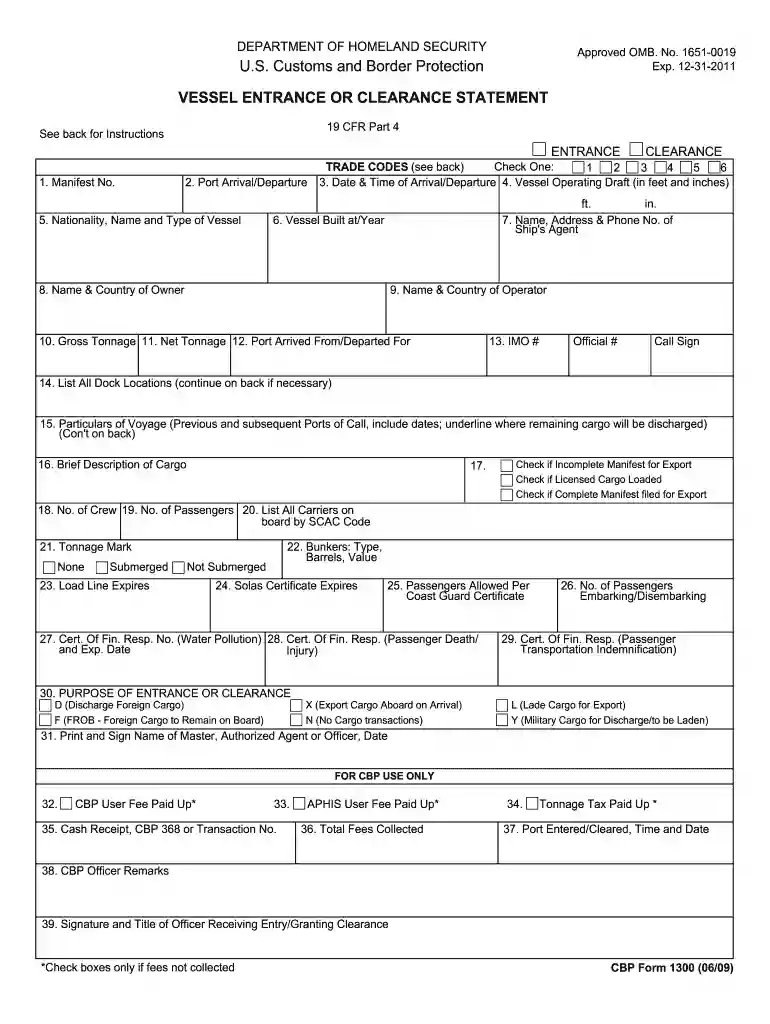
The CBP Form 1300 is a document used by U.S. Customs and Border Protection to facilitate the entry and clearance process for vessels entering U.S. waters. This form plays a critical role in documenting vessel information, ensuring compliance with maritime regulations, and providing necessary data regarding cargo and crew.
The CBP Form 1300 is primarily utilized for vessel entrance or clearance statements. It requires comprehensive details about the vessel, including its specifications, cargo manifest, and travel itinerary. This form is crucial for ensuring that all vessels comply with legal requirements set forth by U.S. regulations before entering or clearing from U.S. ports.
The form is typically used by:
Important elements included in the CBP Form 1300 are:
Completing the CBP Form 1300 requires diligent attention to detail. Here are the key steps:
The CBP Form 1300 is a legally recognized document. Any false information on this form can lead to penalties, including fines or legal repercussions. It’s important for users to understand the legal ramifications of providing accurate information on the form and ensure all details align with actual vessel and cargo data.
The CBP Form 1300 can typically be obtained through:
Consider a vessel arriving from Europe carrying cargo destined for a U.S. warehouse. The vessel operator would need to fill out the CBP Form 1300, detailing the cargo contents, ensuring regulatory compliance. This process facilitates the safe and efficient clearance of the vessel upon arrival at a U.S. port, demonstrating the practical application of the form in ensuring lawful maritime operations.
Failure to submit the CBP Form 1300 can result in significant penalties. These penalties may include:
Vessel operators should prioritize timely and complete submissions to avoid these challenges.
The CBP Form 1300 is an essential document for maritime operations entering U.S. waters. Understanding its purpose, components, and submission process is vital for compliant and efficient vessel management, ensuring adherence to U.S. maritime law.
At DocHub, your data security is our priority. We follow HIPAA, SOC2, GDPR, and other standards, so you can work on your documents with confidence.
Only two exterior walls come together to form an angle of 90 degrees to 135 degrees. There are no other exterior walls attached to either wall to form an alcoveRead more
Jun 4, 2025 A vessel processed in VECS will not be required to fill out a hard copy or digital CBP form 1300 for entrance.Read more
A clearance application for a vessel intending to depart for a foreign port must be made by filing CBP Form 1300 (Vessel Entrance or Clearance Statement)Read more


