
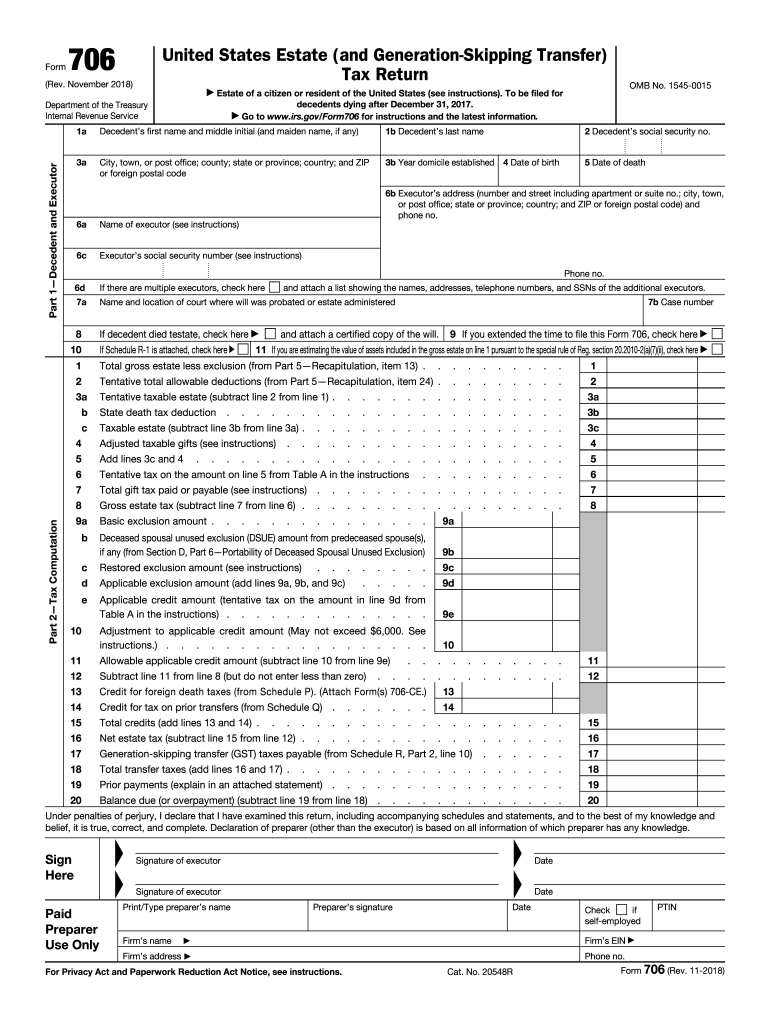







Definition and Purpose of IRS Form 706
Form 706, known as the United States Estate (and Generation-Skipping Transfer) Tax Return, is utilized to calculate estate taxes due for decedents who have died after December 31, 2017. It includes the details necessary to report the total value of the deceased person’s estate and determine the respective tax obligations. The form helps in determining if the combined value of the estate surpasses the requisite thresholds established by tax laws, triggering tax assessments.
The core sections of Form 706 document details about the decedent and the executor, facilitating accurate tax computation. It encompasses various schedules to capture comprehensive information about the decedent’s assets and any applicable deductions. The form also plays a crucial role in the portability election, allowing the transfer of the deceased spousal unused exclusion (DSUE) amount.
Steps to Complete IRS Form 706
-
Decedent and Executor Information: Start by precisely completing the necessary fields with the decedent’s personal details, including their full name, Social Security number, and date of death. Equally important is the inclusion of the executor’s details like their name and contact information.
-
Asset Valuation: List the value of all assets owned by the decedent. This includes real estate, personal property, bank accounts, investments, and business interests. Ensure accurate appraisals to reflect the fair market value on the date of the decedent's passing.
-
Debts and Liabilities: Document any liabilities the estate holds, such as mortgages or outstanding loans. This calculation will impact the net estate value and subsequently the taxable estate.
-
Tax Computation: Utilize the provided worksheets and schedules to compute the gross estate value, account for deductions, and ultimately determine the net estate liable for federal taxation.
-
Elections and Portability: Choose any applicable elections, such as the DSUE amount, within the stipulated sections of the form to optimize tax outcomes favorably.
-
Review and Submission: Once completed, review the form to ensure all information is accurate and comprehensive. Sign the document before submission to the IRS either by mail or electronically as per guidelines.
Required Documents for IRS Form 706
To fill out Form 706 comprehensively, you must gather a series of supporting documents. These documents provide evidence for asset valuations, reported income, and deductions claimed:
-
Death Certificate: Confirm the decedent’s date of death.
-
Property Appraisals: Obtain professional appraisals for real estate and personal property to reflect their market value.
-
Bank Statements: Include statements for each financial account as of the date of death.
-
Investment Portfolio: Document the value of stocks, bonds, and retirement accounts.
-
Debt Documentation: Provide details of any obligations such as loans, credit card statements, or unpaid bills.
-
Prior Gift Tax Returns: Submit previously filed gift tax returns, if applicable.
Filing Deadlines and Important Dates for IRS Form 706
It is critical to understand the deadlines associated with Form 706 to ensure timely compliance and avoid penalties:
-
Initial Filing Deadline: The form is due nine months from the decedent’s date of death.
-
Extension Requests: Executors may file for a six-month extension if more time is needed to gather documentation or appraisals. It’s crucial to file this extension before the original nine-month deadline to avoid interest penalties.
-
Payment Deadlines: While an extension for filing the form is possible, payment of any estate taxes due is required within nine months to prevent incurring interest.
Important Terms Related to IRS Form 706
Understanding specific terminology is essential for accuracy and compliance when completing Form 706:
-
Gross Estate: The total fair market value of all assets owned by the decedent at the time of death before any deductions or debts.
-
Executor: The individual tasked with administering the decedent’s estate, responsible for filing Form 706 and ensuring tax obligations are met.
-
DSUE Amount: The deceased spouse's utilization exclusion, which allows a surviving spouse to utilize any unused federal estate tax exclusion from a predeceased spouse.
-
Marital Deduction: A deduction allowing the transfer of property to a surviving spouse tax-free, thus reducing the taxable estate.
-
Valuation Date: Usually, the date of death is used to assess asset values, though an alternative valuation date six months after the date of death may be utilized, provided it decreases the estate tax liability.
Legal Use and Compliance of IRS Form 706
IRS Form 706 must be legally and accurately filed to comply with federal estate tax laws:
-
Legally Binding Steps: Each section of the form, especially concerning asset declaration and tax calculations, necessitates careful validation to prevent legal liabilities.
-
Disclosure Requirements: All relevant financial details, including those related to income-generating assets and deductions, need to be disclosed transparently.
-
Penalties for Non-Compliance: Errors or omissions can lead to substantial penalties, including interest on underpaid taxes or penalties for late filing. Accurate reporting safeguards against these repercussions.
IRS Form 706 Submission Methods
Form 706 can be submitted to the IRS through different methods to suit varied user needs:
-
Mail Submission: Traditionally, IRS Form 706 can be completed manually and posted. It is important to use certified mail for tracking purposes.
-
Electronic Submission: Enabled through certain tax preparation software, electronic filing offers rapid submission and a confirmation receipt for record-keeping.
-
In-Person Submission: Though less common, direct submission at IRS offices may occur, particularly when complex questions or additional clarification is required.
Software Compatibility and Digital Tools for IRS Form 706
Numerous digital tools and software can assist in preparing and filing Form 706 efficiently:
-
TurboTax and QuickBooks: These platforms offer guidance and systematic data entry, ensuring accurate financial reporting.
-
DocHub Integration: Utilizing DocHub can streamline document management, allowing effective collaboration among multiple executors or legal representatives working on the same return.
-
Tax Preparation Services: Many CPAs utilize specialized estate tax software to maintain compliance with IRS regulations, aiding in the accurate preparation of Form 706.
Examples of Use Cases for IRS Form 706
Form 706 is applicable in a variety of practical scenarios, reflecting its relevance in estate management:
-
Small Business Owners: Executors of estates with business interests must report the fair market value and navigate complex valuation challenges than personal assets.
-
High Net-Worth Individuals: Estates that far exceed the exclusion threshold must utilize Form 706 to compute substantial tax liabilities accurately.
-
Multi-State Estates: Estates with assets across different states must comply with both federal and specific state estate tax regulations, necessitating careful navigation of Form 706 and related documentation.
Each of these examples highlights the diverse applicability and necessity of thorough documentation and compliance when preparing IRS Form 706.




