
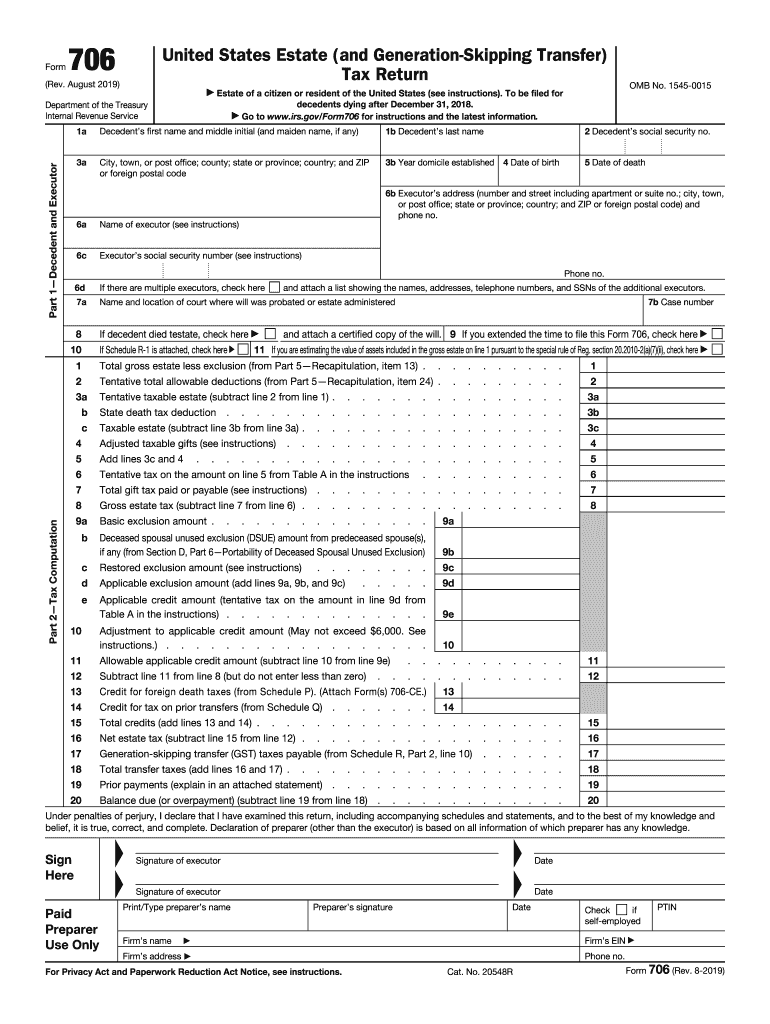







Definition and Meaning of Form 706
Form 706, also known as the United States Estate (and Generation-Skipping Transfer) Tax Return, is a critical document used for computing the estate tax liability of a decedent's estate. The form is required for the estate of deceased U.S. citizens or residents if their gross estate exceeds a certain value threshold, which is adjusted periodically by the IRS. This document plays a crucial role in ensuring the proper taxation of transferred assets and preventing tax avoidance through gifting strategies that bypass estate taxes.
Components of Form 706
- Decedent's Information: Includes full name, Social Security number, and date of death.
- Executor Details: Identifies the individual(s) responsible for filing the return.
- Tax Computation Sections: Covers the calculation of taxes owed after accounting for deductions.
- Schedules and Attachments: Include detailed inventories of assets, liabilities, deductions, and credits.
Practical Example
An example could involve the estate of a deceased individual with a gross estate valued at $15 million. The executor would need to use Form 706 to report this value, subtract applicable deductions, and compute the estate tax due.
How to Use Form 706
Using Form 706 involves several steps that ensure accurate calculation of estate taxes. It requires meticulous documentation and a clear understanding of IRS guidelines to avoid errors and penalties. Below is an outline of the step-by-step process to effectively use this form.
Preparation Steps
- Determine the Need: Establish if the form is required based on the gross estate value.
- Gather Information: Compile all necessary documents, including asset valuations and debts owed by the estate.
- Consult IRS Publications: Refer to IRS instructions for the most recent form requirements and updates.
Filling Out the Form
- Assets and Valuations: List all property, including real estate, personal items, and financial investments.
- Deductions and Credits: Carefully compute allowable deductions like funeral expenses and charitable donations.
- Calculate Tax Owed: Use IRS tables to determine the taxable estate and corresponding tax liability.
Real-World Application
Consider an estate primarily composed of real estate and stocks. You must obtain accurate market appraisals and recent stock valuations to ensure compliance and accuracy in reporting.
Filing Deadlines and Important Dates
Filing deadlines are critical for avoiding penalties when dealing with Form 706. The IRS mandates strict adherence to these timelines to manage estate and gift taxes efficiently.
Key Deadlines
- Initial Filing Date: The form must be filed within nine months of the decedent's death.
- Extension Requests: Executors can file Form 4768 to request an extension, usually up to six months.
- Quarterly Payments: If paying estate taxes in installments, adherence to payment schedules is crucial.
Important Considerations
- Death Date Influence: The date of death directly impacts the valuation of assets and filing requirements.
- Adjustments to Valuation Date: Executors may opt to use the date of death or an alternate valuation date.
Steps to Complete Form 706
Completing Form 706 requires attention to detail and comprehensive documentation. The following steps serve as a guide to ensuring the form is filled out correctly.
Detailed Instructions
- Read IRS Instructions Thoroughly: Understanding nuances in the instructions is vital.
- Complete Personal and Executor Sections: Fill out decedent and executor information first to ensure accurate identification.
- Schedule Preparation: Tackle each schedule carefully, ensuring that all assets and their proper valuations are accounted for.
Finalization
- Double-Check Entries: Verify all calculations, particularly those in the tax computation section, for accuracy.
- Attach Required Schedules: Ensure that all necessary schedules and attachment documents are included.
- Submit by Deadline: Filing on time is crucial to avoiding interest and penalties.
Important Terms Related to Form 706
Understanding specific terms is vital for accurately completing Form 706. These terms often appear in instructions and are integral to correct filing.
Key Terms
- Gross Estate: The total value of an individual's property and assets before deductions.
- Unified Credit: A credit that reduces the amount of estate tax owed.
- Generation-Skipping Transfer: Transfers that skip a generation, subject to special taxation rules.
Examples in Context
For example, understanding how to apply the unified credit can prevent overpayment of taxes and utilize available deductions to the fullest extent.
IRS Guidelines for Form 706
The IRS provides detailed guidelines for Form 706 to ensure compliance and accuracy. These guidelines cover every aspect needed to file effectively.
Coverage
- Filing Thresholds: Provides information about estate value thresholds requiring filing.
- Deductions and Credits: Details on permissible deductions that can minimize tax liability.
Compliance
Adhering to these guidelines is essential for legal compliance and can aid in minimizing tax liabilities through legitimate deductions and exemptions.
Penalties for Non-Compliance
Failure to comply with filing requirements and deadlines for Form 706 can lead to significant penalties. Understanding these penalties can prevent financial consequences.
Types of Penalties
- Late Filing Penalty: Failure to file on time results in a penalty based on the amount of tax owed.
- Accuracy-Related Penalty: Mistakes in reporting can lead to an additional percentage of tax owed.
Avoidance Strategies
- Timely Extensions: Filing for extensions can provide extra time to complete the form accurately.
- Professional Assistance: Employing a tax professional knowledgeable about estate taxes can help avoid costly errors.
Examples of Using Form 706
Form 706 has varied applications depending on the estate's composition and tax situation. Here are several instances illustrating how this form is used.
Case Studies
- High-Value Estates: Estates exceeding the exemption threshold require careful documentation of asset values and deductions.
- Multi-State Estates: Special attention is needed for properties located in multiple states, with respective state tax implications.
Practical Scenarios
- When dealing with a complex estate featuring diverse asset types like businesses, real estate, and investments, thorough documentation and strategic tax planning are essential to reduce overall tax burdens.




