
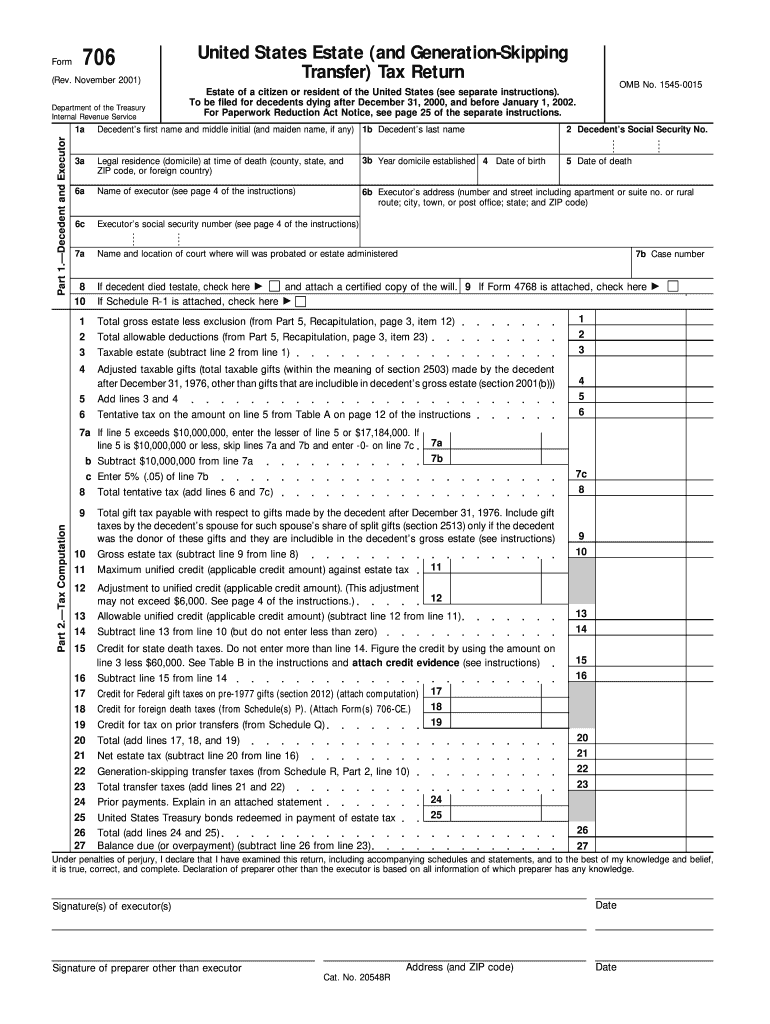







Definition and Meaning of the 2001 Form
The 2001 form, specifically Form 706, also known as the United States Estate (and Generation-Skipping Transfer) Tax Return, is crucial for executors managing estates of decedents who passed away between December 31, 2000, and January 1, 2002. This document helps calculate estate taxes owed to the federal government. The form includes sections for reporting various elements such as personal information of the deceased and comprehensive accounting of the estate's value. The goal is to assess the final tax liability, ensuring compliance with tax regulations.
How to Use the 2001 Form
Using Form 706 involves several detailed procedures designed for accurate tax liability determination. Executors must:
- Gather Necessary Information: Collect details on the decedent's assets, including real estate, bank accounts, investment portfolios, and any life insurance payouts.
- Complete Required Sections: Fill out each section of the form to report assets and liabilities. Sections cover personal information, estate valuations, expenses, and deductions.
- Calculate Estate Tax: Sum up all assets to compute the gross estate total. Subtract deductions to determine the taxable estate, and apply pertinent tax rates to calculate owed taxes.
- Review and Verify: Double-check all entries for accuracy. Mistakes can lead to penalties or audit issues.
Steps to Complete the 2001 Form
- Read Instructions Thoroughly: Begin by reviewing the IRS guidelines to understand each section's requirements.
- Fill Out Personal Details: Start with the decedent’s basic information, like name, social security number, and date of death.
- List Assets and Liabilities:
- Document the value of properties, stocks, bonds, and other financial instruments.
- Include any debts owed by the estate.
- Apply Deductions: Identify qualifying deductions such as funeral expenses, administrative costs, debts, and charitable contributions.
- Complete Schedules: Each type of asset and liability may have a specific schedule that needs to be filled out. Follow the instructions carefully.
- Calculate Tax: Use the form to compute the applicable taxes and total amounts due.
- Finalize and Submit: Ensure every part is complete, signed properly, and submit by the due date.
Key Elements of the 2001 Form
Form 706 is composed of several crucial components:
- Decedent Information: Essential for proper identification and filing.
- Estate Valuation: Comprehensive listing of all assets.
- Deductions and Credits: Crucial for reducing taxable amounts.
- Tax Calculation: Helps determine the correct amount of tax due.
- Filing Status: Must include specific filings for particular scenarios, such as foreign assets or jointly owned property.
IRS Guidelines for the 2001 Form
The Internal Revenue Service (IRS) provides detailed guidelines for completing Form 706:
- Accuracy is Critical: Incorrect or incomplete forms can result in penalties.
- Deadline Compliance: Forms must be submitted typically within nine months of the decedent's death.
- Amendments: Corrections can be filed under IRS rules if initial mistakes are made.
Filing Deadlines and Important Dates
- Initial Filing Deadline: Generally, within nine months from the date of death.
- Extension Availability: Extensions must be formally requested before the deadline.
- Due Dates for Payments: Any taxes owed should be paid by the original filing deadline to avoid interest and penalties.
Digital vs. Paper Version of the 2001 Form
With technological advances, completing and submitting Form 706 has become more flexible:
- Digital Submissions: Many prefer using digital platforms for ease of use. Digital submissions typically offer faster processing times.
- Paper Forms: Still available for those who prefer or require a physical document. Completed paper forms must be mailed to the appropriate IRS service center.
Penalties for Non-Compliance
Failing to correctly complete or submit Form 706 can lead to:
- Financial Penalties: Issued for underpayment due to insufficient reporting.
- Interest Charges: Applied to any unpaid tax from the original due date.
- Legal Repercussions: Severe cases might involve legal actions if non-compliance is determined to be willful.
Ensuring compliance with all guidelines can prevent such issues, safeguarding the executor and beneficiaries from unexpected legal challenges.




