




01. Edit your b 2016 online
Type text, add images, blackout confidential details, add comments, highlights and more.

Type text, add images, blackout confidential details, add comments, highlights and more.

Draw your signature, type it, upload its image, or use your mobile device as a signature pad.

Send 1095 b 2016 via email, link, or fax. You can also download it, export it or print it out.
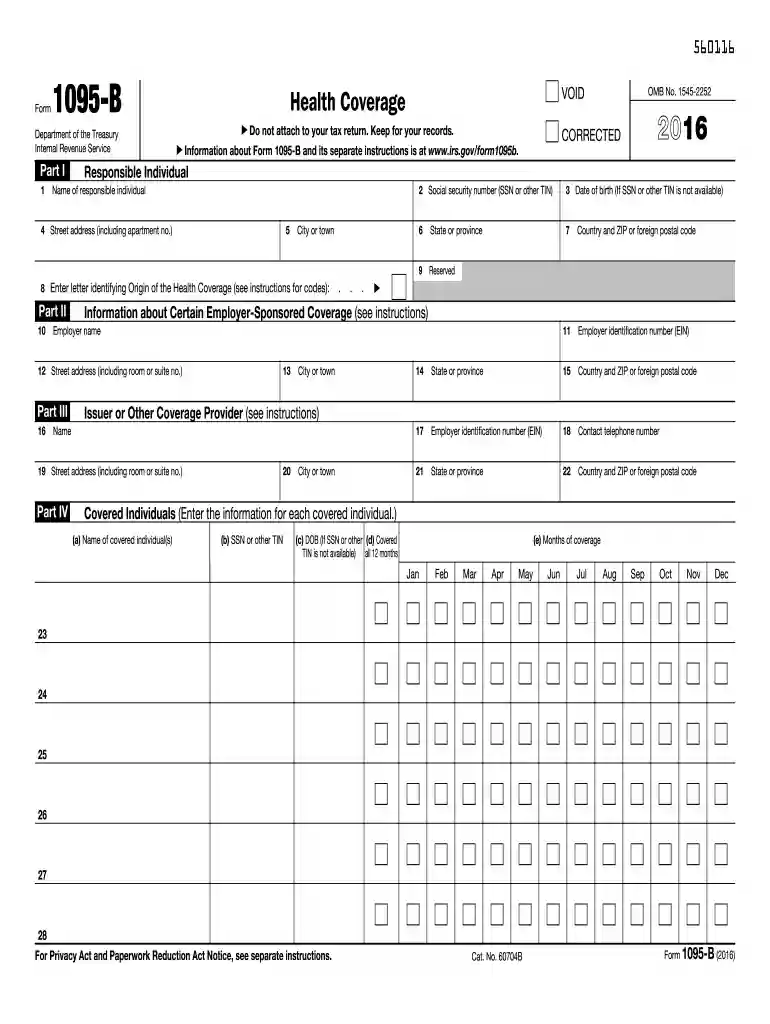
The 1095-B form is primarily used to report health coverage information required by the IRS. It verifies whether individuals and their dependents had minimum essential health coverage in 2016, which is crucial to comply with the Affordable Care Act. Proper understanding of this form ensures that taxpayers can accurately document their health coverage status and avoid potential penalties. The form includes personal details of the covered individuals, details about the coverage provider, and coverage duration.
Gather Required Information: Ensure you have all necessary personal information, including full names, Social Security Numbers, and coverage periods for all covered individuals.
Enter Coverage Provider Data: Include the name, address, and Employer Identification Number (EIN) of the insurance provider responsible for the coverage.
Verify Coverage Periods: Indicate the months during 2016 when minimum essential coverage was in effect for you and your dependents.
Review for Accuracy: Double-check all entries to ensure there are no errors or omissions. Accurate reporting ensures compliance and prevents IRS queries.
Filling out the 1095-B form is important for compliance with federal regulations regarding health coverage. It serves as proof that you met the requirement to maintain health insurance coverage throughout 2016, thus shielding you from potential fines. Additionally, it aids in simplifying the tax filing process by providing detailed health coverage data.
The primary responsibility for issuing the 1095-B form falls on coverage providers, including insurance companies and government-sponsored programs such as Medicaid or CHIP. These entities must distribute the form by January 31 following the year of coverage.
Failure to complete and submit the 1095-B form accurately may have consequences. The IRS can impose fines for not accurately reporting your health coverage status or omitting essential information. Keeping your information consistent and complete is crucial to avoid any compliance-related penalties.
The IRS provides specific guidelines to ensure compliance when filling out the 1095-B form. It is advised to follow these guidelines carefully to avoid fines and ensure accurate filing:
These aspects ensure that taxpayers effectively navigate the complex process of health coverage documentation for 2016, reflecting compliance and meeting personal tax responsibilities.
We've got more versions of the b 2016 form. Select the right b 2016 version from the list and start editing it straight away!
| Versions | Form popularity | Fillable & printable |
|---|---|---|
| 2025 | 4.6 Satisfied (47 Votes) | |
| 2024 | 4.8 Satisfied (24 Votes) | |
| 2023 | 4.1 Satisfied (35 Votes) | |
| 2022 | 4.2 Satisfied (33 Votes) | |
| 2021 | 4.8 Satisfied (189 Votes) | |
| 2020 | 4.4 Satisfied (276 Votes) | |
| 2019 | 4.3 Satisfied (35 Votes) | |
| 2018 | 4 Satisfied (53 Votes) | |
| 2017 | 4.4 Satisfied (157 Votes) | |
| 2016 | 4.2 Satisfied (52 Votes) | |
| 2015 | 4.2 Satisfied (73 Votes) | |
| 2014 | 4.2 Satisfied (71 Votes) |
At DocHub, your data security is our priority. We follow HIPAA, SOC2, GDPR, and other standards, so you can work on your documents with confidence.


Jan 2, 2018 If (a) or (b) applies, see the Form 1040 instructions to figure the taxable part of social security benefits you must include in gross income.Read more
This Form 1095-B provides information needed to report on your income tax return that you, your spouse (if you file a joint return), and individuals you.Read more
Jan 1, 2017 Medicare retirees who meet the following criteria will have a 1095-B form mailed directly to them from CMS. Beneficiaries under the age ofRead more


