




01. Edit your form online
Type text, add images, blackout confidential details, add comments, highlights and more.

Type text, add images, blackout confidential details, add comments, highlights and more.

Draw your signature, type it, upload its image, or use your mobile device as a signature pad.

Send it via email, link, or fax. You can also download it, export it or print it out.
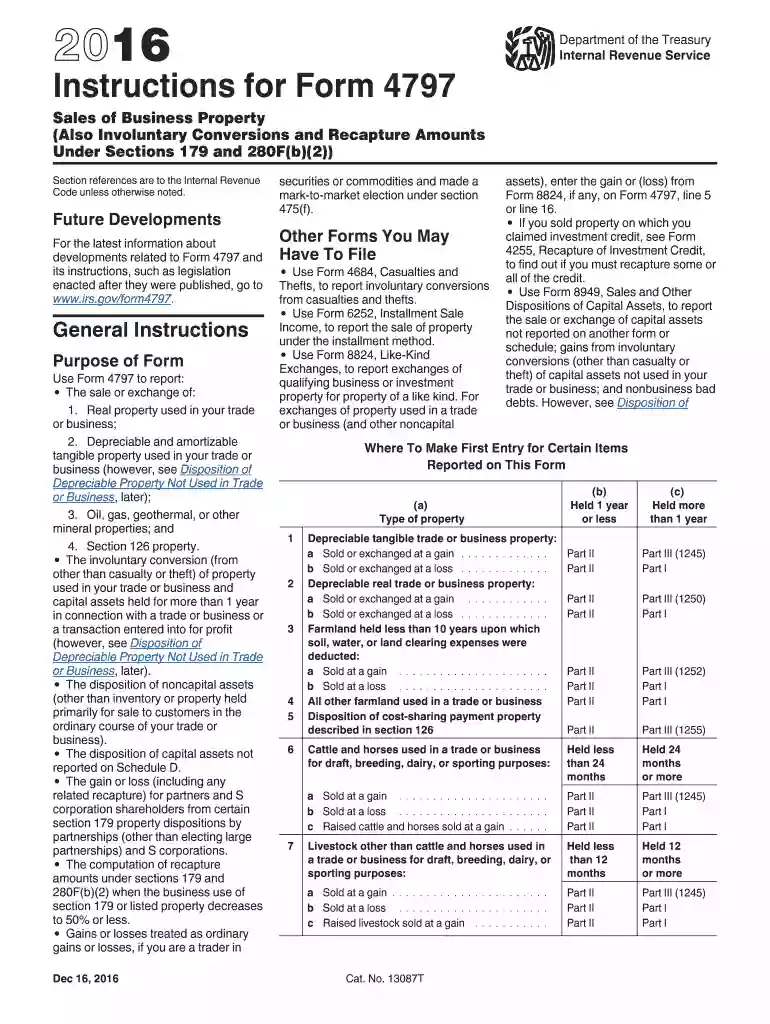
The 4797 Instructions 2016 Form provides essential information for taxpayers required to report the sale or exchange of business property. This document serves as a comprehensive guide to accurately report gains or losses from property transactions, including real estate and depreciable business assets. It helps taxpayers understand how to report specific transactions, ensuring compliance with IRS regulations.
Completing the 4797 Instructions 2016 Form requires careful attention to detail. The following steps guide you through this process:
Collect Necessary Information: Gather details about the property sold or exchanged, including purchase and sale dates, cost basis, selling price, and accumulated depreciation.
Understand the Sections: The form is divided into parts, each targeting specific types of property transactions. Familiarize yourself with each part to determine what applies to your situation.
Complete Part I: Report the sale or exchange of property held for more than one year. This section calculates the total gain or loss from long-term transactions.
Fill Out Part II: Document transactions for property held for one year or less, addressing short-term gains and losses.
Address Part III: This part focuses on computing ordinary gains and losses resulting from the sale of business property.
Utilize Part IV: Record all recapture amounts that may apply under specific IRS guidelines, especially those regarding sections 179 and 280F(b)(2).


Understanding specific terminology enhances the user’s comprehension and improves form accuracy:
Familiarize yourself with relevant IRS guidelines to ensure proper application of the 4797 instructions:
Meeting deadlines is crucial to avoid penalties:
Options make submission more flexible:
Failure to comply with guidelines for the 4797 Instructions 2016 Form can result in:
We've got more versions of the 4797 instructions 2016 form form. Select the right 4797 instructions 2016 form version from the list and start editing it straight away!
| Versions | Form popularity | Fillable & printable |
|---|---|---|
| 2025 | 4.8 Satisfied (38 Votes) | |
| 2024 | 4.5 Satisfied (47 Votes) | |
| 2023 | 4.9 Satisfied (50 Votes) | |
| 2022 | 4.9 Satisfied (36 Votes) | |
| 2021 | 4.8 Satisfied (105 Votes) | |
| 2020 | 4 Satisfied (46 Votes) | |
| 2019 | 4.3 Satisfied (153 Votes) | |
| 2018 | 4.3 Satisfied (104 Votes) | |
| 2017 | 4.3 Satisfied (188 Votes) | |
| 2016 | 4.3 Satisfied (182 Votes) | |
| 2015 | 4 Satisfied (48 Votes) | |
| 2014 | 4 Satisfied (26 Votes) | |
| 2013 | 4.1 Satisfied (26 Votes) | |
| 2012 | 4 Satisfied (43 Votes) | |
| 2011 | 4.3 Satisfied (60 Votes) |
At DocHub, your data security is our priority. We follow HIPAA, SOC2, GDPR, and other standards, so you can work on your documents with confidence.
Dec 16, 2016 Use Form 4797 to report: The sale or exchange of: 1. Real property used in your trade or business; 2. Depreciable and amortizable tangible
Jun 7, 2017 Complete the Qualified Dividends and Capital Gain Tax Worksheet in the instructions for Form 1040, line 44 (or in the instructions for FormRead more
by V Tablan 2021 Instructions for doing so are available on Mımirs web page at: http form-urlencoded form in a. POST request. Alternatively, they may be suppliedRead more


