







Definition & Meaning
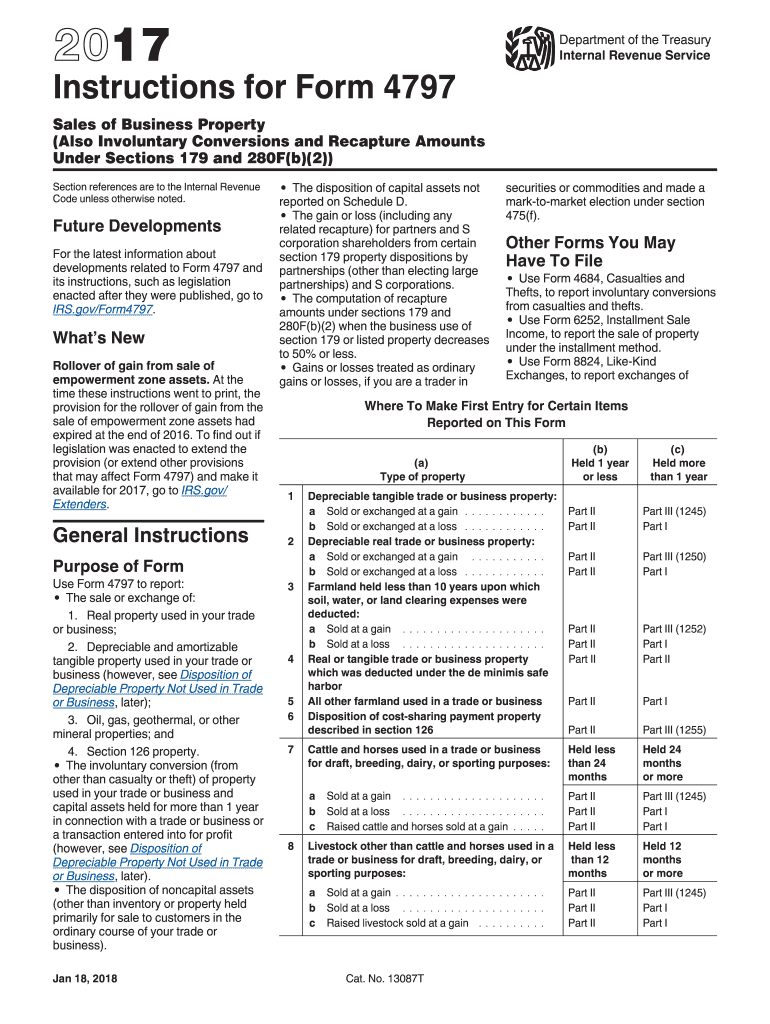
The Form 4797 is a crucial document used to report the sale or exchange of business properties. It covers transactions involving involuntary conversions and captures recapture amounts under the Internal Revenue Code. This form is essential for taxpayers who have sold or exchanged real estate or depreciable property used in business, as well as those who have business property involuntarily converted. Distinguishing personal property sales from business assets is important since differing tax treatments apply.
How to Use the Fill out 4797 Instructions 2017 Form
- Review Key Updates: Before using the form, examine any recent legislative changes affecting property transactions.
- Gather Required Information: Collect details of the sale, including purchase and sale prices, depreciation deductions, and cost basis.
- Follow Detailed Instructions: The 4797 instructions walk users through each section of the form, specifying how to report gains and losses accurately.
- Apply Special Rules: Pay attention to rules for specific property types and scenarios, such as installment sales and mark-to-market elections.
Steps to Complete the Fill out 4797 Instructions 2017 Form
- Enter Personal Information: Begin by providing basic taxpayer details at the top of the form.
- Complete Part I: Record gains and losses from all property except those entered in Part III.
- Fill Out Part II: This section covers ordinary gains and losses.
- Proceed to Part III: Here, list all gains and losses from equipment sales that were held longer than one year.
- Finish with Part IV: Document any recapture amounts from prior dispositions.
Key Elements of the Fill out 4797 Instructions 2017 Form
- Sections for Different Property Types: The form includes distinct parts to handle various property and transaction types.
- Recapture Provisions: Special attention must be given to the recapture of depreciation deductions, which can affect taxable income.
- Section 1231 Transactions: Reporting rules for specific property sales are governed by Section 1231, offering a mix of capital gain tax benefits.
Important Terms Related to Fill out 4797 Instructions 2017 Form
- Involuntary Conversion: A forced property change due to circumstances like theft or condemnation, requiring careful reporting.
- Recapture Amount: Taxable income portion representing previously taken depreciation deductions on sold assets.
- De Minimis Rule: Exclusion threshold for petty transactions that do not meet defined significant financial levels.
IRS Guidelines
The Internal Revenue Service provides comprehensive guidelines to ensure taxpayers understand applicable tax laws and regulations impacting the completion of Form 4797. Guidelines cover recognition of gains and losses, reporting obligations, and documentation requirements. Taxpayers are encouraged to review IRS directives closely to uphold compliance.
Filing Deadlines / Important Dates
- Standard Tax Deadline: Aligning with the federal tax deadline of April 15, Form 4797 submissions must be completed in a timely manner.
- Extension Requests: Taxpayers can file for an extension using Form 4868, but any due tax must still be paid by the original deadline to avoid penalties.
Required Documents
- Sales Agreements: Documentation of the sale or exchange agreement is essential for accurate reporting.
- Previous Tax Returns: Necessary to determine depreciation deductions taken on the property.
- Proof of Proceeds: Include supporting evidence of the amount received from the transaction, such as closing statements.
Form Submission Methods (Online / Mail / In-Person)
- Online Submission: The IRS offers an electronic filing service for convenient and speedy form submission.
- Mail Options: For those preferring paper submissions, a traditional mail route is available.
- In-Person Assistance: Taxpayers seeking personalized help can visit IRS field offices for additional guidance.




