




01. Edit your 2021 form 4797 online
Type text, add images, blackout confidential details, add comments, highlights and more.

Type text, add images, blackout confidential details, add comments, highlights and more.

Draw your signature, type it, upload its image, or use your mobile device as a signature pad.

Send 2021 irs 4797 via email, link, or fax. You can also download it, export it or print it out.
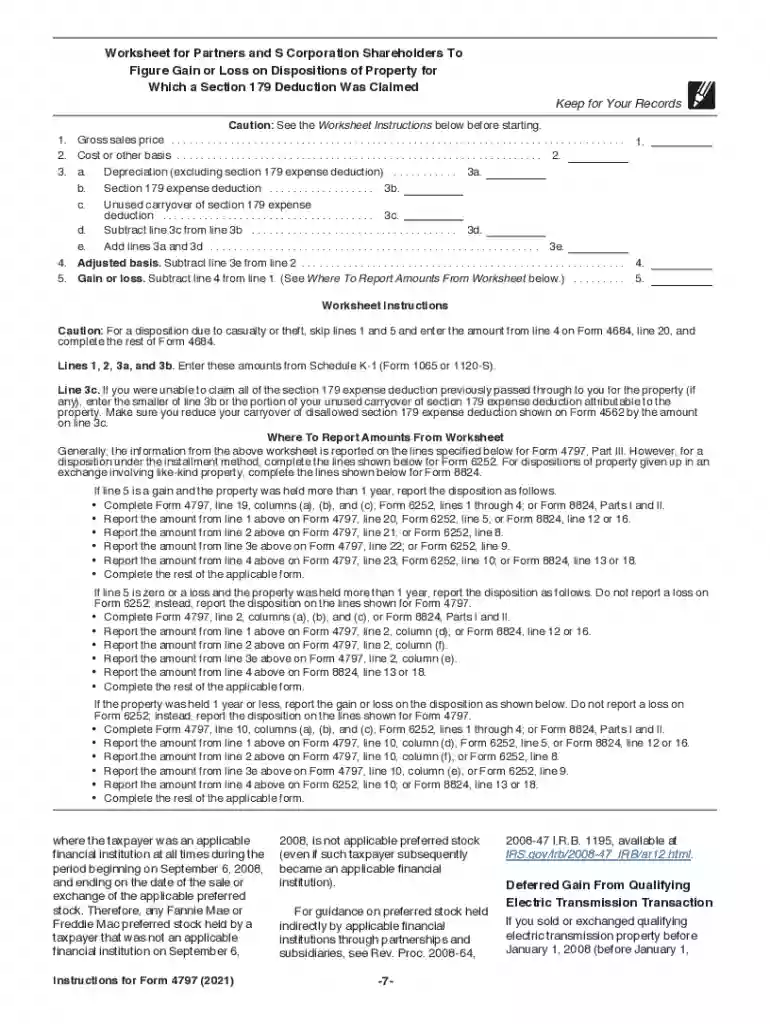
Form 4797 is used to report gains or losses from the sale or exchange of business properties, including involuntary conversions due to theft or casualty, and recapture amounts under sections of the Internal Revenue Code. The form is crucial for taxpayers who dispose of business assets, as it ensures accurate reporting of property transactions that can affect one's taxable income. It differentiates ordinary gains or losses from capital gains, providing clarity in tax reporting and compliance.
Involuntary conversions occur when business property is destroyed, stolen, or condemned, and compensation is received. Form 4797 handles these transactions by detailing whether the gain or loss should be treated as ordinary or capital. Additionally, the form covers recapture of depreciation, which refers to the portion of a gain that is taxable as ordinary income because of prior depreciation deductions. Understanding these elements is essential to comply with IRS guidelines, which require accurate categorization on the form.
To effectively use the Form 4797 instructions, begin by reviewing the form’s outline to understand its sections: Part I for gains and losses, Part II for ordinary gains, Part III for computations, and Part IV for summary information. Follow the instructions step-by-step to ensure accurate entries, especially in complex areas like capital loss limitations. The instructions provide detailed examples and calculations for different types of disposals, aiding clarity in what figures to report. Consulting these instructions can minimize errors, potentially avoiding penalties.
Completing Form 4797 involves several systematic steps, starting with gathering relevant documentation such as purchase contracts and records of improvements. This form requires careful input of transaction details, including dates, sales prices, and adjusted basis. The instructions walk you through computing gains or losses derived from these figures, ensuring you categorize them correctly. Following a precise sequence, each part of the form is filled in logical order, reflecting the nature of the transactions accurately.
Understanding specific terminology used in Form 4797 instructions is critical for accurate completion. Terms such as "ordinary gain," "capital gain," "depreciation recapture," and "adjusted basis" have precise meanings. The adjusted basis, for instance, represents the original cost adjusted for various tax-related changes. Depreciation recapture concerns reclaiming previously deducted sums as taxable income, affecting how gains are reported. Grasping these terms ensures correct reporting and helps in avoiding potential misinterpretations of tax liabilities.
Depreciation recapture represents the IRS's method of recovering tax benefits from depreciation deductions. It applies when selling property for more than its adjusted basis, with the difference between the depreciation taken and the depreciation claimed being taxed as ordinary income rather than capital gain. This impacts final tax calculations and is a common area for mistakes if not properly understood.
The IRS guidelines for Form 4797 emphasize accurate and timely filing. Adhering to specified filing periods is essential, as is following detailed instructions for identifying property types and related income treatments. The guidelines provide clarity on the proper classification of property, whether it falls under ordinary income or capital gain. Strict adherence to these guidelines ensures the transaction is captured correctly, aligning with legal requirements and preventing misunderstandings with the IRS.
Taxpayers must file Form 4797 with their regular tax return. The typical deadline is April 15, yet variations exist if extensions are awarded. Understanding these deadlines ensures timely submission, preventing late fees or penalties. The form should reflect all relevant transactions for the reporting year, and changes in deadlines due to holidays or IRS policy updates are typically publicized by the IRS to accommodate accurate filings.
Submitting Form 4797 accurately involves compiling various documentation, including transaction confirmation, invoices, deeds, cost basis calculations, and records of depreciation. These records support entries on the form and substantiate claims made within it. Proper organization of these documents ensures smooth filing and assists in resolving any queries or audit checks that might arise.
Practical scenarios illustrating Form 4797 use include the sale of business assets, such as a company vehicle switch resulting in a gain or the sale of office equipment due to company downsizing. In each case, the form helps identify how much of the gain or loss affects ordinary income versus capital gains. Examples often detail the computation of adjusted bases, capturing the depreciation recapture portion separately.
A small business selling its outdated office machinery needs to file Form 4797 to report the proceeds correctly. The sale involves calculating the original purchase price, less any claimed depreciation, to register an accurate gain or loss on the machinery's sale. This example underscores the form’s role in ensuring federal income impact reflecting true business transactions.
Non-compliance with Form 4797 reporting can lead to IRS penalties, involving fines and interest on underpayments. Failing to categorize gains or losses properly might also result in extended IRS reviews or audits. Accurately applying instructions mitigates these risks, ensuring transactions are reported correctly and timely.
We've got more versions of the 2021 form 4797 form. Select the right 2021 form 4797 version from the list and start editing it straight away!
| Versions | Form popularity | Fillable & printable |
|---|---|---|
| 2025 | 4.8 Satisfied (38 Votes) | |
| 2024 | 4.5 Satisfied (47 Votes) | |
| 2023 | 4.9 Satisfied (50 Votes) | |
| 2022 | 4.9 Satisfied (36 Votes) | |
| 2021 | 4.8 Satisfied (105 Votes) | |
| 2020 | 4 Satisfied (46 Votes) | |
| 2019 | 4.3 Satisfied (153 Votes) | |
| 2018 | 4.3 Satisfied (104 Votes) | |
| 2017 | 4.3 Satisfied (188 Votes) | |
| 2016 | 4.3 Satisfied (182 Votes) | |
| 2015 | 4 Satisfied (48 Votes) | |
| 2014 | 4 Satisfied (26 Votes) | |
| 2013 | 4.1 Satisfied (26 Votes) | |
| 2012 | 4 Satisfied (43 Votes) | |
| 2011 | 4.3 Satisfied (60 Votes) |
At DocHub, your data security is our priority. We follow HIPAA, SOC2, GDPR, and other standards, so you can work on your documents with confidence.
Instructions for Form 4797 to report exchanges of qualifying business or investment real property for real property of a like kind. Use Part III of Form 4797
The disposition of each type of property is reported separately in the appropriate part of Form 4797 (e.g., for property held more than 1 year, report the sale.Read more
Feb 23, 2018 See the Instructions for Form 4562 for more in- formation on preparing the form. Form 4797: Sales of business property 14. Form 8582Read more


