
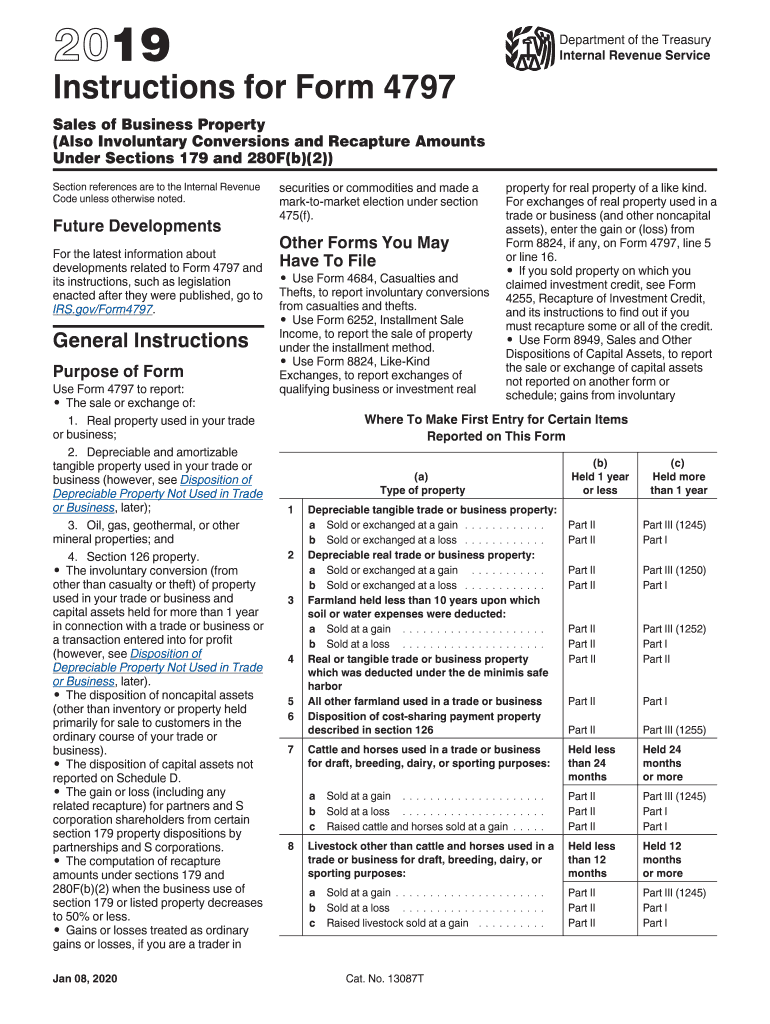







Definition & Purpose of Form 4797
Form 4797, Sales of Business Property, is used to report gains and losses from the sale or exchange of business property. This includes real estate and depreciable business assets. The form is essential for conveying details of sales, exchanges, and involuntary conversions of assets, ensuring all taxable transactions are properly accounted for in accordance with Internal Revenue Service (IRS) guidelines.
Key Components of Form 4797
- Part I: Reports the sale or exchange of property used in a trade or business for more than one year.
- Part II: Addresses ordinary gains and losses that may arise from sales of such properties.
- Part III: Details gains from the sale or exchange of property held for one year or less.
- Part IV: Used for recapture of depreciation deductions; you must report the total excess depreciation on the property sold.
Understanding these components is crucial for accurately reporting and filing your business property-related transactions.
Steps to Complete Form 4797
-
Gather Necessary Information: Collect details on each property sale or exchange, including purchase and sale dates, cost, sale price, and any depreciation claimed.
-
Begin with Part I: Enter necessary details for property used in a trade or business sold after one year.
-
Proceed to Part II if Applicable: If your transaction includes ordinary gains or losses, complete this section next.
-
Fill Out Part III for Short-Term Transactions: If your property was held for one year or less, these details are entered here.
-
Address Depreciation in Part IV: Ensure accurate entry of recaptured depreciation as required.
-
Complete Remaining Sections: Double-check all details before finalizing the form.
Examples of Using Form 4797
-
Real Estate Transactions: A company sells a manufacturing building, applying reported gains in Part I after holding it for over a year.
-
Depreciable Business Equipment: An LLC sells a depreciated machinery, listing gain and depreciation recapture on the form.
-
Casualty and Theft Losses: If an unexpected event leads to asset conversion, report the resulting gains or losses on Form 4797.
These scenarios illustrate the form's diverse applications and its necessity in providing a complete picture of business property transactions.
Important Terms Related to Form 4797
- Depreciable Assets: Assets whose value can be expensed over time for tax purposes.
- Involuntary Conversions: Situations where property is destroyed, stolen, or condemned.
- Recapture: The process of including previously taken depreciation as income upon sale.
Understanding these terms is core to accurately completing Form 4797 and ensuring compliance with IRS policies.
Filing Deadlines and Important Dates
Form 4797 should be filed along with your annual federal income tax return—typically by April 15 if you're following the calendar year. Extensions may apply, but staying aware of these deadlines is vital to avoid penalties.
Who Typically Uses Form 4797
- Real Estate Investors: To report profits from selling business properties.
- Manufacturers and Retailers: For asset sales and exchange reports.
- Small Business Owners: When property used in operations is sold.
These groups frequently use Form 4797 to report property-related transactions and any associated financial outcomes.
IRS Guidelines for Form 4797
The IRS outlines comprehensive instructions in Publication 544 for using Form 4797. This document provides detailed guidelines on who should file, what transactions must be reported, and methodological specifics.
Penalties for Non-Compliance
Failing to file or inaccurately reporting gains and losses on Form 4797 can lead to penalties, including fines and increased scrutiny on subsequent filings. Accuracy and adherence to deadlines are essential for compliance.
State-Specific Rules for Form 4797
While Form 4797 is a federal document, some states may require additional forms or amendments for state tax purposes. Business owners must check their state’s regulations to ensure full compliance at both the state and federal levels.


